
Review · BANGKOK
Bangkok: Thai Cooking Class With 4 Dishes & Thai Drink
A visit to a local market followed by a tuk-tuk ride sets this Bangkok cooking class apart from a lesson held in a sealed-off studio. You begin at Huai Khwang MRT Station, look at the ingredients used in Thai kitchens, then head to a small cooking school where you prepare four dishes from start to finish.
I like the small group of eight or fewer, since it gives you space at your own station and a better chance to ask questions. I also like the full menu: Pad Thai, Tom Yum Goong, Som Tum, and Mango Sticky Rice cover noodles, soup, salad, and dessert. The main consideration is time. Four hours is a good part of your day, and the market walk and shared meal make this more than a quick cooking demonstration.
Key points at a glance
- Start at Huai Khwang MRT Exit 3: The meeting point is easy to reach by Bangkok’s metro system.
- Visit a neighborhood market first: You see the fresh ingredients before they reach your cooking station.
- Ride a tuk-tuk to the kitchen: This short transfer adds local flavor and helps connect the market visit with the class.
- Cook four complete dishes: You make Tom Yum Goong, Pad Thai, Som Tum, and Mango Sticky Rice.
- Work at your own station: Ingredients and equipment are provided, with instruction in English.
- Finish near Sutthisan MRT: The school is one MRT stop from the meeting point, useful if your schedule is tight.
From Huai Khwang MRT to the market
Your class begins at Huai Khwang MRT Station, Exit 3. This is a practical meeting point because you can reach it by Bangkok’s underground rail system rather than trying to find a small kitchen down an unfamiliar side street.
After meeting your host, you walk through a nearby local market. This part is more than a warm-up before the cooking starts. Thai food makes more sense when you see the raw materials in their everyday setting. Herbs, vegetables, seafood, noodles, fruit, and seasonings stop being anonymous items on a printed recipe and become things you can recognize later at home.
The market visit also gives you useful context for the four dishes. You may see the ingredients that bring heat, sourness, sweetness, salt, and fragrance to Thai food. The experience does not promise a long market lecture, so you should think of this as a focused introduction rather than a dedicated food market tour. Still, it is a smart addition, especially if this is your first time learning how Thai dishes are built.
Bring comfortable shoes. The walking portion is short enough to fit naturally into the class, but Bangkok’s markets are active places, and you will get more from it if you are ready to move at an easy pace rather than rush.
More Thai Cooking Classes in Bangkok:
- Bangkok: Hands-on Thai Cooking Class and Market Tour
★ 4.9 · 1,614 reviews - Bangkok: Tingly Thai Cooking School Half-Day Cooking Class
★ 4.9 · 1,191 reviews - Bangkok: Maliwan Thai Cooking Class with Market Tour
★ 4.9 · 1,133 reviews
A tuk-tuk ride to the cooking school
After the market, you take a tuk-tuk to Homies Thai Cooking School. The ride is part of the character of the experience. It connects two very different parts of the day: the public market and the quieter cooking space.
This is not a sightseeing tuk-tuk circuit, and you should not book the class expecting a long city tour from the back seat. The ride is a transfer. Its value is that it feels more local and memorable than simply stepping into a taxi or ordering a car.
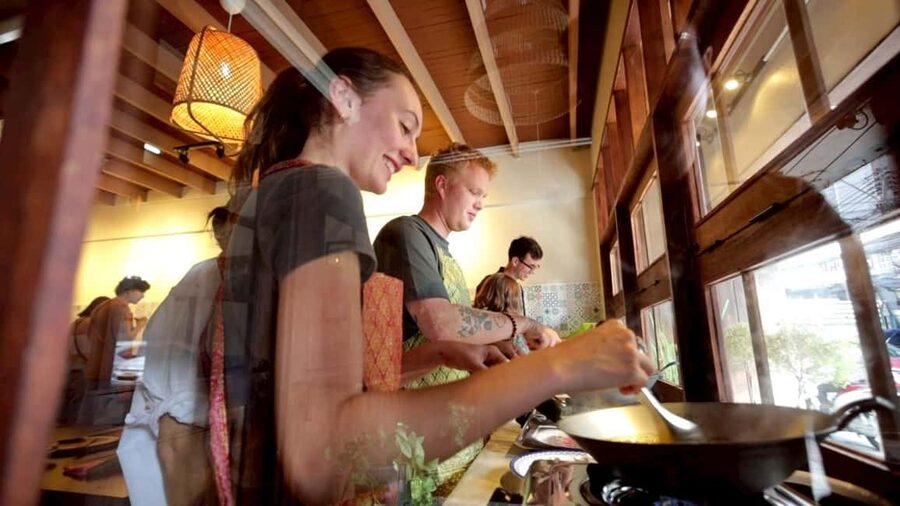
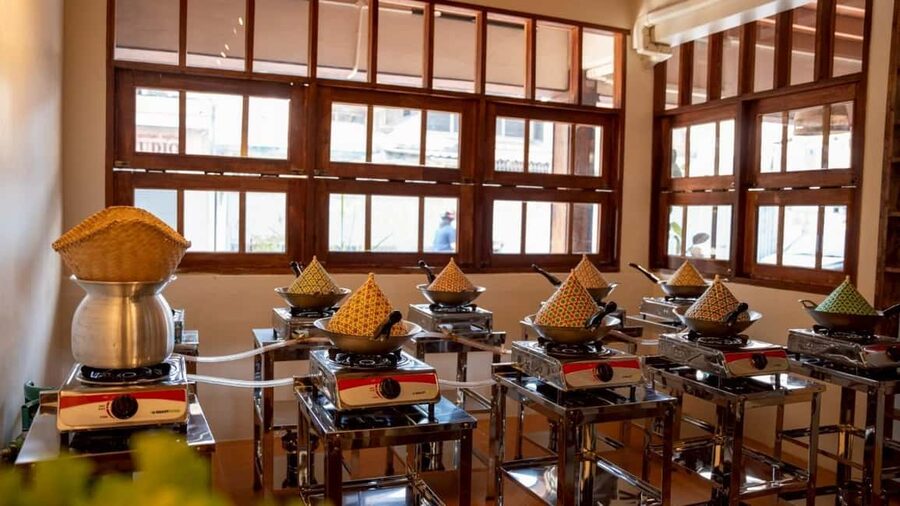
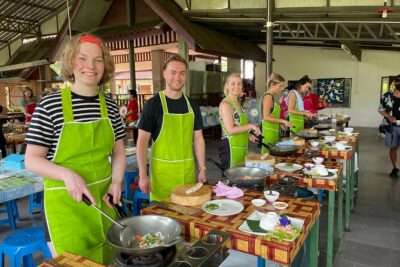
The cooking school is designed in a cozy, home-style manner. That setting matters. You are not watching a chef work from the back of a large room. The class is limited to eight participants, and each person receives an individual cooking station with the necessary equipment and ingredients.
A small class can make a big difference in a hands-on lesson. You can keep up with the instructor, see the cooking process clearly, and ask for help before a sauce becomes too salty or a pan becomes too hot. The class is taught in English, which makes the step-by-step instructions accessible to English-speaking participants.
Four Thai dishes with four different lessons
The menu is well chosen because each dish teaches a different part of Thai cooking. You do not spend four hours making minor variations of the same recipe. Instead, you work across several familiar styles and finish with a proper meal.
Tom Yum Goong, hot and sour shrimp soup
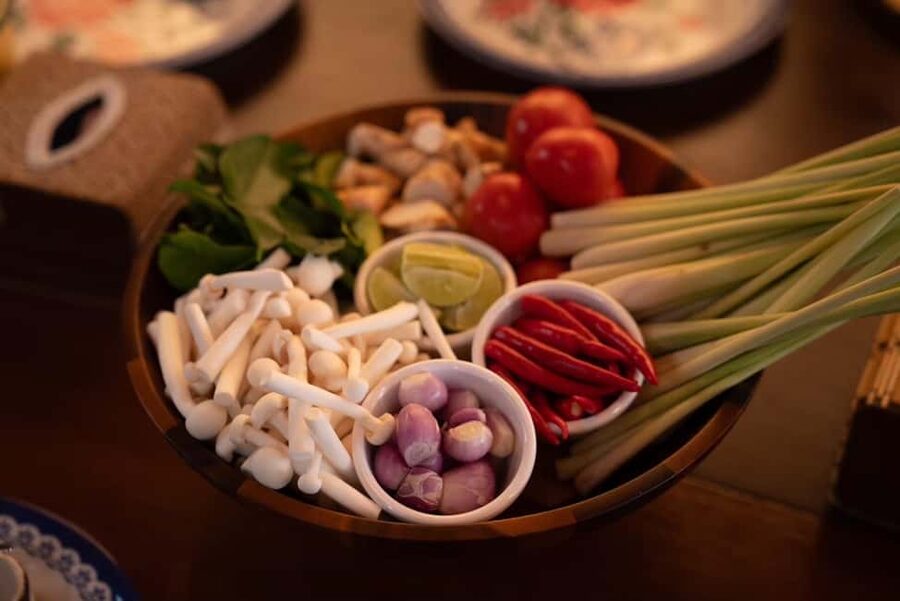
Tom Yum Goong gives you a lesson in balance. The soup is known for its spicy and sour character, with shrimp adding a fuller savory note. You learn how Thai cooks combine herbs and seasonings so that no single flavor has to do all the work.
This is useful at home because many people think Thai food is simply hot. A good Tom Yum Goong also depends on sourness, fragrance, salt, and the taste of the main ingredient. The instructor can show you how those parts work together rather than handing you a fixed sauce and asking you to stir.
If you do not eat shrimp, ask about an alternative when booking or before the class begins. Vegetarian, vegan, and halal options are available by request, but the request needs to be made ahead of time.
More Hands-On Workshops in Bangkok:
- Hands on Thai Cooking Class and Market Tour
★ 5.0 · 660 reviews - Tingly Thai Cooking Class with Morning Market Tour
★ 5.0 · 589 reviews - Hands-on Thai Cooking Class & Market Tour in Sukhumvit
★ 5.0 · 571 reviews - Pink Chili – Thai Cooking Class and Market Tour in Bangkok
★ 5.0 · 416 reviews
Pad Thai, the familiar favorite
Pad Thai is the dish most people expect to see on a Thai cooking menu, and it earns its place here. It is recognizable, practical, and easy to try again at home once you understand the method.
The value of making it yourself is not just eating a plate of noodles. You see how the ingredients come together and how the final taste depends on the balance of sweet, salty, sour, and savory elements. You also get a better sense of timing than you would from watching a prepared dish arrive at a restaurant table.
Pad Thai is a good confidence builder for beginners. The dish is familiar enough to make the class feel approachable, but the recipe still teaches techniques you can use with other stir-fried meals.
Som Tum, fresh and punchy papaya salad
Som Tum brings a raw, crunchy element to the menu. Green papaya salad is a useful contrast to the hot soup and cooked noodles, and it shows how Thai food can feel light while still carrying plenty of flavor.
This dish is also a reminder that texture matters. The papaya, dressing, and other ingredients must work together, and the seasoning needs to be adjusted to your taste and dietary needs. If you like food with a sharp, fresh edge, Som Tum may become your favorite part of the class.
The recipe can be especially helpful if you want to recreate Thai flavors without using a stove for every dish. You leave with more than a list of ingredients. You gain a sense of how to build a salad that is sour, salty, sweet, and spicy in the right proportions.
Mango Sticky Rice, the sweet finish
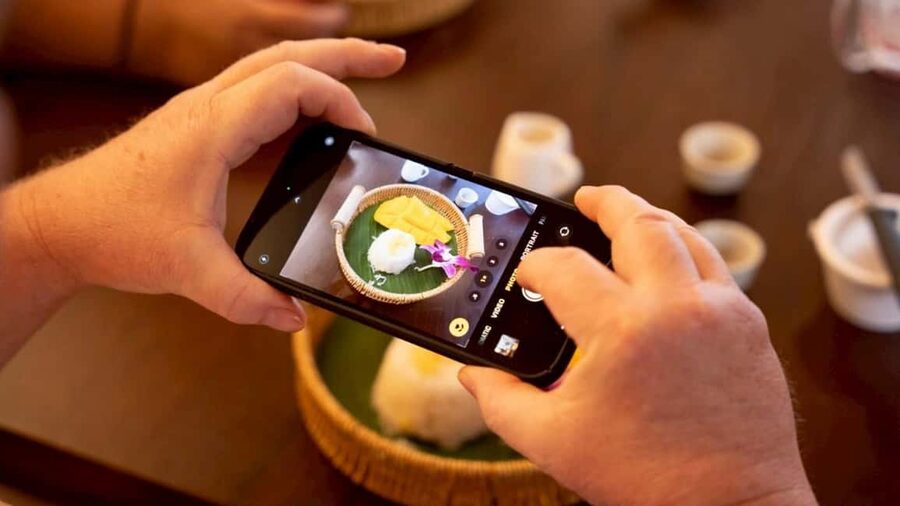
Mango Sticky Rice closes the menu with a simple dessert that feels distinctly Thai. It gives you a chance to learn how a few ingredients can work together when the preparation is handled carefully.
Including dessert is a real advantage. Many cooking classes stop after the main courses, leaving you full but without one of Thailand’s best-known sweets. Here, the meal has a clear beginning, middle, and end.
The four dishes also create a sensible amount of work. You get variety without being asked to prepare an enormous menu. The class has enough material to fill four hours, but the cooking remains focused on dishes you can remember and attempt again.
What the hands-on format is like
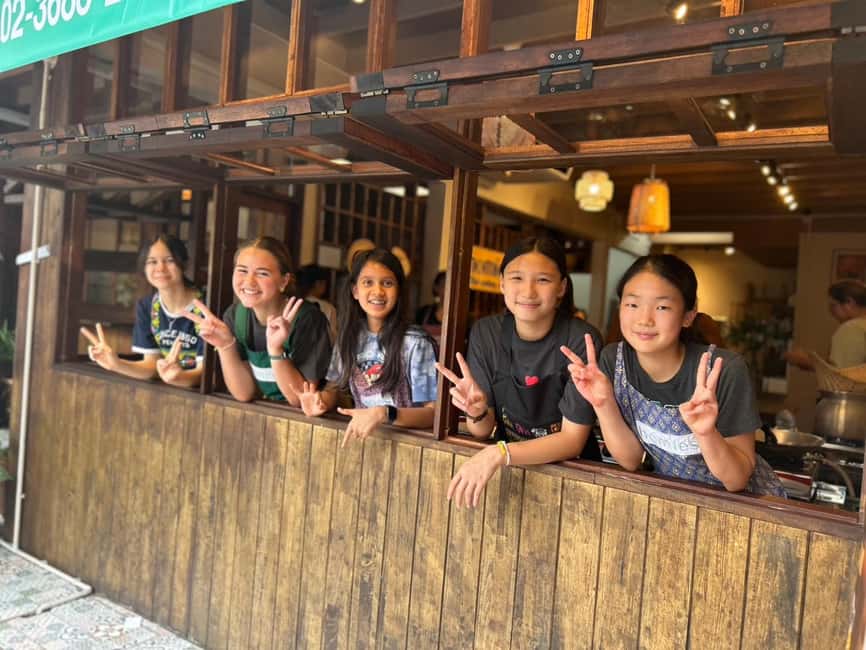
Every participant has a personal cooking station, with ingredients and equipment supplied. That removes much of the usual hassle. You do not need to shop for a long list of unfamiliar items, carry cooking tools across Bangkok, or guess how much of each ingredient to prepare.
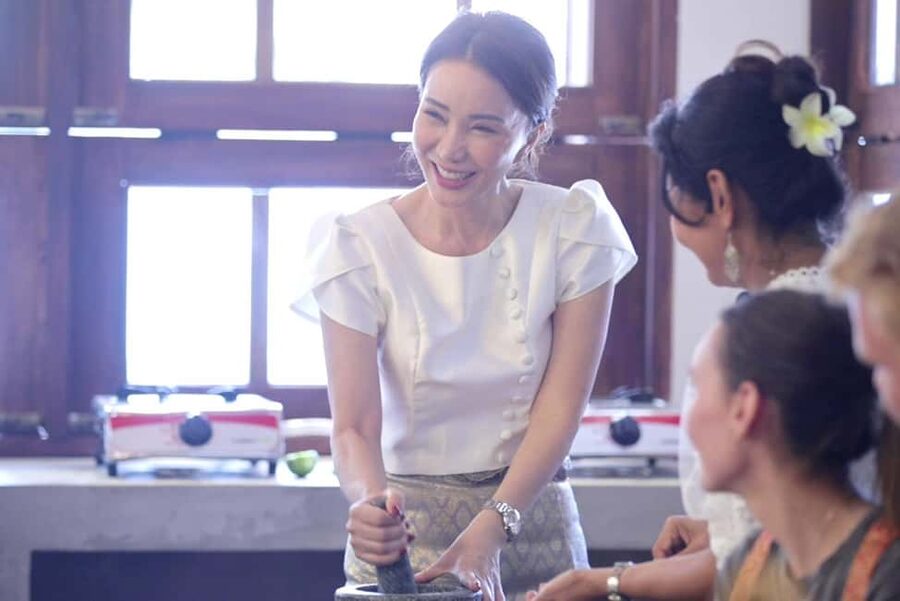
The instructor guides you through the recipes step by step. The strongest practical benefit is control. You are not merely taking notes while someone else cooks. You handle the ingredients, follow the process, and learn what each stage is meant to achieve.
The class is taught in English. Nut is named as one of the instructors, and the feedback connected with the experience specifically praises Nut for making the lesson easy to follow. If Nut is leading your session, you can expect an instructor who has been noted for clear explanations and a friendly approach.
A class of no more than eight people should suit beginners, couples, families with older children, and solo visitors who want a social activity. The cooking school requires every person who enters and participates to have a paid place. A child under 10 may accompany a paying adult free of charge only if the child does not participate in the class.
That rule is worth noting before you book. A small child who wants to chop, stir, or cook will need a paid place, and personal translators or photographers also need to be paid participants. Exceptions require approval in advance.
The shared meal is part of the lesson
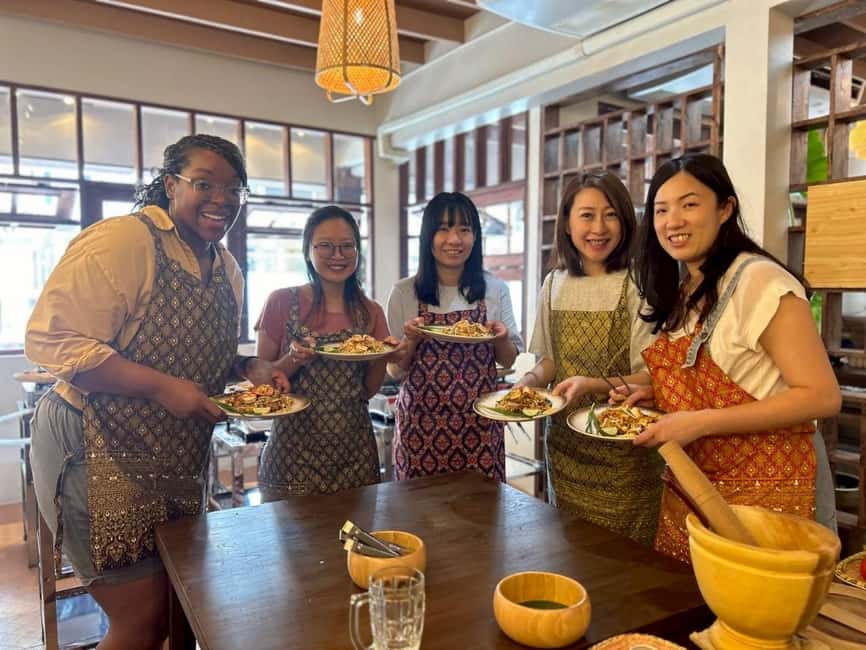
Once the cooking is finished, you sit down and eat the dishes you made. The meal is served in a family-style atmosphere, which gives the class a relaxed ending instead of sending you away as soon as the final pan is clean.
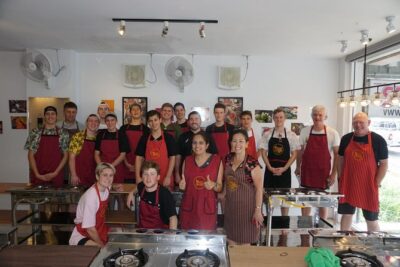
This shared meal is where the experience becomes more than a sequence of cooking tasks. You can compare results, taste the dishes while they are fresh, and enjoy the social side of the class. The format should appeal to people who like meeting others through food, though anyone seeking a private lesson should check the group setup before booking.
The cooking itself may not produce restaurant-perfect results on your first attempt. That is part of the point. You get to taste what your hands made and understand which flavors you would adjust next time. The feedback connected with this class repeatedly highlights the friendliness of the staff and the quality of the food, with one participant especially praising the market visit and planning to make the recipes at home.
You also receive recipes to take home. That is important value. Without written recipes, a cooking lesson can become a pleasant memory that is hard to repeat. The recipe sheets give you a practical starting point when you want to recreate Pad Thai or Mango Sticky Rice after returning home.
Price, time, and overall value at $46
At $46 per person, this is not the cheapest way to eat Thai food in Bangkok. A local restaurant meal costs far less, and street food costs less again. But the price covers four hours of instruction, a market visit, a tuk-tuk transfer, four dishes, ingredients, equipment, your own station, a shared meal, and recipes.
That makes the price reasonable for someone who wants an activity rather than just lunch. You are paying for participation, guidance, and the chance to learn techniques that can be used after the holiday. The value is strongest if you intend to cook Thai food at home.
The small group also helps justify the cost. A lesson for up to eight people should feel more personal than a large demonstration, and you are not sharing one work surface with a crowd. The class includes an English-speaking instructor, which is useful when timing and seasoning matter.
Four hours is long enough to feel substantial. Plan this as a main activity for part of the day, not a quick stop between several attractions. The class ends at Homies Thai Cooking School near Sutthisan MRT Station. Sutthisan is one stop from Huai Khwang, so the finish is convenient if you need to continue across Bangkok afterward.
Starting and ending at different nearby MRT stations is also practical. You begin at Huai Khwang Exit 3, then finish close to Sutthisan. If you have a tight schedule, you can join the class directly from the meeting point and continue from the ending station without returning to where you started.
Dietary requests and who should book
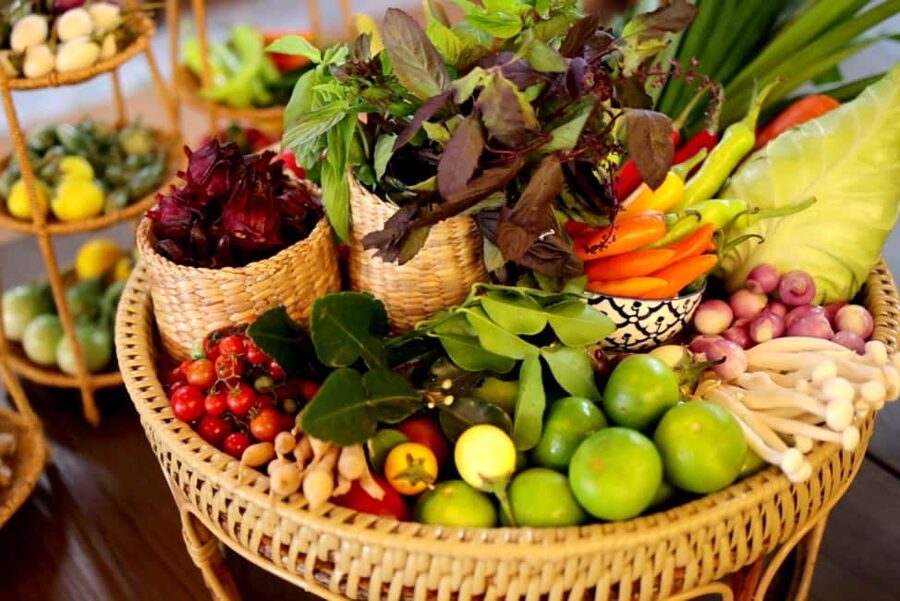
Vegetarian, vegan, and halal options are available by request. Other food restrictions can also be discussed, but you should contact the operator before the class rather than waiting until you arrive. Thai cooking often uses seafood, fish-based seasonings, shrimp, or other ingredients that may not fit every diet.
I would recommend this experience to you if you want to learn by doing, enjoy a small social setting, and plan to cook at home. It is also a good choice for couples and friends who want a shared Bangkok activity that ends with a meal.
You may want to choose another activity if you dislike group cooking, have very limited time, or want a private chef-led lesson. The class is friendly and practical, but it is still a four-hour group experience with a market walk and transport between locations.
The starting point is accessible by MRT, and the end point is also near the metro. That makes the class easier to fit into a Bangkok itinerary than an activity in a distant suburb. Free cancellation is available up to 24 hours before the start time, and you can reserve now and pay later, which helps if your plans are still shifting.
Should you book this Bangkok cooking class?
Book it if you want more than a meal and like the idea of taking Thai skills home with you. The market visit, tuk-tuk ride, small class, four-dish menu, and shared meal create a full experience rather than a single cooking demonstration.
The best reasons to choose it are the personal cooking stations, the clear mix of dishes, and the friendly instruction associated with Nut. The main caution is the four-hour commitment and the need to arrange dietary requests in advance.
For a reasonable $46, you get a hands-on introduction to Thai food with a strong practical payoff. If Pad Thai, Tom Yum Goong, Som Tum, and Mango Sticky Rice are already on your must-eat list, this class gives you a way to understand them and try making them yourself.
FAQ
Where does the Thai cooking class begin?
The class begins at Huai Khwang MRT Station, Exit 3, in Bangkok.
How long does the experience last?
The cooking experience lasts four hours.
Which dishes will I cook?
You will prepare Tom Yum Goong, Pad Thai, Som Tum, and Mango Sticky Rice.
Is the class taught in English?
Yes. The instructor language is English.
How many people can join the class?
The class is limited to eight participants.
Are vegetarian, vegan, and halal options available?
Yes. Vegetarian, vegan, and halal options are available upon request. Other food restrictions can also be discussed in advance.
Where does the class finish?
The experience finishes at Homies Thai Cooking School near Sutthisan MRT Station, one MRT stop from the Huai Khwang meeting point.
Just added around Bangkok
- Bangkok: Hands-on Thai Cooking Class & Market Tour in Sathon★ 5.0 · 16 reviews
- Bangkok: Thai Cooking Class and Onnuch Market Tour★ 4.7 · 72 reviews
- Bangkok Cooking Class : Traditional Thai dishes&Market Trip★ 5.0 · 108 reviews
- Bangkok: Cooking Class with Market Visit & Tuk Tuk Ride★ 4.8 · 27 reviews
- Bangkok: Half-Day Thai Cooking Class in Bangrak District★ 4.9 · 96 reviews
- Bangkok: Cook authentic Thai food with Smart Cook★ 5.0 · 20 reviews
- BANGKOK: Canal Tour and Cooking Fun★ 5.0 · 4 reviews
- Bangkok: Cooking Class + Tuk Tuk Ride + Market Tour★ 4.9 · 70 reviews
Thai Cooking Classes, compared.
Half-Day Thai Cooking Class at Organic Farm in Chiang Mai
Read our review →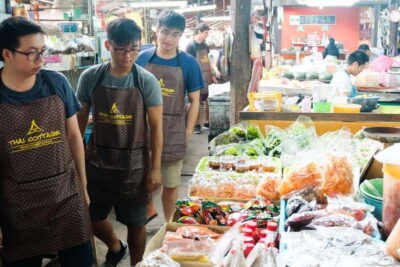
Chiang Mai: Cooking Class, Market & Thai Herbs Garden Tour
Read our review →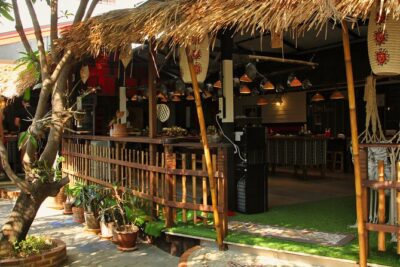
Phuket Thai Cooking Class with Market Tour Option
Read our review →
Bangkok: Hands-on Thai Cooking Class and Market Tour
Read our review →
Bangkok: Tingly Thai Cooking School Half-Day Cooking Class
Read our review →
Bangkok: Maliwan Thai Cooking Class with Market Tour
Read our review →
Browse the lists this tour appears in