
Review · ATHENS
Cooking Class with Aspasia in the Heart of Athens
Cooking in Aspasia’s bright Athens home gives you a close look at Greek food beyond the taverna table. You help prepare seven dishes, then sit down with your host for a full meal and two glasses of white wine. I like the private setting and the chance to ask questions without a large class getting in the way. I also like the menu’s range, from Cretan dakos to Mani-style kayanas and Northern Greek ravani.
The main consideration is the level of hands-on cooking. This may feel more like a hosted Greek meal with cooking instruction than a formal culinary course, especially if you want to measure every ingredient, make every sauce, and handle each step yourself. The menu is also made up of familiar home-style dishes, not unusual restaurant creations.
Key points to know before booking
- A private meal in Aspasia’s home: Your group is the only group taking part.
- Seven Greek dishes: The menu covers starters, two mains, and dessert from several parts of Greece.
- A social three-hour format: Cooking, eating, conversation, and wine are all part of the experience.
- Two glasses of white wine included: The meal is designed to be enjoyed at the table, not rushed.
- A good fit for beginners: The host is described as patient and willing to explain each step.
- A possible mismatch for serious cooks: Expect participation, but not necessarily a technique-heavy cooking school.
What happens inside Aspasia’s Athens home
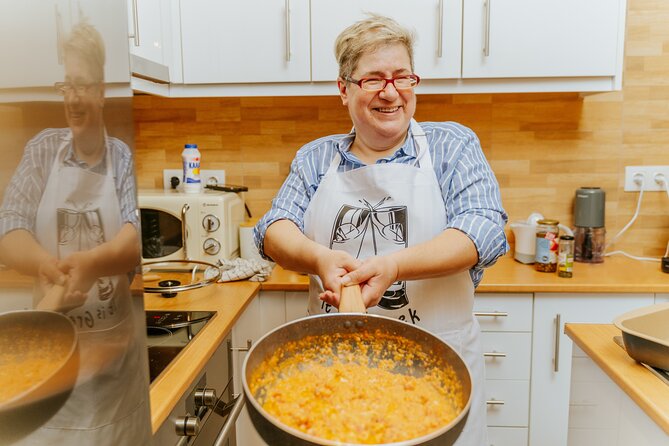
The experience begins at Tsocha 3 in Athens, where you enter a private, light-filled home rather than a commercial cooking studio. That setting changes the feel at once. You are not simply watching a chef perform behind a counter. You are stepping into someone’s domestic space, with the warmth and informality that come with it.
Aspasia hosts in English and keeps the session personal because only your group participates. That matters if you want to ask about family cooking, Greek ingredients, or why a dish belongs to one region rather than another. It also means the mood can be shaped around your group, though the exact amount of cooking you do may depend on the flow of the session.
The total time is about three hours. That is long enough to prepare several dishes, sit down for a proper meal, and talk without turning the evening into a rushed demonstration. You should think of the class as a shared food occasion with instruction woven through it.
More Hands-On Workshops in Athens:
- Athens: Classic Cooking Class with Market Visit and Wine
★ 5.0 · 1,101 reviews - Athens: Food Market Visit and Cooking Class with Wine
★ 4.9 · 1,087 reviews - Greek Cooking Class in Athens Including Rooftop Dinner with Acropolis View
★ 5.0 · 826 reviews
Seven dishes that tell a Greek food story
The menu moves around Greece rather than focusing on one narrow local style. That is one of its best features. You get a taste of different regional habits in a single sitting, from barley rusks in Crete to a semolina cake associated with Northern Greece.
Paximadi, olives, and graviera
The meal starts simply with paximadi bread, olives, and graviera cheese. Paximadi is a dry, sturdy Greek bread, often made with barley, and it gives the opening course a rustic texture.
Graviera is a hard cheese whose taste can run from gently sweet to slightly spicy. This first plate is not a complicated cooking project, but it gives you useful context for Greek eating. Strong cheese, bread, olives, and good olive oil are not just side items. They are a basic pattern of the table.
If you are hoping to spend most of the class chopping and cooking, this starter will not provide much technical work. Its value is in setting the tone and introducing ingredients you will see again in Greek cooking.
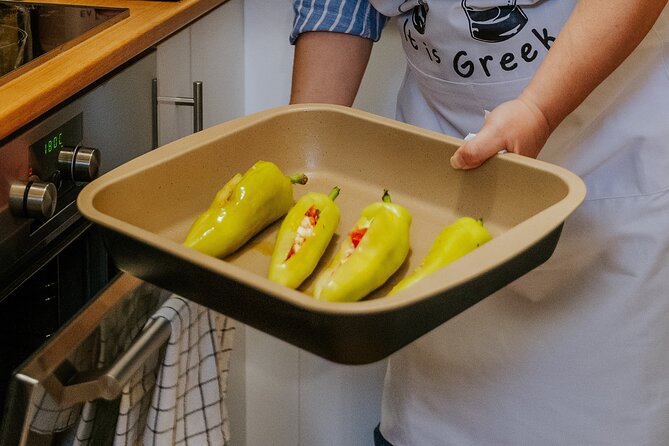
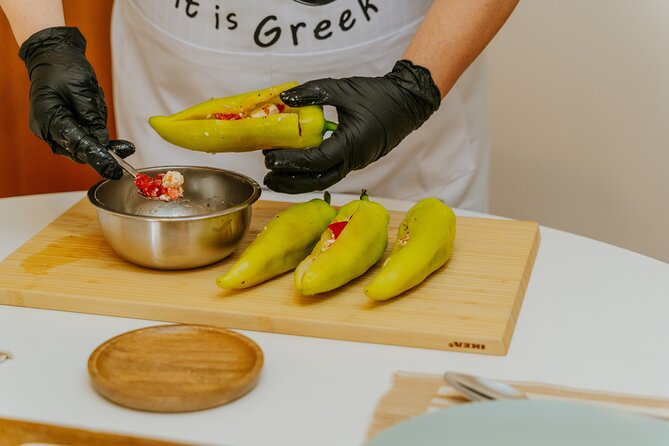
Stuffed long sweet peppers
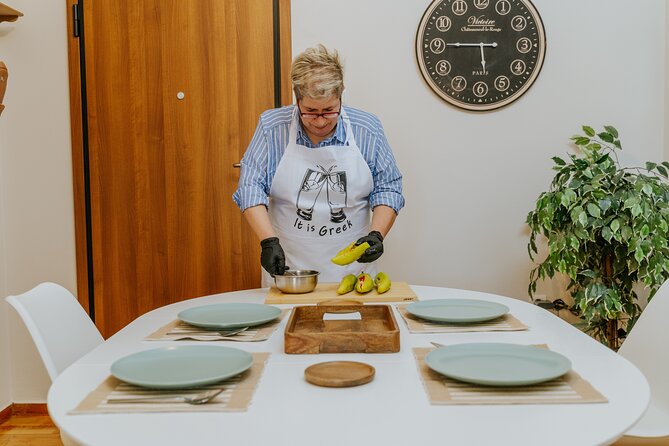
The long sweet peppers are filled with feta, tomatoes, and herbs such as spearmint. This is a vegetarian dish with the fresh, salty, and herbal balance that makes Greek home food easy to like.
The recipe should be approachable for a beginner. You can expect to learn how the filling comes together and how herbs change the character of a dish without requiring a long list of ingredients. The use of sweet peppers also gives the meal a gentler flavor than the hotter peppers found in some other cuisines.
This is the sort of course that works well for a relaxed class, though a confident home cook may find the technique familiar. If you already make stuffed vegetables regularly, you may want to ask Aspasia in advance how much of the preparation you will handle.
A few more cooking classes around Athens worth a look
- Greek Small-Group Athens Cooking Class & Dinner
★ 5.0 · 574 reviews - Athens: Greek Cooking Class & Dinner on a Rooftop
★ 5.0 · 383 reviews - Athens: Greek Cuisine Cooking Class and 3-Course Dinner
★ 4.8 · 270 reviews - Traditional Greek cooking class and lunch or dinner with an Acropolis view
★ 5.0 · 250 reviews
Mani-style kayanas eggs
Kayanas comes from Mani and combines scrambled eggs, fresh tomatoes, and cured pork called siglino. It is a good example of a dish that sounds simple but carries a strong regional identity.
Eggs and tomatoes are common across Greece, yet the cured pork gives this version a distinctive local character. It is also the kind of dish that shows how Greek cooking makes a satisfying meal from a few practical ingredients.
This course may be especially useful if you want something you can repeat at home. It is not restaurant food built around rare products. It is a traditional combination that can fit into an ordinary kitchen.
Cretan dakos salad
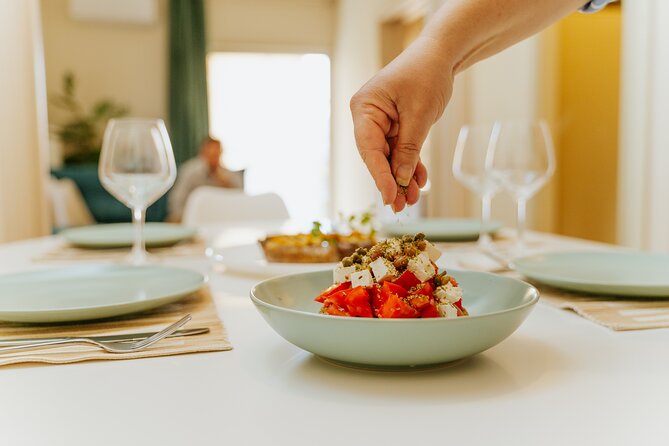
Dakos is one of the most recognizable Cretan dishes. It uses crisp barley rusks with tomato, olive oil, and feta. The contrast between the hard rusk and the juicy tomato is the point.
The dish also shows how texture matters in Greek food. The rusk is not simply bread placed under a salad. It absorbs tomato juices and olive oil while keeping some of its bite. That makes dakos more substantial than a standard chopped salad.
You will probably appreciate this course most if you enjoy food that is fresh but not fussy. It also offers a clear link to Crete without requiring a separate island trip.
The two main dishes bring the meal together
Greek meatballs with yogurt sauce
The meatballs use ground beef, flour, and a selection of Greek spices, then come with yogurt sauce. They are described as a traditional grandmother-style dish, and that is the right expectation: familiar, filling, and tied to family cooking rather than fine dining.
This may be the most obvious hands-on part of the class. Mixing and shaping meatballs is accessible even if you rarely cook. A first-time cook can take part without needing advanced knife skills or professional equipment.
The yogurt sauce adds a cooling contrast to the seasoned meat. If you are mainly interested in learning a useful Greek meal for home, this is one of the recipes with the clearest practical value.
Still, you should not book this expecting an advanced lesson in butchery or sauce work. The menu describes the main ingredients, but not a detailed technique syllabus. Ask questions as the dish is prepared if you want more detail about spice combinations or texture.
Eggplant imam
Eggplant imam is filled with onions, tomatoes, garlic, herbs, and spices. The name and recipe are closely associated with the broader food traditions of the eastern Mediterranean, but here it is presented as a Greek dish.
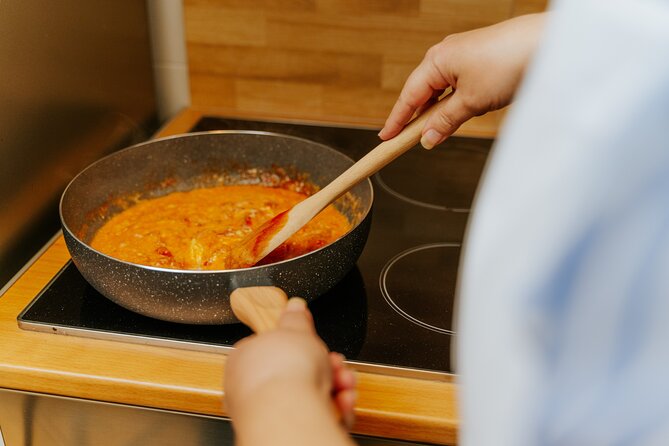
This is likely to be one of the more rewarding items for anyone who wants to understand how vegetables can carry a main course. Eggplant absorbs flavor well, while the onion, tomato, garlic, and herbs create a soft, savory filling.
It is also a useful counterpoint to the meatballs. The menu does not treat vegetarian food as an afterthought. You get a substantial vegetable main alongside the meat dish, which makes the meal friendlier for mixed groups.
The possible drawback is timing. Eggplant dishes often need attention and cooking time, but the supplied information does not spell out exactly how much of the process you perform yourself. Again, the format is best approached as shared preparation rather than a strict lesson in which you control every pan.
Ravani closes the table with syrup and semolina
Dessert is ravani, a sweet semolina cake soaked in aromatic syrup. It comes from Northern Greece and gives the meal a regional finish that differs from the cheese, tomatoes, and herbs earlier in the session.
Semolina cakes are less familiar to many people than standard chocolate or fruit desserts, so this is one place where the class offers something beyond everyday cooking. The syrup gives the cake its moist texture and sweet finish.
Ravani also works well as a teaching dish because it shows how a simple cake can change once syrup is added. If you enjoy baking, you may want to pay close attention to the balance between the cake and the syrup.
The published menu lists ravani, so you should confirm the final dessert if you have dietary needs or a strong preference. The menu also includes dairy, eggs, meat, and gluten-containing items, making an advance question sensible for anyone with restrictions.
The meal matters as much as the recipes
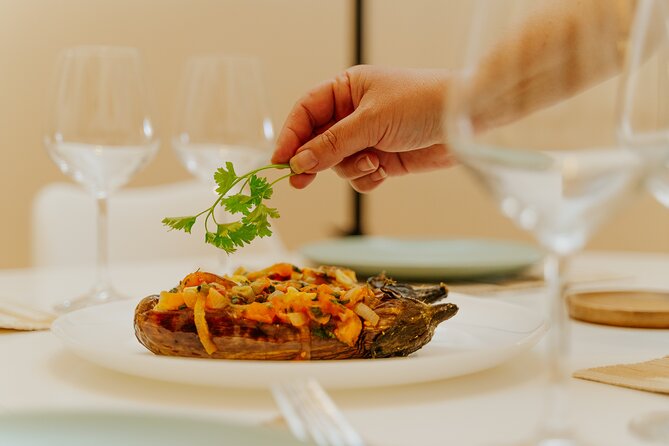
After the preparation, you eat the food you helped make at the same home. This is not a quick tasting between sightseeing stops. The three-hour schedule gives the meal time to become the main event.
Two glasses of white wine per person are included. That is a modest but welcome touch, especially since the format is built around conversation and sitting down together. You can expect the wine to accompany the meal rather than function as a separate tasting session.
The strongest appeal here is the social side. One account describes Aspasia as patient with a person who did not cook often, and that is important. A private class can be intimidating if the host assumes you already know your way around a kitchen. Her approach appears suited to beginners who want encouragement rather than pressure.
At the same time, a more experienced cook may want more control. The menu consists of familiar dishes such as bread with cheese, stuffed peppers, eggs, meatballs, eggplant, and cake. If you already make these foods, the value will come from the setting, regional context, and personal exchange with Aspasia, not from advanced culinary novelty.
Is $130.04 a fair price?
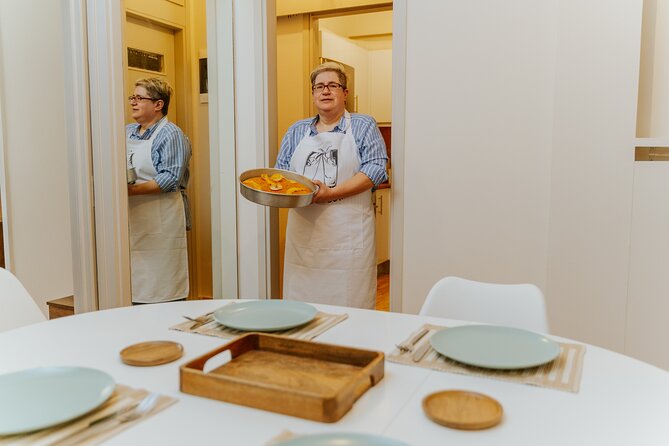
The cost is $130.04 per person. That is clearly more than you would spend on the ingredients for a simple Greek meal, and it may also exceed the price of a casual restaurant dinner. Comparing it only with food prices, however, misses what you are paying for.
The fee covers a private three-hour experience, instruction, the full seven-dish menu, the use of a private home, and two glasses of wine. You are also paying for personal attention and the chance to ask questions in a small setting. For a couple or family that values conversation and a local connection, that can make the price reasonable.
The value is weaker if your only goal is to eat cheaply or learn advanced cooking skills. You could spend less at a restaurant and probably receive more polished presentation. You could also choose a formal cooking school if your priority is detailed technique and guaranteed hands-on work.
I would book this for the human side of the experience. I would not book it solely for recipe complexity. The experience earns its price when the private setting, friendly host, and shared meal matter to you.
Who will enjoy this most?
This class suits a few types of visitors especially well:
- First-time Greek cooks: The dishes are approachable, and the host is described as patient.
- Couples and small private groups: You get time to talk without a large class around you.
- Food-focused visitors: The menu covers several Greek regions in one meal.
- Vegetarians sharing with meat eaters: Eggplant imam and stuffed peppers provide substantial meat-free dishes.
- People seeking a social evening: Cooking, wine, and conversation are central to the format.
It is less suitable for someone looking for a professional kitchen, advanced pastry instruction, or unusual ingredients. It may also disappoint you if you expect to prepare every dish from start to finish. Read the menu closely and decide if the dishes themselves appeal to you.
Practical details for your Athens plans
The meeting point is Tsocha 3, Athina 115 21, Greece, and the experience ends at the same location. It is near public transportation, which makes it easier to fit into an Athens day without arranging a separate return point.
The activity is offered in English and includes a mobile ticket. Confirmation is provided when you book. Service animals are allowed, and the activity is private for your group.
This experience is often booked about 29 days ahead. That does not guarantee that every date fills early, but it is a useful reason to plan ahead if you have fixed Athens dates.
Free cancellation is available up to 24 hours before the start time for a full refund. Changes made inside that 24-hour window are not accepted, and cancellations inside that period are not refunded. The activity also requires a minimum number of participants, so if that minimum is not met, you are offered another date or experience, or a full refund.
Should you book Aspasia’s cooking class?
Book it if you want a friendly, private introduction to Greek home food and like the idea of eating in a local home. The seven-dish menu gives you plenty to taste, and the regional spread adds interest to familiar ingredients.
Think carefully before booking if you want a rigorous cooking course. The experience may include plenty of preparation and explanation, but the available details do not promise that you will personally execute every step. For the best match, approach it as a hosted Greek meal with meaningful cooking participation.
My practical advice is simple: read the menu, confirm any dietary concerns, and decide how much hands-on work you need. If the dishes appeal to you and the social setting sounds better than a formal classroom, this is a good way to give one Athens evening a personal flavor.
FAQ
Where does the cooking class begin?
It begins at Tsocha 3, Athina 115 21, Greece.
Where does the experience end?
The activity ends back at the meeting point.
How long does the experience last?
The cooking experience lasts approximately three hours.
Is the activity private?
Yes. Only your group participates in this private activity.
What language is the experience offered in?
The experience is offered in English.
How many dishes are included?
The menu includes seven dishes: three starters, two mains, and dessert, along with the opening bread, olives, and cheese course listed in the menu.
Is wine included?
Yes. Each person receives two glasses of white wine.
Are service animals allowed?
Yes. Service animals are allowed.
Can I cancel for a full refund?
Yes, if you cancel at least 24 hours before the experience start time. Cancellations made less than 24 hours before the start time are not refunded.
Just added around Athens
- Hands On Greek Cooking Classes in Athens★ 5.0 · 7 reviews
- Athens: Traditional Vegan Cooking Class incl. Drinks★ 5.0 · 41 reviews
- Greek Meze Cooking class and dinner with an Acropolis view★ 5.0 · 41 reviews
- Pick Your Plates, Cook & Savor- Greek Cooking Class in Athens★ 5.0 · 8 reviews
- Local Home Cooking – A Taste of the Greek Islands in Athens★ 5.0 · 9 reviews
- Athens Greek Cooking Class Pita Gyros from Scratch with a Local★ 5.0 · 175 reviews
- Cooking Class at Diamond Roof Garden★ 5.0 · 14 reviews
- Athens Central Market Tour and Greek Cooking Class with Penelope★ 5.0 · 4 reviews
Cooking Classes, compared.
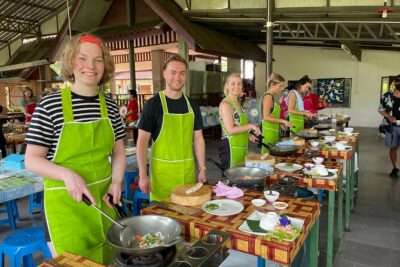
Half-Day Thai Cooking Class at Organic Farm in Chiang Mai
Read our review →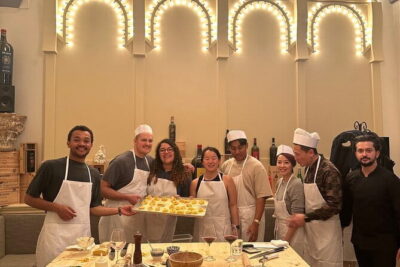
Florence: Pasta Cooking Class with Unlimited Wine
Read our review →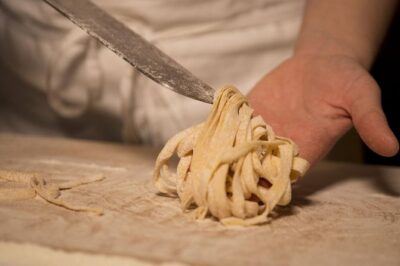
3 in 1 Cooking Class near Navona: Fettuccine, Ravioli & Tiramisu
Read our review →
Hanoi Cooking Class: Culture, Local Market & Meaning CSR Impact
Read our review →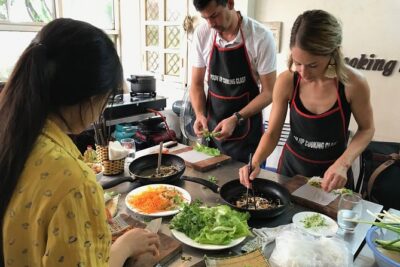
5 Traditional Dishes Hanoi Cooking Class with Market Trip
Read our review →
Cooking Class and Lunch at a Tuscan Farmhouse with Local Market Tour from Florence
Read our review →
Chiang Mai: Cooking Class, Market & Thai Herbs Garden Tour
Read our review →Browse the lists this tour appears in