
Review · PARIS
Paris: Montmartre Macaron Baking Workshop
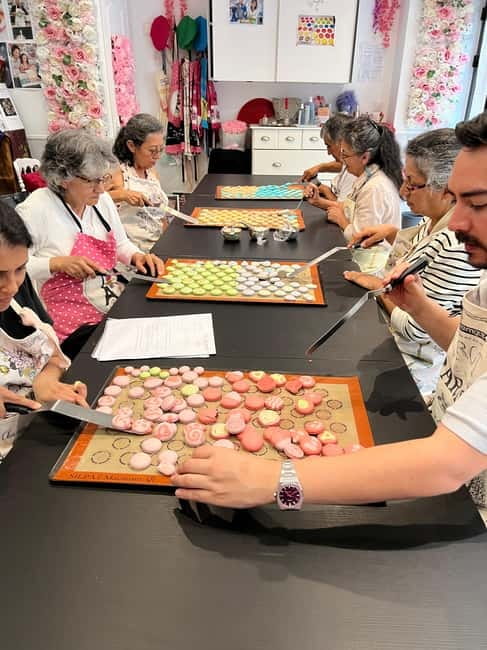
Making a French macaron is less about stirring ingredients than getting several small details right. At Maca’Rong, you learn the Italian meringue method, practice macaronage until the batter shines, and pipe your own shells before decorating them with a double nozzle.
I like the six-person limit and the fact that each person makes a personal batch rather than watching a chef do all the work. I also like the choice of fillings, including raspberry, mango-passion, yuzu, and even savory cheese. The main drawback is that you may not receive a printed recipe. The class directs you to find the recipe on Instagram, so bring a phone and take notes.
Key points at a glance
- Italian meringue technique: Learn the more technical method for making stable, smooth macaron shells.
- About 15 macarons to take home: Your finished sweets come in a special box with bags for carrying them.
- Small, hands-on class: The group is limited to six, with English and French instruction.
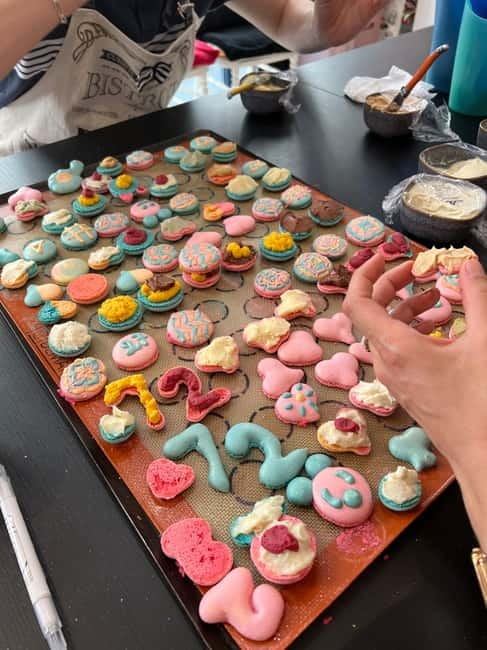
- Creative piping: Use a round template first, then add personal designs with a smaller double nozzle.
- More than one filling: The class includes access to 10 fillings, with raspberry, mango-passion, yuzu, and cheese among the flavors mentioned.
- A practical Paris stop: The workshop takes place inside the ground-floor Maca’Rong shop at 175 Rue Legendre.
A two-hour pastry class in Montmartre
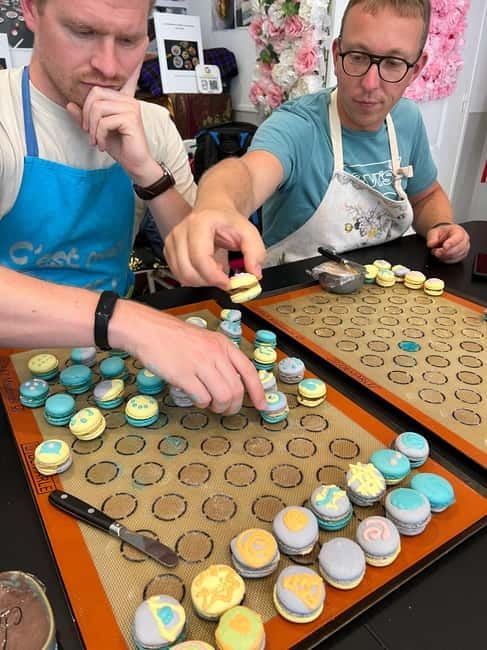
This is a focused baking workshop, not a sightseeing walk through Montmartre. You meet at Maca’Rong, a shop on the ground floor at 175 Rue Legendre, and spend the full two hours making macarons.
The address is useful to check carefully. One family found it about a 20-minute walk from the main Montmartre area, so do not assume the meeting point is beside Sacré-Cœur. Give yourself time to find the shop and enter through the ground-floor storefront.
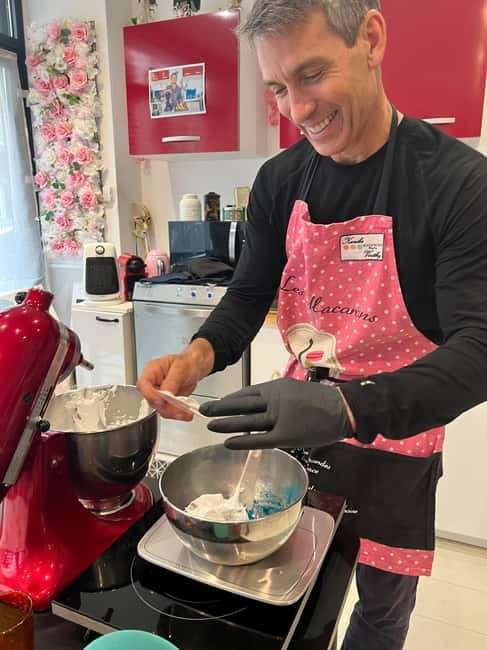
The room is set up for hands-on work. Each participant has a bowl of tant pour tant, the equal-parts mixture of almond flour and powdered sugar used for macaron shells. That preparation saves time and lets you begin with the technique rather than measuring every ingredient from scratch.
Kanika and Vouthy lead the instruction in English and French. The class is small enough for questions and close help with piping, which matters here. Macaron batter can go from too thick to too loose with only a little overmixing, and small corrections are easier when the instructor can watch what you are doing.
More Baking Classes in France
- Paris Croissant Small-Group Baking Class with a Chef
★ 5.0 · 910 reviews - Paris: French Croissant Baking Class with a Chef
★ 4.9 · 712 reviews - Paris: Baking Insider Experience
★ 4.7 · 397 reviews
Why Italian meringue matters
The central lesson is the Italian meringue method. Instead of simply whipping egg whites with sugar, you work with a hot sugar syrup and beaten egg whites. It is a more technical process, but the class presents it as a dependable way to produce smooth shells.
You also hear about other macaron methods, so you are not left thinking there is only one correct approach. The useful part is the practical advice for repeating the process at home: how to judge the meringue, how to mix the batter, and how to avoid the cracked or hollow shells that frustrate first-time bakers.
The chef also explains the bec d’oiseau, the small bird-beak shape that forms at the end of a properly lifted whisk or spatula of meringue. This is the sort of visual clue that helps more than a vague instruction to mix until ready.
For a beginner, the lesson is technical without being intimidating. You do not need to arrive with baking experience. At the same time, the class has enough detail for someone who already knows the French or Swiss method and wants to compare it with Italian meringue.
Macaronage, piping, and the moment things can go wrong
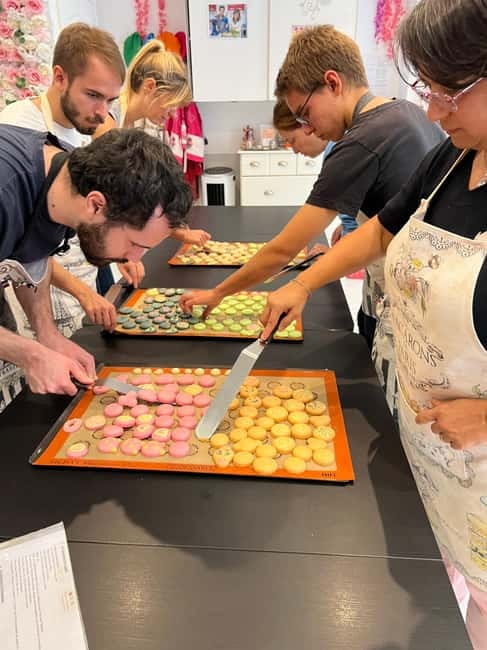
Once the meringue meets the almond mixture, the group works on macaronage. This is the folding stage that turns a stiff mixture into a smooth batter with a glossy finish.
You are looking for batter that flows correctly, not a mixture that sits in a mound or runs across the tray. The instructors guide you through the point where the batter shines and moves with the right amount of ease. That is a small but important lesson, since overmixing is hard to undo.
Filling a piping bag gets its own attention. It may sound basic, but keeping the bag tidy and avoiding wasted batter makes the piping stage much easier. The chef demonstrates how to pipe onto round templates, giving you a clear target for size and shape.
Then the creative part begins. You use a smaller double nozzle to add designs to the shells. Each person can give the macarons different colors and patterns, so the finished boxes do not all look alike. Precision helps, but the point is not to create identical pastry-shop pieces. You get to make a batch that feels like your own.
Depending on your accuracy and how much batter you produce, the usual result is about 15 macarons per person. Some families report leaving with more than that, but the stated amount to plan around is 15.
Raspberry ganache, mango-passion, and unusual fillings
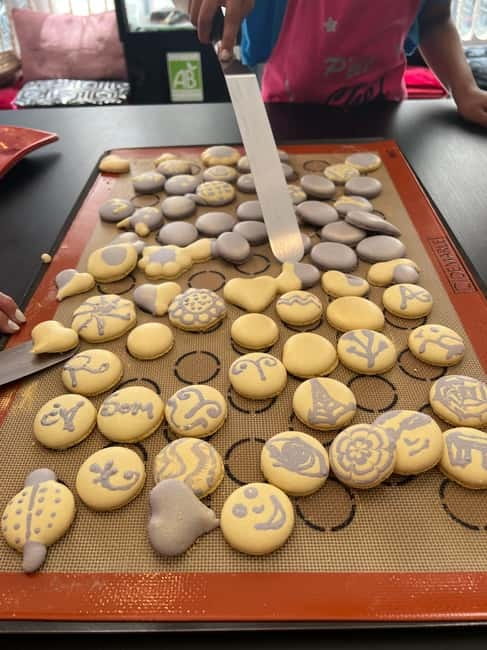
While the shells bake, the class shifts to filling. You see how to make a fruit ganache, with raspberry or mango-passion given as the main examples. This filling adds sharp fruit flavor to the sweet almond shells and gives you another recipe to repeat at home.
The class includes 10 fillings, which is a better choice than a workshop that limits everyone to one or two flavors. Other flavors mentioned during the sessions include yuzu and cheese. The cheese option may sound surprising, but it gives you a chance to try a less sugary, more savory-style macaron.
This range is one of the strongest parts of the workshop. You are not only learning a shell recipe. You are also seeing how different fillings change the character of the finished pastry. If you prefer fruit, choose raspberry, mango-passion, or yuzu. If you like trying something less expected, ask about the cheese filling.
Tea, coffee, and macarons are included during the class. Some sessions also offered other small tastes and refreshments, but you should treat those as part of the hosts’ hospitality rather than a guaranteed menu.
More Baking Classes in Paris
- Paris Macarons Small-Group Baking Class with a Chef
★ 5.0 · 316 reviews - Paris: Macaron Baking Class for Families and Kids
★ 4.7 · 270 reviews - Paris: Macaron Baking Class in Central Paris
★ 5.0 · 208 reviews - Paris Baking Insider Experience near Notre-Dame
★ 5.0 · 206 reviews
What you take home
Your macarons are packed into a special box, with bags provided for carrying them afterward. Fifteen handmade sweets are a generous souvenir, especially compared with buying a small luxury box from a Paris pastry shop.
The box also gives you a practical reason to schedule this class before the end of your trip. You can share the macarons with family or friends, though you will need to protect them from being crushed while you continue sightseeing.
The real souvenir is the method. A shop-bought macaron gives you a taste. This class gives you a way to understand why the shell has its smooth top and ruffled foot, how the filling affects the texture, and where a home batch can fail.
One point to plan for: the recipe may not be printed for you. A participant specifically wished for a paper copy and was told to get the recipe from Instagram. If you want to recreate the macarons later, save the recipe before leaving, take notes during the demonstrations, and write down the filling combinations you prefer.
Is $150 a fair price?
At $150 per person, this is not a cheap snack stop. You are paying for two hours of instruction, ingredients, a small class, refreshments, and roughly 15 macarons to take home.
The price makes more sense if you value participation and want to learn a technique you can use again. It is also a strong choice for a family or pair who would otherwise spend money on several pastry tastings without learning how the sweets are made.
The value is weaker if you only want to eat macarons or if you dislike following detailed kitchen instructions. Paris has plenty of places to buy excellent macarons, and a short class is still a commitment in the middle of a sightseeing day.
For a special occasion, the price can work well because each person leaves with a personal box. It also compares favorably with paying more than €40 for a box of macarons if your main goal is both tasting and taking home a large quantity. Just remember that the class is priced as an activity, not as a simple pastry purchase.
Who will enjoy this most?
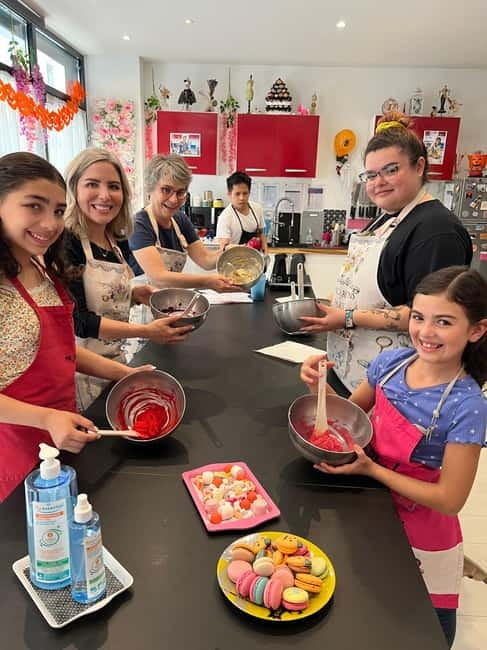
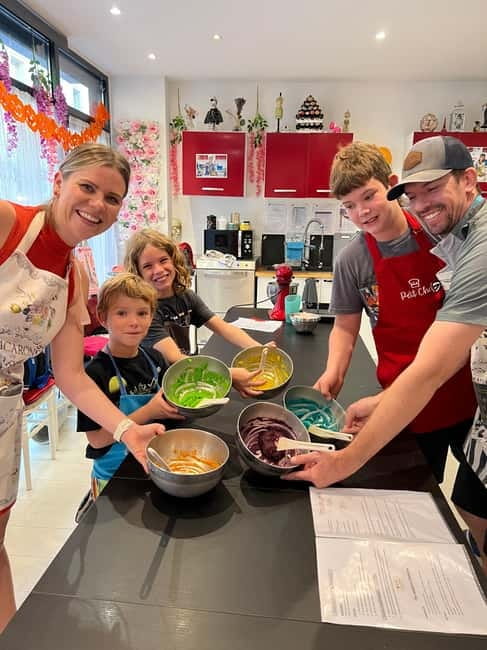
This workshop suits families, couples, friends, and solo bakers who like doing something active. The small format makes it easier for adults and children to share the work, and the instructors are described as patient with younger participants.
The stated minimum age is six. Children under six are not allowed, and the class is not suitable for babies under one year. Families with children around seven and older may find the piping and decorating especially engaging, since the creative stage breaks up the more technical meringue lesson.
It also suits mixed-level groups. One person can be new to baking while another has already made macarons using French or Swiss methods. The step-by-step format gives beginners a clear path, while the Italian method and filling choices offer useful details for more experienced bakers.
I would not choose it for anyone with food allergies or lactose intolerance. The activity is specifically listed as unsuitable for people with food allergies and lactose intolerance. It is also not suitable for wheelchair users, and oversize luggage is not allowed.
Planning the rest of your Montmartre day
Because the class lasts two hours, it works best as one planned part of your day rather than a quick stop between major sights. You can pair it with time in Montmartre before or after, but allow for the walk between the Rue Legendre meeting point and the hilltop area.
The class itself does not include a walking tour, monument entry, or a guided introduction to Montmartre. Its connection to the neighborhood is mainly its location and the chance to visit the area around the shop.
I would book a morning or afternoon session based on your sightseeing route, then avoid carrying oversize bags to the workshop. Since you leave with a box of delicate macarons, keep the rest of the day manageable if you want them to arrive home in good shape.
Cancellation is flexible up to 24 hours before the activity for a full refund, and you can reserve now and pay later. Starting times vary, so check availability for the date you want.
The atmosphere and instruction
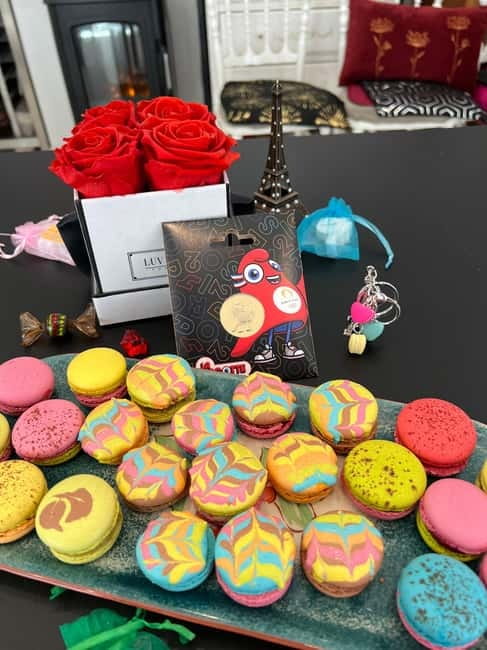
The strongest feature is the balance between instruction and play. You get clear demonstrations, then enough time to pipe and decorate your own shells. That makes the class feel like a real workshop rather than a pastry demonstration where you only watch.
Kanika and Vouthy are repeatedly praised for being friendly, patient, and engaging. Their use of both English and French helps mixed-language groups, though one person found a thick French accent a little difficult to understand at times. The small group and visual demonstrations help offset that issue.
The class also works well for several generations. Families ranging from children to grandparents have taken part, and the activity gives everyone a task. A child can focus on decoration, an adult can handle careful piping, and more experienced bakers can ask about the technical points.
You should expect a brisk pace. One participant described the class as moving fast, which makes sense in a two-hour session that includes meringue, macaronage, piping, baking, and ganache. Listen closely during demonstrations and ask questions as soon as something is unclear.
Should you book the Maca’Rong workshop?
Book it if you want a hands-on Paris activity, enjoy sweets, and like the idea of taking home something you made yourself. The small class, patient instruction, varied fillings, and personal box of macarons give it more substance than a simple tasting.
I would be especially likely to choose it for a family, a couple with different baking skills, or anyone who has tried making macarons at home and wants help with the technical points. Save the recipe from Instagram, arrive without bulky luggage, and allow time to reach Rue Legendre.
Skip it if you have food allergies, lactose intolerance, mobility needs that make the venue unsuitable, or only want a quick pastry purchase. At $150, the value depends on enjoying the lesson as much as the macarons. For the right person, the box is the souvenir, but the confidence to try Italian meringue again is the lasting part.
FAQ
Where does the macaron class meet?
Meet inside the Maca’Rong shop on the ground floor at 175 Rue Legendre in the Montmartre area.
How long does the workshop last?
The workshop lasts two hours.
How many people are in the class?
The class is limited to six participants, making it a small-group activity.
What languages are spoken?
Instruction is available in English and French.
How many macarons can I take home?
You can expect to make and take home about 15 macarons per person, packed in a special box with bags for carrying them.
What filling flavors are available?
The class includes 10 fillings. Raspberry, mango-passion, yuzu, and cheese are among the flavors mentioned.
Can children join the workshop?
Children six and older may participate. Children under six and babies under one year are not suitable for the activity.
Is the class suitable for people with allergies or lactose intolerance?
No. The activity is not suitable for people with food allergies or lactose intolerance.
More Hands-On Workshops in Paris
- Paris Cooking Class and Lunch with Wine plus Market Visit Option
★ 5.0 · 1,024 reviews - Paris Cooking Class: Learn How to Make Macarons
★ 5.0 · 634 reviews - Paris: French Macaron Culinary Class with a Chef
★ 4.9 · 591 reviews - Paris Evening Cooking Class French Dinner and Market Visit Option
★ 5.0 · 430 reviews
Just added around Paris
- Paris: Macarons Cooking Class with Pâtisserie Chef Noémie★ 4.8 · 179 reviews
- Paris: Hands-On Small Group Cooking Class★ 4.9 · 19 reviews
- Paris: Millefeuille baking class with a chef★ 5.0 · 5 reviews
- Paris: Macaron Baking Class★ 4.4 · 26 reviews
- Paris: Evening Cooking Class with Optional Market Visit★ 4.8 · 19 reviews
- Paris: Lemon Tart Baking Class with a Pastry Chef★ 5.0 · 4 reviews
- Paris: French Pastry and Baking Workshop★ 4.1 · 12 reviews
- Eclair Baking Class with A Pastry Chef★ 5.0 · 3 reviews
Baking & Bread Classes, compared.
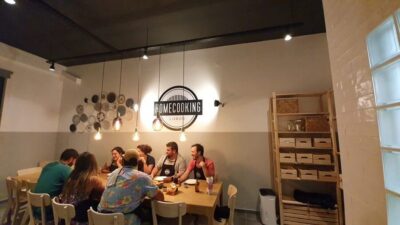

Group Tour: Garni, Symphony of Stones, Geghard, Lavash Baking
Read our review →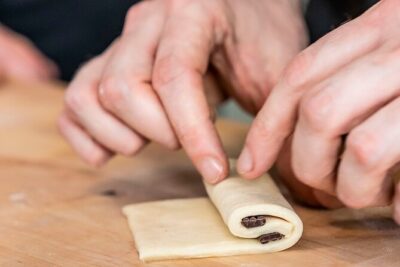
Paris Croissant Small-Group Baking Class with a Chef
Read our review →
Garni & Geghard Small-Group Day Trip with Lavash Baking
Read our review →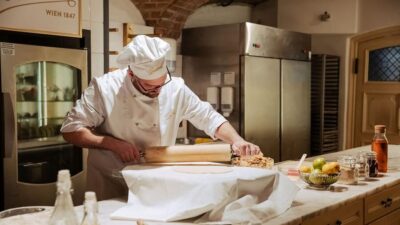
Vienna: Gerstner KuK Hofzuckerbäcker Baking Show & Tasting
Read our review →
Yerevan: Garni, Geghard, Symphony of Stones & Lavash Baking
Read our review →
Paris: French Croissant Baking Class with a Chef
Read our review →
Laugarvatn Fontana: Geothermal Bread-Baking Experience
Read our review →Browse the lists this tour appears in