
Review · BUDAPEST
Walk and Cook Budapest
Budapest’s past makes more sense when you can taste its results. This five-hour experience links a guided city walk with a hands-on Hungarian cooking class, moving from Ottoman influence and Jewish heritage to Austro-Hungarian architecture and the dishes served at the table.
I like the small maximum of 10 people, which should make it easier to ask questions and take part in the cooking. I also like the full sit-down dinner, since you are not just watching a demonstration and then hunting for food afterward. The main thing to consider is the price, $131.06 per person, which is a serious sum for a half-day activity, especially if you mainly want a sightseeing walk.
Key points to know before you book
- Gül Baba’s Tomb begins the history lesson: The opening stop introduces Ottoman influence in Budapest.
- Parliament and the Great Synagogue add two very different chapters: The route connects grand Austro-Hungarian architecture with Jewish history during the Second World War.
- The walk lasts about 1.5 hours: Most of the remaining time is devoted to cooking and eating.
- You help prepare Hungarian food: Possible dishes include stuffed peppers, roast goose, goulash soup with sauerkraut, poppy-seed dessert, doughnuts, and plum dumplings.
- The group is limited to 10 people: That matters when several people are working in one kitchen.
- Kata and Karolina may lead the experience: A seasonal review specifically thanked both guides for the tour and the memories they helped create.
Why this Budapest tour works as a history lesson
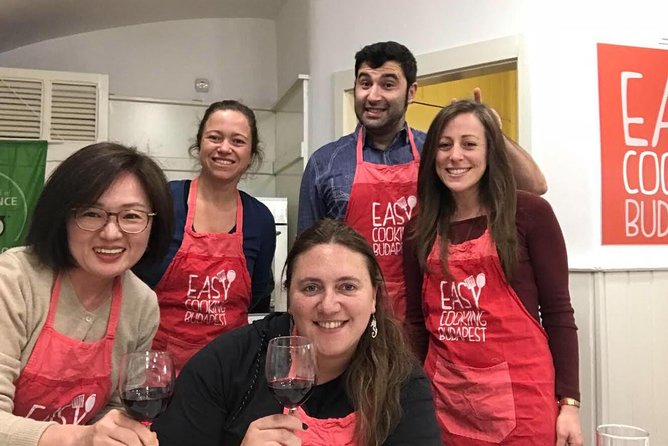
Many city tours give you dates, buildings, and a quick photo stop. This one has a more useful idea: show how outside powers and communities shaped Hungarian food, then let you prepare the results yourself.
The opening walk lasts roughly 1.5 hours. That is long enough to give the cooking class some context, but short enough that the food remains the main event. You will visit three named places: Gül Baba’s Tomb, the Hungarian Parliament Building, and the Great Synagogue.
The tour description connects these stops with several periods of Hungarian history. You can expect discussion of what the Ottoman Empire left behind, what happened to Budapest’s Jewish people during the Second World War, and the beautiful buildings created during the Austro-Hungarian period.
That combination gives the experience a clear shape. You are not simply walking past handsome buildings, then switching to a random cooking lesson. The food is presented as part of Hungary’s contact with other nations and cultures.
There is also a human advantage to the format. With only 10 people, you should have more opportunity to ask about a building, clarify a historical point, or get help with a recipe. A larger group could make the kitchen feel crowded and reduce the hands-on part. Here, the small size is one of the strongest reasons to consider the booking.
More Walking Tours in Budapest:
- Easy Cooking Class Budapest – with Market Walk (local wine & pálinka included)
★ 5.0 · 62 reviews - Tokyo: Tsukiji Market Walking Tour & Sushi Cooking Class
★ 4.6 · 122 reviews - Cape Town: Bo-Kapp Walking Tour and Malay Cooking Class
★ 4.7 · 105 reviews
Gül Baba’s Tomb and the Ottoman chapter
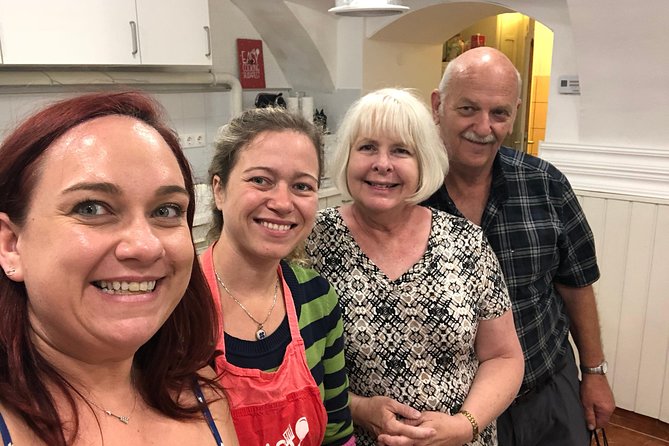
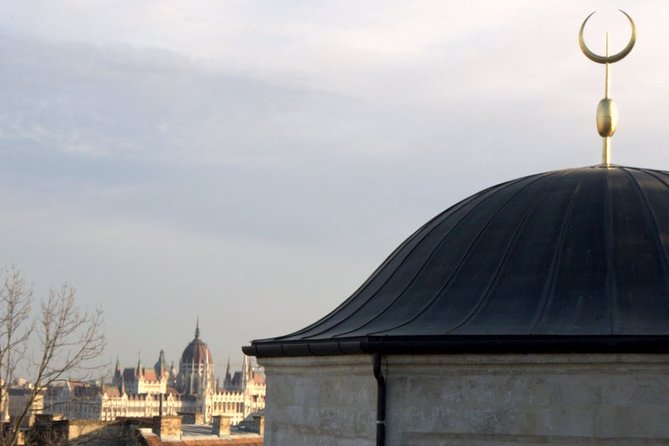
Gül Baba’s Tomb, also called Gül Baba Turbeje, is the first named stop. Its presence gives the walk an unusual opening. Instead of beginning with Budapest’s best-known postcard building, you start with the Ottoman period and the traces it left in the city.
That matters because Hungarian food did not develop in isolation. The stated focus of the tour is the influence of each nation connected with Hungary, and the Ottoman Empire is one of the clearest examples of that wider story.
The stop is also useful for setting the tone. You are being asked to look past a single national story and notice the layers that shaped Budapest. I like that approach, especially for a cooking experience. Food often reveals contact between cultures more clearly than a list of rulers does.
The provided details do not specify how long you remain at the tomb, whether admission is included, or the exact route between the stops. I would therefore treat it as a guided exterior visit unless your confirmation says otherwise. The overall walking portion is about 1.5 hours, so expect a focused introduction rather than a long archaeological visit.
Parliament connects architecture with the Austro-Hungarian era
The Hungarian Parliament Building is the grandest stop on the route. It represents the monumental side of Budapest and fits the tour’s focus on the Austro-Hungarian period.
You will learn about the period when many of Budapest’s notable buildings were constructed. Parliament gives that subject a natural focal point, with its scale and ornate design making it easy to discuss how architecture reflected political ambition and imperial-era confidence.
This part of the walk should appeal to you if you want your sightseeing to include more than a photo. The guide can connect what you see to the period in which the building was created, then later connect those outside influences to the cooking lesson.
There is an important limit here. The information provided does not say that the tour enters Parliament or includes an interior visit. Do not book this expecting a full Parliament tour. Plan on seeing the building as one of the walking stops, with the guide supplying the historical setting.
The Great Synagogue brings a sobering human story
The Great Synagogue, or Nagy Zsinagoga, introduces Budapest’s Jewish heritage. The experience specifically refers to what happened to Jewish people in Budapest during the Second World War, making this more than an architectural stop.
That subject deserves a measured approach. It adds weight to the tour and reminds you that food and buildings can carry painful memories as well as pleasant ones. The synagogue also gives the walk a different character from the Ottoman and Austro-Hungarian sections.
Again, the available details do not confirm entry or admission to the synagogue. I would assume that the stop is part of the guided walk and not a separate interior tour unless the booking confirmation states otherwise.
The sequence is sensible. Gül Baba’s Tomb presents Ottoman influence, Parliament represents the Austro-Hungarian period, and the Great Synagogue opens discussion of Jewish life and wartime persecution. You get three distinct windows onto Budapest before sitting down to cook.
Same place, a different menu:
- Budapest Cooking Class & Market Tour with Local Guide & Wines
★ 5.0 · 553 reviews - Premium Hungarian Home Cooking Experience with Chef Marti
★ 5.0 · 169 reviews - Budapest: Small-Group Cooking Class & Market Tour with Local
★ 5.0 · 138 reviews - Hungarian Cooking and optional Local Market Tour
★ 4.5 · 98 reviews
From the pavement to the kitchen
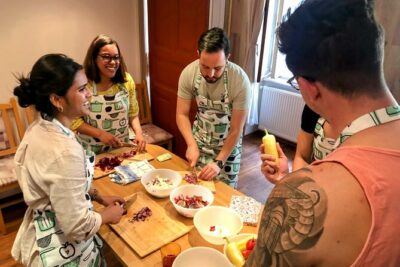
After the walking section, you head to a kitchen to prepare Hungarian dishes. The change from sightseeing to cooking is what makes this experience different from a standard city tour.
You are not simply told that foreign influences shaped Hungarian food. You get to work with dishes that reflect the country’s food traditions. The exact dish served may vary, since several possible mains and desserts are listed, but the choices give you a useful sense of the class.
Possible main courses include:
- Stuffed peppers, or töltött paprika
- Roast goose with onion potatoes and braised cabbage
- Székelygulyás, a goulash soup with sauerkraut
Possible desserts include:
- Mákos guba, a poppy-seed dessert
- Fánk, a special doughnut
- Szilvásgombóc, or plum dumplings
These are not interchangeable snacks. A dinner built around roast goose, onion potatoes, and braised cabbage has a different feel from goulash soup with sauerkraut. Stuffed peppers offer another familiar Hungarian direction, with the pepper serving as both container and central flavor.
The class is valuable because it gives you a practical memory of Budapest. You may forget the name of a building after a few days. It is harder to forget making a dish with your own hands, then sitting down to eat it with the group.
The supplied details do not explain whether you choose the menu, how many dishes you prepare, or whether dietary substitutions are available. Ask before booking if you have allergies, follow a special diet, or need a guaranteed menu choice. The listing presents sample dishes rather than one fixed meal.
The dinner is a real part of the experience
A full sit-down dinner makes the $131.06 price easier to assess. You are paying for a guided walk, a cooking workshop, and a meal, not just a quick tasting.
I especially like the fact that the experience ends with everyone eating together. Cooking classes can feel rushed when the food is packed away or served as small samples. Here, the stated format includes a full dinner, which gives the group time to enjoy the result of the work.
The meal also creates a natural ending. The walk supplies the setting and historical background. The kitchen gives you something to do. Dinner lets you talk, compare results, and finish the activity without needing to search for another restaurant.
Still, the value depends on your priorities. If you want a cheap way to see Parliament and the Great Synagogue, this is not the most economical choice. If you already planned to pay for a meal and a separate cooking class, the combined format may make more sense.
The price includes neither a stated breakdown nor a guarantee of every dish listed. Before paying, check which menu is planned for your date and whether the meal is included as described. The activity is offered in English, so the historical discussion and kitchen instructions should be accessible to English-speaking participants.
What the small group changes
A maximum of 10 people is a strong practical feature. A cooking class needs enough space for everyone to participate, and a walking tour works better when the guide can hear questions from the back of the group.
A small group can also make the dinner feel less like a scheduled service and more like a shared table. That is especially useful if you are traveling alone. One seasonal review thanked Kata and Karolina for guiding the participant and giving them good memories of Budapest during the Christmas period.
That review is limited, and the overall rating is based on only six reviews. I would not treat a perfect rating as proof that every date will be identical. Still, the direct praise for Kata and Karolina points to the personal side of the activity, which is exactly where a 10-person maximum should help.
The group size may also mean less flexibility if you arrive late or need to leave early. The experience starts and ends at the meeting point in Budapest, and the full activity takes about five hours. Keep the afternoon or evening clear rather than trying to squeeze in a separate appointment.
Timing, meeting point, and practical planning
The listed location is Budapest, Hungary, and the activity returns to the meeting point at the end. It is near public transportation, which should help you reach the start without arranging a private transfer.
The exact meeting address is not included in the supplied information. Wait for the booking confirmation before planning your route. Confirmation is issued within 48 hours, subject to availability, so do not assume that a request is final until it is confirmed.
Because the experience combines walking and kitchen work, wear comfortable clothing and shoes. The tour includes about 1.5 hours on foot, followed by cooking, so an outfit suitable for both parts is the sensible choice. This is practical advice rather than a stated dress rule.
The experience is offered in English. If you want detailed explanations of the Ottoman period, Jewish history, and the Austro-Hungarian era, English fluency will help you get more from the first part. The kitchen portion should also be easier when you can follow instructions quickly.
Free cancellation is available if you cancel at least 24 hours before the start time. Changes or cancellations inside that window are not accepted for a refund. The activity also requires a minimum number of participants, so if that minimum is not reached, you are offered another date or experience, or a full refund.
Who should book this experience
I would recommend it most strongly to someone visiting Budapest for the first time who wants a compact introduction to the city and its food. You get major historical themes, three significant stops, practical cooking, and dinner in one booking.
It also suits solo visitors and couples who prefer a small group over a large sightseeing bus. The 10-person maximum should make it easier to speak with the guides and take part in the meal.
Food-minded visitors will get the most from the second half. If stuffed peppers, roast goose, goulash soup with sauerkraut, doughnuts, and plum dumplings sound more appealing than a standard restaurant meal, this format gives you a closer connection to what you eat.
I would be more cautious if your priority is extensive monument access. The information confirms the three walking stops but does not promise entry to Parliament or the Great Synagogue. It also does not provide a fixed menu, so ask about the date-specific plan if a particular dish matters to you.
Should you book Walk and Cook Budapest?
Book it if you want Budapest explained through both places and food. The best parts are the clear historical arc, the hands-on kitchen session, the full dinner, and the maximum of 10 people. The personal attention from guides including Kata and Karolina is another encouraging detail.
Skip it if you only want a low-cost walking tour, a formal interior visit to Parliament or the Great Synagogue, or a guaranteed dish from the sample menu. At $131.06, this is a premium half-day activity, but it can be fair value when you would otherwise pay separately for sightseeing, a cooking class, and dinner.
For the right person, it is a smart way to give Budapest’s past a place at the dinner table.
FAQ
How long does Walk and Cook Budapest last?
The experience lasts approximately five hours. The guided walking portion takes about 1.5 hours, followed by the cooking session and dinner.
What language is the tour offered in?
The experience is offered in English.
How many people can join the group?
The maximum group size is 10 travelers.
Where does the experience start and finish?
It starts in Budapest, Hungary, and ends back at the meeting point.
Which places are included in the walking portion?
The named stops are Gül Baba’s Tomb, the Hungarian Parliament Building, and the Great Synagogue, also called Nagy Zsinagoga.
What food might be prepared?
Possible main dishes include stuffed peppers, roast goose with onion potatoes and braised cabbage, and székelygulyás, a goulash soup with sauerkraut. Possible desserts include mákos guba, fánk, and szilvásgombóc.
How much does the experience cost?
The listed price is $131.06 per person.
Can I cancel for a full refund?
Yes. You can cancel at least 24 hours before the experience start time for a full refund. Cancellations or changes made less than 24 hours before the start time are not refunded or accepted.
Just added around Budapest
- Hungarian Home Cooking Class with Chef Marti★ 5.0 · 30 reviews
- Budapest Market Tour & Home Cooking Class with local Chef & Guide★ 5.0 · 23 reviews
- Hungarian Cooking Class with Nelli – ONLINE over Zoom★ 5.0 · 16 reviews
- Authentic Jewish Cooking Class by a Professional chef★ 5.0 · 8 reviews
- Easy Cooking Class Budapest – with Market Walk (local wine & pálinka included)★ 5.0 · 62 reviews
- Budapest: Cooking School – Hungarian Menu & Local Market★ 5.0 · 7 reviews
- Hungarian Premium Cooking Class with 4-course meal★ 5.0 · 15 reviews
- Chefparade Cooking School_ Hungarian menu★ 4.7 · 22 reviews
Budapest Cooking Classes, compared.
Budapest Cooking Class & Market Tour with Local Guide & Wines
Read our review →
Premium Hungarian Home Cooking Experience with Chef Marti
Read our review →
Budapest: Small-Group Cooking Class & Market Tour with Local
Read our review →
Hungarian Cooking and optional Local Market Tour
Read our review →
Easy Cooking Class Budapest – with Market Walk (local wine & pálinka included)
Read our review →
Budapest Market Tour & Home Cooking Class with local Chef & Guide
Read our review →
Browse the lists this tour appears in