Review · BOLOGNA
Bologna Local Pasta Cooking Class, Ragu, Spritz, Wine & Gelato
Bologna’s best food lesson may be the simplest one: flour, eggs, a rolling pin, and enough time to sit down together afterward. This three-hour class takes you from a local aperitivo to hand-cut tagliatelle with homemade ragù, then adds wine, coffee, amaro, and gelato.
I especially like the hands-on pasta work and the relaxed social setup. You also get a useful taste of Emilia-Romagna through mortadella, Crescenta, Pignoletto, San Giovese, parmigiano, and a regional Casoni spritz. The main consideration is that the ragù is prepared before class, so you learn the pasta more than the full sauce.
Key things to know before booking
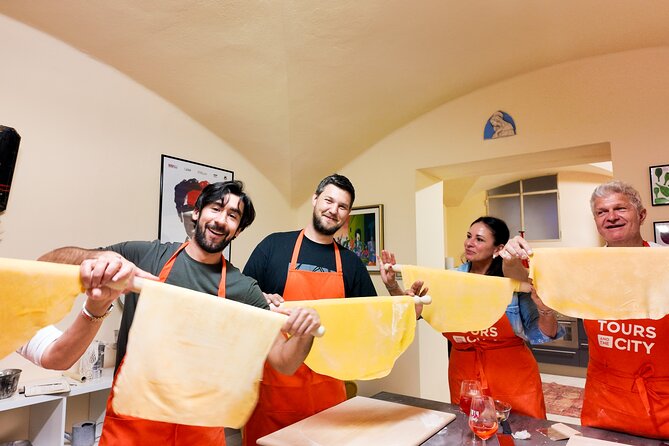
- You make tagliatelle by hand: Eggs and flour become pasta through your own mixing, kneading, rolling, and cutting.
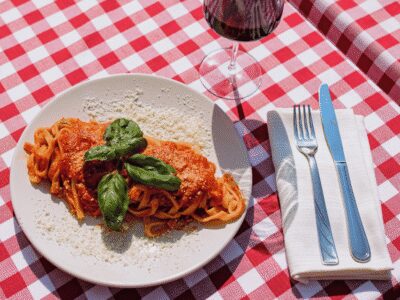
- The meal is part of the lesson: Your pasta is cooked and served with homemade ragù, parmigiano reggiano aged 24 months, and local red wine.
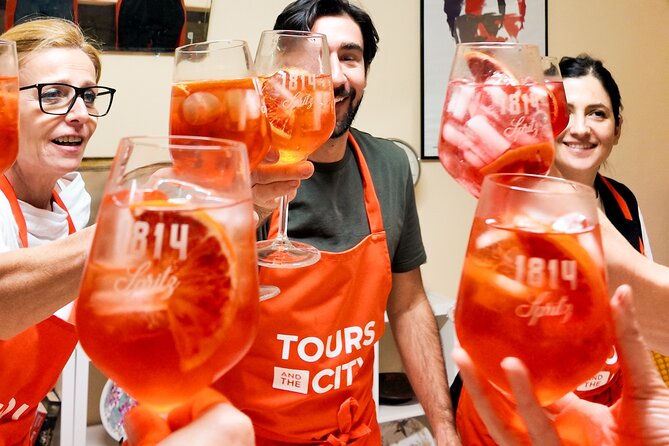
- A Casoni spritz is included: You learn a local cocktail made with regional herbs and recipes, rather than simply ordering a familiar branded spritz.
- The welcome tastes are distinctly Bolognese: Expect mortadella, Crescenta or piadina, and Pignoletto before the pasta work begins.
- The group is social and fairly small: The experience is described as limited to 10 people, with a maximum capacity of 13.
- You leave with usable recipes: Recipes can be sent by email as PDFs, giving you a way to repeat the pasta at home.
Why this Bologna class feels more local than a standard food tour
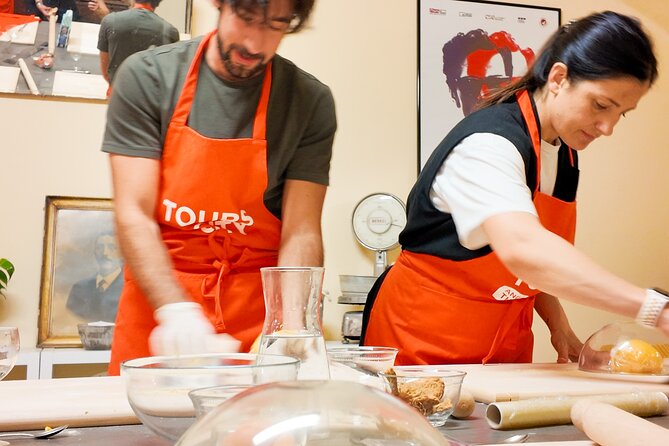
Bologna is often called Italy’s food capital, and this class focuses on food you can actually find in a Bolognese kitchen. There is no parade of restaurant samples or hurried sampling from one shop to the next. You sit down, handle the dough, and eat the result at the same table.
That difference matters. A food tour can introduce you to local flavors, but a cooking class shows how those flavors fit together. Mortadella is not just a famous pink slice on a plate. It appears as part of an aperitivo, alongside bread or Crescenta, wine, and conversation.
The setting is a traditional Bolognese kitchen or cooking space in the old town area. The meeting point is Piazza Galileo Galilei, near public transportation, and the class finishes where it begins. That makes the outing easy to fit between sightseeing stops, although you should allow the full three hours rather than planning a tight connection afterward.
Hosts vary by session. Names associated with the class include Stefania, Stella, Sonia, Claudia, Valentina, Roberta, Lucrezia, Beatrice, and others. The consistent thread is a friendly, informal teaching style. You can expect the instructors to guide your hands through the tricky bits instead of simply demonstrating from a distance.
More Cooking Classes with Wine Tasting in Bologna
- Bologna: Pasta Cooking Class, Ragu, Spritz, Wine & Gelato
★ 4.9 · 775 reviews - Bologna: Pasta and Tiramisu Cooking Class with Wine
★ 4.7 · 507 reviews - Bologna: Pasta and Tiramisu Small Group Cooking Class with Wine
★ 5.0 · 409 reviews
Starting with Pignoletto, mortadella, and Crescenta
The class opens with a local welcome drink, usually Pignoletto, a white wine from the Emilia-Romagna region. Alongside it come mortadella and Crescenta or piadina, setting up the meal in the Italian way: first a little food, then a little drink, then conversation.
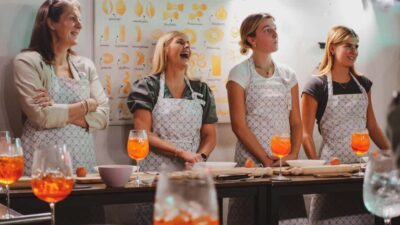
This is more than filler before the cooking begins. It gives you a quick introduction to local ingredients and lets the group get comfortable. Several people have found the social side one of the strongest parts of the evening, especially couples, solo participants, and families who want an activity that does not feel formal.
The pacing also works well for beginners. You are not expected to arrive with pasta-making skills. The class is built around a step-by-step demonstration, and instructors such as Stefania, Stella, Sonia, and Claudia have been praised for helping when dough becomes sticky, dry, or difficult to roll.
If you prefer a quiet, private lesson, this may not be your best match. The point is to cook and eat with other people. If you like a shared table and do not mind chatting with people you just met, the group format adds real value.
Making a Casoni spritz with a local accent
Before or during the pasta work, you learn to make a Casoni spritz. Casoni is tied to Emilia-Romagna and uses local herbs and recipes, so this is not simply a standard Aperol pour with a different label.
The class gives you a chance to compare local aperitivo customs with the better-known versions found around Italy. One account of the experience included tasting the difference between Campari and Aperol spritz while preparing the pasta. The exact tasting lineup may vary, but the central idea is clear: the drink is part of the lesson, not just a beverage placed in front of you.
This section is a good fit for people who enjoy learning the small cultural details behind a drink. You see how an aperitivo helps shape an Italian meal, and you get a recipe or method you can try again. It also breaks up the flour work nicely.
Keep in mind that alcohol is served throughout the experience. The welcome wine, spritz, red wine, coffee, and amaro make this feel like a generous meal, but the format may not suit anyone avoiding alcohol. The supplied information does not describe a nonalcoholic alternative, so ask in advance if that matters to you.
Rolling tagliatelle with only eggs and flour
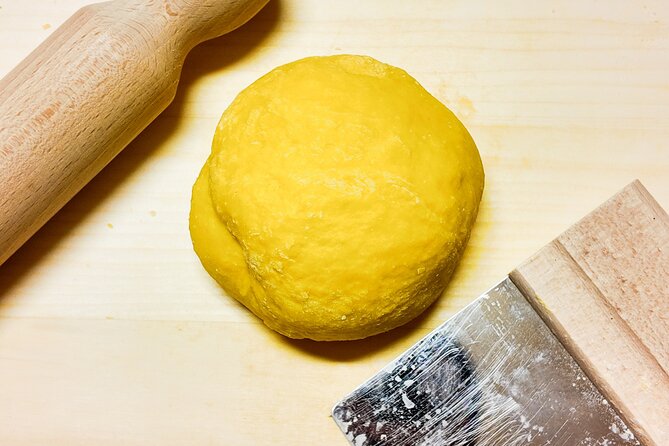
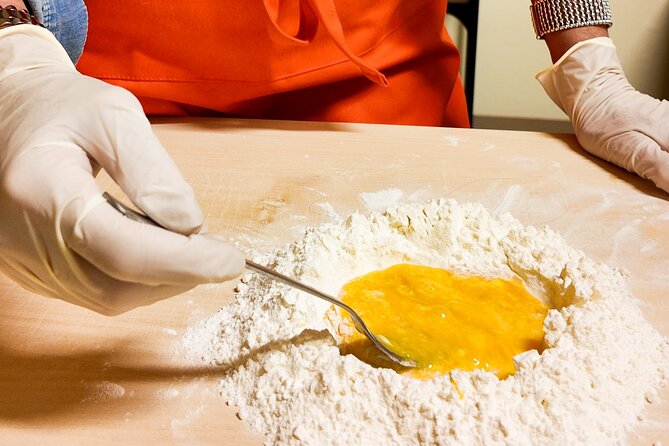
The central lesson uses two basic ingredients: eggs and flour. You mix the dough by hand, then knead and roll it with a rolling pin. There are no pasta machines doing the hard work for you. Your arms provide the power.
That old-fashioned method is useful because it teaches you what the dough should feel like. You learn to notice when it needs more work and how thin the sheet should become before cutting. The instructors demonstrate the process, then help you correct your technique.
Tagliatelle is an excellent choice for a first pasta lesson. It is more forgiving than delicate filled pasta, yet it still teaches the essential skills: making dough, rolling a sheet, cutting even ribbons, and drying the pasta before cooking.
The class is also suitable for experienced home cooks. One participant who already made pasta at home still found the historical and cultural context useful, while a beginner in the same group could follow the lesson. That mixed skill level is a strength. You can work at your own pace without the session being reduced to a basic demonstration.
Expect flour on your hands and some uneven noodles at first. That is part of the appeal. The goal is not restaurant-perfect strands. It is to understand the process well enough to repeat it at home.
More Cooking Classes with Wine Tasting in Italy
- Florence: Pasta Cooking Class with Unlimited Wine
★ 4.9 · 10,285 reviews - Florence: Pasta & Tiramisu Cooking Class with Unlimited Wine
★ 4.9 · 6,708 reviews - Florence: Pasta Cooking Class with Unlimited Wine
★ 5.0 · 6,413 reviews - Rome: Pasta Making Class with Wine, Limoncello, and Dessert
★ 4.9 · 3,177 reviews
The ragù is homemade, but already prepared
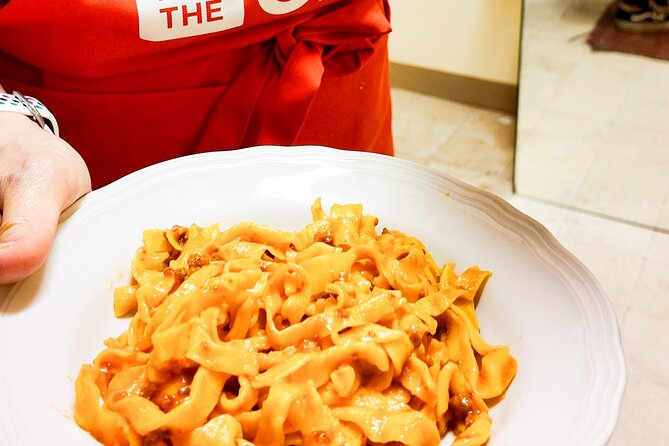
Here is the most important limitation to understand: the ragù preparation is not included because the class does not have enough time. The sauce is homemade, but it is already simmering when you arrive at the pasta stage.
This keeps the three-hour schedule realistic. Making a proper ragù from start to finish would take much longer than the class allows, and you would have less time to work on pasta and enjoy the meal. Still, if your main goal is to learn Bolognese sauce, you should choose a different lesson or ask whether sauce instruction is available.
You do get useful context about the traditional Bolognese sauce, and the finished ragù is paired with your freshly made tagliatelle. The dish is completed with parmigiano reggiano aged for 24 months, giving you a chance to taste how a mature cheese changes the simple pasta.
San Giovese, a local red wine, accompanies the main course. The meal is not a small tasting portion. The format is designed so you cook, sit down, and eat a proper lunch or dinner with the group.
Sitting down to a full Emilia-Romagna meal
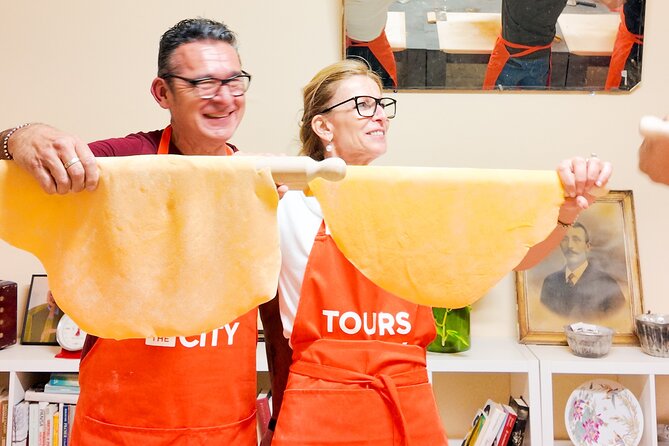
The food sequence gives this class a clear beginning, middle, and end. You start with aperitivo snacks, move into the pasta course, and finish with Italian coffee, amaro, and gelato.
The main dish is the reward for the work. Fresh tagliatelle cooks quickly, and the texture is noticeably different from dried pasta. You combine it with the prepared ragù and parmigiano, then eat it while it is fresh.
The final course includes a mystery gelato. The flavor is not specified in advance, which keeps a small element of surprise in the meal. Coffee and amaro finish things in a distinctly Italian fashion, rather than rushing you out after the pasta.
Some sessions have included a drizzle of aged balsamic vinegar from Modena with the dessert. Since that detail is not listed as guaranteed, consider it a possible extra rather than something to book around.
The food and drink help explain the price. At $59.26 per person, you are paying for a three-hour activity, instruction, multiple local tastes, a cooked meal, wine, cocktails, dessert, and recipes. For Bologna, that is solid value if you plan to enjoy the full social meal. It is less compelling if you only want a short pasta demonstration or do not drink.
How the group size affects the experience
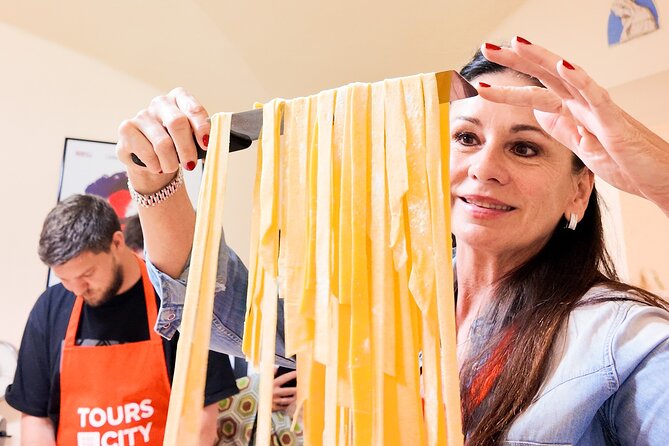
The class is promoted as a small-group activity limited to 10 people, while the additional booking information gives a maximum of 13 participants. Either way, this is far more personal than a large demonstration where you watch from the back.
A group of four has also been accommodated, and sessions can include couples, families, solo participants, and friends. That mix helps explain why the class works for different types of visitors. You can book it as a shared activity with a partner, or arrive alone and still have a natural way to meet people.
The tradeoff is that your exact amount of one-on-one help depends on the group size. With four participants, the instructors can give close attention. With a full group, you may need to wait briefly while others receive help with rolling or cutting.
The teaching style is informal and encouraging. Hosts such as Roberta and Lucrezia, Stefania and Claudia, or Sonia and Beatrice have been described as keeping the group busy without making the lesson feel rushed. That balance is important: you want enough instruction to learn, but enough breathing room to laugh and eat.
Dietary needs, families, and practical limits
Gluten-free pasta and vegetarian sauces can be accommodated, but you must provide dietary information in advance. The class may not be suitable for severe allergies or strict dietary requirements, so do not rely on an informal request made at the door.
Children are welcome, though the menu and structure are designed for adults. A family can take part, but young children may find the three-hour pace and alcohol-centered aperitivo less appealing than a shorter family cooking lesson.
The activity is offered in English and confirmation is provided at booking. Mobile tickets make arrival straightforward, and the meeting point is Piazza Galileo Galilei. The experience ends back at that same location.
You can cancel for a full refund up to 24 hours before the start time. Cancellations or changes made inside that window are not refunded or accepted, so keep your Bologna schedule reasonably firm.
Who will get the most from this class
I would choose this experience if you want to learn one practical pasta skill and enjoy a full Italian meal without spending an entire day in a cooking school. It suits first-time pasta makers particularly well because the instructors break the process into manageable steps.
It is also a good choice for couples and friends. You work side by side, then share the finished dish with the rest of the group. Solo participants can fit in easily because the aperitivo and table meal create natural conversation.
You should also consider it if you are already comfortable in the kitchen. The class is not limited to beginners, and the local food background, spritz preparation, and regional ingredients add interest beyond the mechanics of pasta dough.
I would hesitate if your priority is learning ragù from start to finish. The sauce is homemade and central to the meal, but its preparation happens before the lesson. I would also think twice if you have severe allergies, need strict dietary control, or want a private and alcohol-free experience.
Should you book the Bologna pasta class?
Book it if you want an easygoing Bologna evening built around hand-made tagliatelle, local wine, a regional spritz, and a shared meal. The strongest reasons are the patient instruction, the social group size, and the useful pasta skills you can repeat at home.
At $59.26, the combination of food, drinks, dessert, teaching, and recipes makes good sense. Just arrive knowing that you will learn pasta rather than the full ragù process, and confirm your dietary needs in advance. For most visitors who like to cook, eat, and meet people, this is a practical and delicious way to spend three hours in Bologna.
FAQ
Where does the Bologna pasta class meet?
The class begins at Piazza Galileo Galilei, Piazza Galileo Galilei, 40123 Bologna BO, Italy. The experience ends back at the meeting point.
How long does the experience last?
The cooking class lasts approximately three hours.
What pasta will I make?
You will make tagliatelle by hand using eggs and flour. You will roll and cut the dough yourself, without pasta machines.
Is the ragù made during the class?
No. The ragù is 100 percent homemade, but its preparation is not included because of the limited class time. It is prepared in advance and served with your fresh tagliatelle.
Can the class accommodate dietary restrictions?
Gluten-free pasta and vegetarian sauces can be accommodated. You must share dietary restrictions in advance, and the class may not be suitable for severe allergies or strict dietary requirements.
What is included in the meal?
The experience includes local aperitivo items such as mortadella and Crescenta or piadina, Pignoletto, a Casoni spritz, hand-made tagliatelle with homemade ragù and 24-month-aged parmigiano reggiano, San Giovese, coffee, amaro, and mystery gelato.
More Pasta Making Classes in Italy
- 3 in 1 Cooking Class near Navona: Fettuccine, Ravioli & Tiramisu
★ 5.0 · 7,376 reviews - Pastamania – Florence Pasta Making Class
★ 5.0 · 3,050 reviews - Rome Cooking Class: Make Pasta and 3 Spritz Cocktails
★ 5.0 · 2,937 reviews - Rome: 3-in-1 Fettuccine, Ravioli, and Tiramisu Cooking Class
★ 4.9 · 2,704 reviews
More Pasta Making Classes in Bologna
- Bologna: Pasta Tagliatelle al Ragu Cooking Class with Wine
★ 4.7 · 225 reviews - Authentic Bologna Home Cooking Class: Tagliatelle & Tortellini
★ 4.5 · 136 reviews - Bologna: Tagliatelle & Ragù Home Cooking Class with wine
★ 4.5 · 55 reviews
Just added around Italy
- Verona: Pasta and Tiramisu Cooking Class with Fine Wine★ 4.8 · 633 reviews
- Siena: Small group Cooking Class in Chianti Farmhouse★ 5.0 · 162 reviews
- 3-hour Tuscan Cooking Class with Wine & Oil Tasting★ 4.5 · 36 reviews
- Italian Cooking Class and Wine Tasting in Tuscany★ 5.0 · 30 reviews
- Truffle Hunting and Cooking Class★ 4.5 · 26 reviews
- Cooking Class in a Secret Courtyard – Culurgiones (Sardinian Pasta)★ 4.5 · 55 reviews
- Cagliari Cooking Class: Sardinian Ravioli, Wine & Local Flavors★ 5.0 · 20 reviews
- Alghero Home Cooking Pasta Class at a Farmhouse with Wine★ 5.0 · 130 reviews
Pasta Making Classes, compared.
Florence: Pasta Cooking Class with Unlimited Wine
Read our review →
3 in 1 Cooking Class near Navona: Fettuccine, Ravioli & Tiramisu
Read our review →
Rome: Pasta Making Class with Wine, Limoncello, and Dessert
Read our review →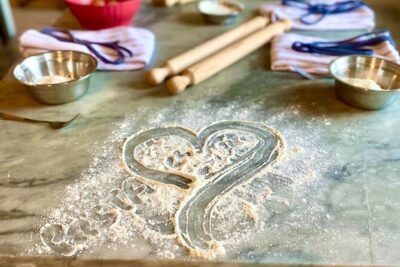
Rome Cooking Class: Make Pasta and 3 Spritz Cocktails
Read our review →
Rome: 3-in-1 Fettuccine, Ravioli, and Tiramisu Cooking Class
Read our review →