
Review · DA NANG
5 traditional dishes Da Nang cooking class with market trip
Da Nang’s best food lesson may begin before you touch a knife. You first walk through Chợ Bắc Mỹ An, a nearby market, to see the produce and buy what you will cook. Then you return to the kitchen for five Central Vietnamese dishes, including Bún Bò Huế, bánh xèo, fresh rolls, jackfruit salad, and avocado ice cream.
I like the market-to-table format, which gives the recipes a real local setting. I also like the friendly, patient teaching style reported from instructors such as Blue, Bora, and Chi, especially for families and first-time cooks. The main consideration is that some preparation may be shared, and larger sessions can feel less personal than a small class.
Key points
- Bắc Mỹ An Market visit: Learn about local ingredients and shop for the class before cooking.
- Five Central Vietnamese dishes: Prepare soup, savory pancakes, fresh rolls, salad, and dessert.
- Hands-on but not fully individual: Some dishes, especially the soup, may be prepared as a group.
- Flexible menu: Vegetarian adjustments are available when arranged with the class.
- Four-hour schedule: Meet 10 minutes early and finish back at the Nguyen Ba Lan Street kitchen.
- Useful take-home extras: You receive a cookbook and certificate after the meal.
Why this Da Nang cooking class works so well
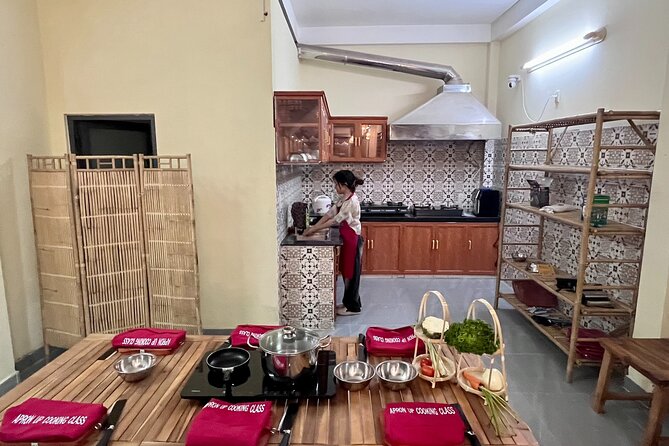
A cooking class can be a pleasant way to fill an afternoon. This one gives you more than a set of recipes because it starts with the ingredients themselves. At Bắc Mỹ An Market, you see the foods in the place where local cooks buy them, then use those same ingredients in class.
That order matters. When you later handle herbs, vegetables, noodles, rice paper, and other ingredients, you have already seen them in their everyday setting. You are not just following a recipe prepared for tourists. You are getting a practical look at how Central Vietnamese food begins.
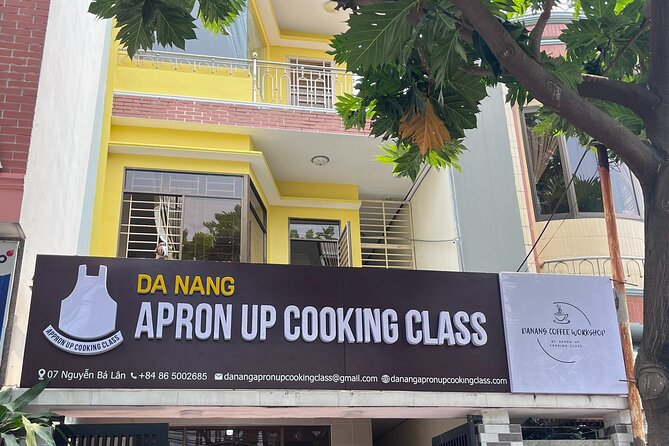
The class is run by Apron Up Cooking Class at 07 Nguyễn Bá Lân Street in the Bắc Mỹ An area of Ngũ Hành Sơn. The session lasts about four hours and ends at the same address. At $39 per person, the price covers the market visit, instruction, cooking tools, the meal, drinks, fruit, a recipe book, and a certificate. That is a fair package for an activity that combines a guided outing with lunch or dinner.
More Market Tour Cooking Classes in Vietnam
- Hanoi Cooking Class: Culture, Local Market & Meaning CSR Impact
★ 5.0 · 5,147 reviews - 5 Traditional Dishes Hanoi Cooking Class with Market Trip
★ 5.0 · 4,890 reviews - Cooking Class Hoi An:Local Market, Basket Boat, Fishing & Cooking
★ 5.0 · 3,660 reviews
Starting at Bắc Mỹ An Market
Plan to arrive 10 minutes before the start time at 07 Nguyễn Bá Lân Street. The market stop is nearby, so the outing does not spend its energy on a long transfer. That keeps the focus on food and leaves plenty of time for cooking.
Bắc Mỹ An Market is the practical heart of the experience. You go there to learn about local produce and help shop for the ingredients needed for the class. The value is not simply seeing stalls. You get context for the dishes, including the raw materials and everyday foods that may be unfamiliar if this is your first visit to Vietnam.
This is also the most visually interesting part of the morning or afternoon. The market gives you useful subjects for photographs, though it is best to stay focused on the guide and the shopping list. You may also find this portion more active than expected, since local markets are working places rather than arranged displays.
The market stop is especially useful if you plan to cook Vietnamese food at home. It gives you a better sense of what ingredients look like before they are trimmed, sliced, mixed, or cooked. The instructor can also explain the role of local products in each dish, which helps you understand the food rather than simply copy steps.
Five dishes from Central Vietnam
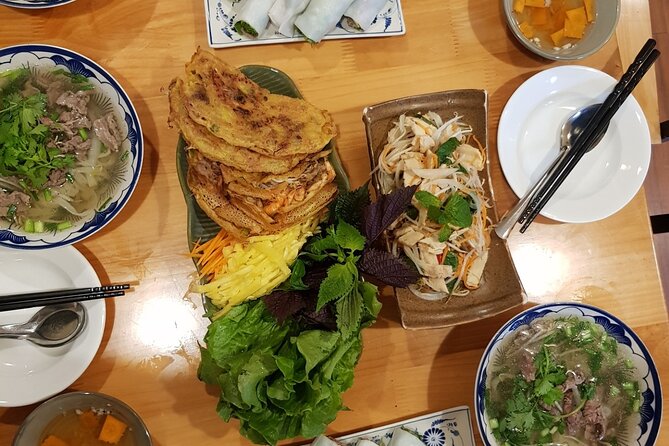
The menu is broad for a four-hour class. You work with five dishes that cover several styles of Vietnamese cooking, from soup and pancakes to rolls, salad, and dessert.
Bún Bò Huế
Bún Bò Huế is the substantial dish on the menu. This Central Vietnamese beef noodle soup brings the class closer to the food culture of Huế and the wider central region. Because soup requires several components, it may be prepared as a shared group recipe rather than as a separate bowl made entirely by each person.
That arrangement has a practical advantage: everyone can learn the overall method without each participant having to manage a full soup station. The tradeoff is that you may not control every stage yourself. If your priority is complete individual preparation, ask how the group will divide the work at the start.
Same place, a different menu:
- Hoi An Cooking Class(Market,BasketBoat Crabfishing&Cooking Class)
★ 5.0 · 3,386 reviews - HCM: Mekong Delta Islands Boat & Tuk-Tuk Tour with Tastings
★ 4.8 · 2,285 reviews - From Hoi An: Market Tour, Basket Boat Ride and Cooking Class
★ 4.8 · 2,208 reviews - Cai Be Mekong Delta Tour: Cooking Class, Cycling & Craft Villages
★ 5.0 · 1,881 reviews
Bánh Xèo
Bánh xèo is the hands-on crowd favorite. This savory Vietnamese pancake is known for its crisp, browned surface, and the class focuses on the technique needed to get that texture right.
The cooking process gives you something concrete to practice: batter, heat, filling, and folding all need to come together. It is also a good dish for families, since the steps are easy to follow once the instructor demonstrates them. The final result is best eaten fresh, so the class lets you enjoy the point of the exercise right away.
Tam Hữu fresh roll
The fresh roll adds a lighter, cooler contrast to the hot soup and pancake. You learn how to work with rice paper and arrange the fillings, then roll the ingredients into a neat package.
Rice paper can be less cooperative than it looks. One of the useful cautions from the class feedback is that rolls can fall apart or taste bland if the filling balance and rolling technique are not right. Pay close attention to how much filling the instructor uses. A smaller roll is often easier to close and easier to eat.
Young jackfruit salad
Young jackfruit salad brings an ingredient that may be new to many visitors. The dish gives you a chance to see how a local vegetable can form the base of a fresh salad rather than a sweet dessert.
It also adds texture and variety to the meal. You are not spending four hours making five versions of noodles or fried food. The menu moves between soft, crisp, fresh, and creamy elements, which is one reason the final meal feels like a proper spread.
Da Nang avocado ice cream
Dessert is Da Nang avocado ice cream, a local-style finish that makes good use of a familiar fruit in a less expected form. It gives the class a sweet ending without relying on a standard Western dessert.
Vegetarians can request a vegetarian version of the menu. The class description says the menu can be adjusted for dietary needs, but you should communicate those needs before the session so the kitchen has time to plan.
What the four-hour schedule feels like
The experience has a clear rhythm. You meet at the kitchen, visit the market, return to cook, then sit down to eat what you made. That simple structure helps the time pass without feeling rushed.
The kitchen provides cooking tools, so you do not need to bring equipment. You can expect the instructor to demonstrate the dishes and guide you through the techniques. Several instructors have been praised for patient explanations and an easy sense of humor, with Blue, Bora, and Chi among the names connected with the class. The specific instructor for your date may vary.
The class suits beginners. You do not need advanced knife skills or prior Vietnamese cooking experience. It also works for families: the instruction has been described as patient with children around age 10 and 13, though younger children may need close adult help around cooking equipment.
The maximum group size is 30 people, which is worth noting. Some sessions may be much smaller, with one reported class of six, but you should not assume that every date will have that size. A small group offers more direct help and more time at the cooking station. A larger class may feel more social but can mean less individual preparation.
Eating what you made
After the cooking, you sit down to eat the meal with fruit, drinks, and conversation with the instructor. Coffee or tea is included, as are lunch and dinner in the general inclusions, depending on the class time.
This shared meal is one of the strongest parts of the experience. You can taste the results while the instructions are still fresh in your mind. It also gives you a chance to ask about daily life in Da Nang and the local food traditions behind the dishes.
The meal may not mean that every person independently prepares every plate. The soup, in particular, can be a group effort. Some participants may also share plating or finishing work. If you want a strictly individual cooking test, this format may feel less exacting. If you want to learn several dishes, eat well, and enjoy a social kitchen, it makes more sense.
The food itself is the main reward. You leave with a full meal rather than a small tasting, and the menu offers a good spread of Central Vietnamese flavors. Fruit and rice vodka are also part of the post-meal gathering, so tell the instructor if you do not want alcohol.
The teaching style and group atmosphere
The instructors are a major part of the experience. Blue has been described as friendly and patient, while Bora and Chi have also been singled out for clear guidance and an upbeat manner. The teaching appears designed for people who want a relaxed introduction, not culinary school discipline.
That does not mean every moment is perfectly controlled. In a larger class, the work can become crowded, and you may have to wait for a turn or share a task. Some people prefer this social style. Others would rather prepare every component alone.
I would choose this class if you enjoy talking with other people and want to meet fellow cooks during your time in Da Nang. I would look for a smaller session if personal attention is your top concern. Since the maximum is 30, it is reasonable to ask about expected group size when booking.
The activity is also a good option for families. The menu is varied enough to keep different ages interested, and the instructors are used to explaining steps in a friendly way. Children should still have adult supervision during cooking.
Is $39 a good value?
At $39, you are paying for several connected experiences rather than only an hour or two at a stove. The price includes the market visit, ingredients, tools, instruction, a full meal, fruit, drinks, a cookbook, and a certificate.
The market visit is what strengthens the value. A cooking class without that stop could still teach you useful skills, but the market adds local context and helps explain what goes into the dishes. You also save the effort of finding ingredients and arranging a separate meal.
The cookbook gives the experience a life after Da Nang. It is described as concise, with the dishes made in class and some additional recipes. You can take it home and try the food again, though you should expect your first attempt to look less polished than the instructor’s.
The price is less compelling if you want a private lesson or a fully individual cooking session. This is a join-in class, and the group format affects how much direct attention you receive. For a social half-day built around local food, though, the cost is sensible.
Practical details before you book
The meeting point is 07 Nguyễn Bá Lân Street, Bắc Mỹ An, Ngũ Hành Sơn, Da Nang. The experience begins and ends there, and you should arrive 10 minutes early.
The ticket is mobile, and confirmation is provided when you book. The location is near public transportation, and service animals are allowed.
Free cancellation applies when you cancel at least 24 hours before the start time. Cancellations or changes made within 24 hours are not refunded or accepted. The class also requires a minimum number of participants, so if the provider cancels for that reason, you are offered another date or experience, or a full refund.
For dietary needs, contact the class ahead of time. The menu can be adjusted, including a vegetarian version, but early notice gives the kitchen a better chance to prepare.
Who should book this class?
I would recommend it to first-time visitors who want a food activity with a local setting. It is also a strong choice if you like learning by doing, want a substantial meal, or plan to recreate Vietnamese dishes at home.
Families should find the format approachable, especially with children who enjoy mixing, rolling, and watching food change as it cooks. Couples and solo visitors can also use it as an easy way to meet people during a Da Nang stay.
I would hesitate only if you want a private chef lesson, a small guaranteed group, or complete individual control over every dish. The group size can reach 30, and some cooking may be shared. For most people, that is a modest tradeoff for the market stop, broad menu, and full meal.
FAQ
Where does the Da Nang cooking class meet?
The class meets at 07 Nguyễn Bá Lân Street, Bắc Mỹ An, Ngũ Hành Sơn, Da Nang 550000, Vietnam.
How long does the experience last?
The experience lasts about four hours.
What market does the class visit?
The class visits Chợ Bắc Mỹ An, a nearby local market where you learn about produce and shop for ingredients.
What dishes are included?
The menu includes Bún Bò Huế, bánh xèo, tam hữu fresh roll, young jackfruit salad, and Da Nang avocado ice cream. A vegetarian version is available for vegetarians.
Does the class include a meal?
Yes. You eat the food prepared during the class. Fruit, rice vodka, and coffee or tea are also included.
Do I need to bring cooking tools?
No. Cooking tools are included.
Is the class suitable for dietary requirements?
The menu can be adjusted to meet dietary requirements, including a vegetarian version. It is best to share your needs before the class.
What is the cancellation policy?
You receive a full refund if you cancel at least 24 hours before the start time. Cancellations or changes made within 24 hours are not refunded or accepted.
Should you book it?
Book this class if you want Da Nang food in context, not just on a plate. The market visit, five-dish menu, patient teaching, and take-home cookbook give the $39 price real value.
Choose another option if you need a private kitchen lesson or guaranteed one-person preparation. Otherwise, this is a practical, friendly way to spend four hours learning Central Vietnamese cooking and eating the results in the same room where you made them.
More Hands-On Workshops in Vietnam
- Hoi An: Basket Boat with Lantern-Making & Cooking Class Tour
★ 4.9 · 1,444 reviews - Hoi An: Basket Boat Ride, Cooking Class by Hangcoconut
★ 4.9 · 802 reviews - Hanoi: Handcrafted Wood Carving Workshop with Local Artisan
★ 5.0 · 733 reviews - Hoi An Eco Tour Cooking Class & Fishing (Local market,basket boat,learn cooking)
★ 5.0 · 567 reviews
More Shopping Trips in Vietnam
- Hoi An Cooking Class(Local market,Basket Boat,Fishing & Cooking)
★ 5.0 · 1,323 reviews - Hoi An: Market Experience with Optional Fishing and Cooking
★ 4.7 · 928 reviews - Small-group Mekong Floating Market Day Trip from Ho Chi Minh City
★ 5.0 · 886 reviews - Vietnamese Food Cooking Class in Hanoi with Market Experience
★ 5.0 · 778 reviews
Just added around Vietnam
- Hoi An/Da Nang: Vegetarian Cooking Class & Basket Boat Ride★ 4.8 · 90 reviews
- Hoi An : Vegetarian Cooking Class W Optional Coconut Village★ 4.9 · 28 reviews
- Hoi An Vegan Cooking School with Local Chef and Basket Boat★ 4.8 · 31 reviews
- Hue City: Cyclo, Market Tour & Cooking Class at Madam Thu★ 5.0 · 48 reviews
- Hue’s Vegetarian Cooking Class in Ancient Garden★ 5.0 · 47 reviews
- Hue Specialty Food Cooking Class★ 5.0 · 89 reviews
- Vietnamese Cooking Class with Local Family in Hue★ 5.0 · 38 reviews
- Hoi An countryside biking – Basket Boat – Vegetable village – Local home Cooking★ 5.0 · 37 reviews
Cooking Classes with a Market Tour, compared.
Hanoi Cooking Class: Culture, Local Market & Meaning CSR Impact
Read our review →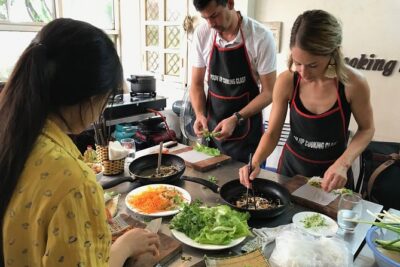
5 Traditional Dishes Hanoi Cooking Class with Market Trip
Read our review →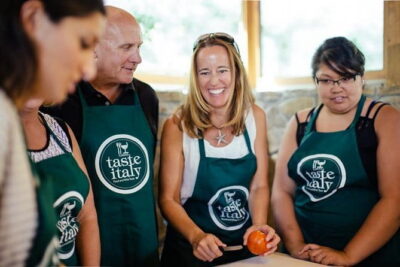
Cooking Class and Lunch at a Tuscan Farmhouse with Local Market Tour from Florence
Read our review →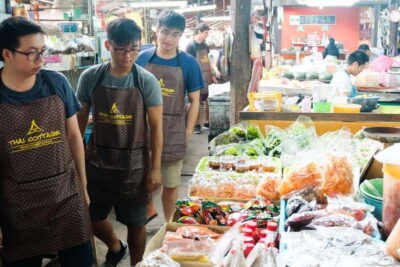
Chiang Mai: Cooking Class, Market & Thai Herbs Garden Tour
Read our review →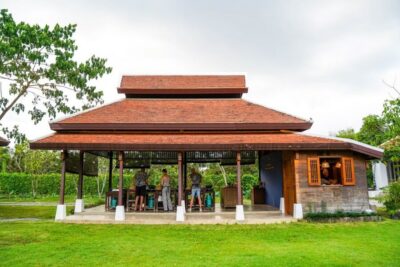
Chiang Mai: Authentic Cooking Class with Market & Farm Visit
Read our review →
Barcelona: Paella Cooking Experience & Boqueria Market Tour
Read our review →
Cooking Class Hoi An:Local Market, Basket Boat, Fishing & Cooking
Read our review →
Hoi An Cooking Class(Market,BasketBoat Crabfishing&Cooking Class)
Read our review →Browse the lists this tour appears in