Review · DA NANG
DaNang Farm-to-Table Cooking Class with Market and Coffee Tasting
Da Nang’s best food lesson starts before anyone turns on a stove. You walk through a small vegetable village, see how herbs are grown, taste Vietnamese coffee, then shop for ingredients at a local market. The final stop is a local home, where you prepare and eat your own lunch.
I like the farm-to-table route, because it explains where Vietnamese cooking begins, not just how to copy a recipe. I also like the small group of no more than 10 people, plus the fact that guides speak English and French. The main thing to consider is the early meeting point and the lack of hotel pickup, so you must arrange your own way to 9 Hàm Tử.
Key points at a glance
- A vegetable village comes first: See local herbs and produce growing before you cook with them.
- The market visit has a practical purpose: You learn how everyday Vietnamese ingredients are selected and used.
- Coffee is part of the food lesson: The Vietnamese coffee tasting gives you a short, flavorful break between stops.
- Lunch is hands-on: You prepare traditional dishes step by step, then eat what you made.
- The group stays small: A maximum of 10 people leaves more room for questions and help at the stove.
- The $60 price covers the essentials: Ingredients, equipment, refreshments, transport during the experience, and your meal are included.
Why this Da Nang cooking class feels different
Many cooking classes begin with a chopping board and end with a plate of food. This one gives you the shopping trip first. That matters in Vietnam, where herbs, leafy greens, noodles, fish sauce, and fresh produce are central to the way meals are planned.
You start with a short walk to a nearby vegetable village. This is not a grand farm visit or a long rural outing. It is a look at how produce is grown close to the city, with attention to the herbs and leaves used in Vietnamese kitchens.
I like this opening because it gives you useful context without adding a long transfer. You can see that the fresh flavors in Vietnamese food come from simple ingredients handled well. The garden also makes the cooking class easier to follow later, since you have already seen some of the produce in its growing place.
After the garden, Vietnamese coffee provides a natural pause. Coffee in Vietnam is often strong, sweet, and prepared in a way that feels quite different from a standard café drink. This tasting is brief, but it adds another piece to the country’s food culture instead of treating the cooking class as a stand-alone activity.
More Farm Cooking Classes in Vietnam
- Cooking Cycling and Pure Water Experience in Danang Rural Village
★ 5.0 · 6 reviews - Mekong Day Trip Explore Village Bicycle CookingClass Group 12 Pax
★ 5.0 · 705 reviews - Cocolocal Farm Cooking Class with market tour and basket boat
★ 5.0 · 231 reviews
Walking through the vegetable village
The garden visit is one of the most useful parts of the morning for anyone who wants more than a recipe card. You learn about local farming life and see fresh herbs and vegetables being grown in a city setting.
The exact plants can vary, but the focus is on ingredients used in daily Vietnamese cooking. That means the stop connects directly to what comes later. When you handle the ingredients during class, you have already seen their role in local meals.
The walk is short, which helps keep the four-and-a-half-hour schedule comfortable. Still, wear shoes suited to a walk and bring protection from the sun. The tour description does not promise a long farm tour, so you should see this stop as an introduction to local growing methods rather than a full agricultural excursion.
A family connected with the garden may also be part of the visit. That adds a personal touch, though the depth of that interaction can depend on the day and the group. The class is at its best when you ask questions, especially since the guide can speak English and French.
Vietnamese coffee before the market
The coffee tasting gives you a chance to slow down before the next stop. It also shows how food and drink fit together in Vietnamese daily life. You are not simply passing through a market to collect ingredients. You are learning how a local meal is surrounded by small rituals and shared tastes.
The experience includes refreshments, and the coffee tasting is specifically included. That is useful on a morning with walking and several activities. If you do not drink coffee, the stop may have less appeal, but it remains a short part of the overall program rather than the main reason to book.
Shopping at a local Da Nang market
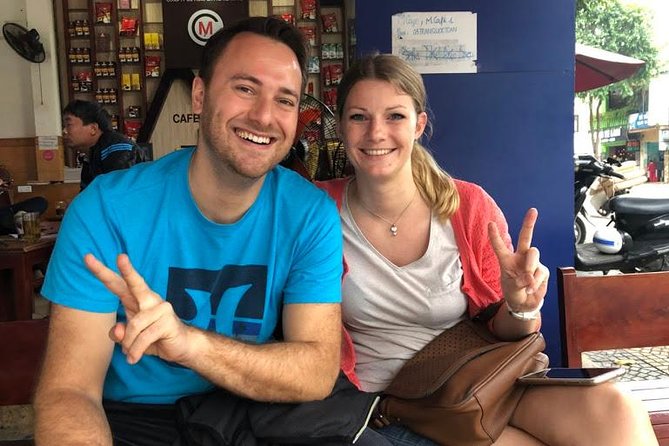
The market visit is where the farm-to-table idea becomes practical. You learn how to look for the ingredients used in ordinary Vietnamese cooking and how a local shopper might build a meal from fresh produce.
One class description names Han Market as a stop, and the experience is presented as a visit to a local market. The exact market arrangement can depend on the operating schedule, but you should expect a real food market rather than a polished cooking-school display.
Markets can feel crowded and noisy, and this is one place where the pace may not suit everyone. On the other hand, the sounds, smells, and close look at everyday ingredients are part of the lesson. You get a better sense of Vietnamese food by seeing the raw materials in their normal setting.
Your guide helps explain what you are looking at and answers questions in English or French. The value is not only in identifying ingredients. You also begin to understand why Vietnamese meals balance fresh herbs, savory sauces, crisp textures, and cooked elements.
Do not expect an independent shopping trip with unlimited time. The group needs to stay together, and the market visit is one part of a fixed four-and-a-half-hour experience. If you have a specific ingredient you want to ask about, bring the question with you.
More Market Tour Cooking Classes in Vietnam
- 5 Dishes Cooking Class with Market Trip in Da Nang
★ 5.0 · 466 reviews - 5 traditional dishes Da Nang cooking class with market trip
★ 5.0 · 331 reviews - Da Nang Cooking Class with Coffee Tasting and Market Visit
★ 5.0 · 310 reviews - Market Tour, Basket Boat Ride & Cooking Class by Hangcoconut
★ 4.8 · 95 reviews
Cooking lunch in a local home
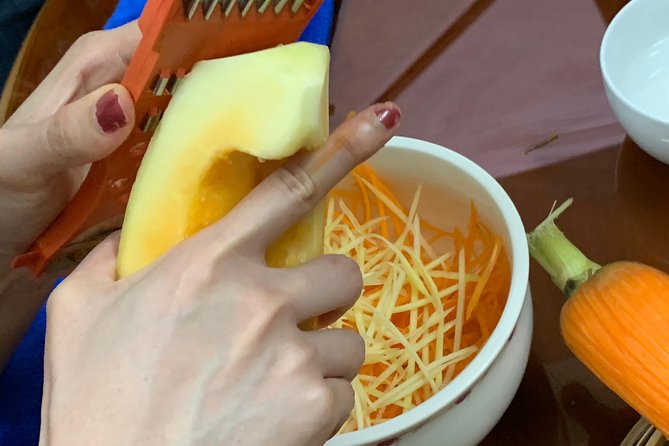
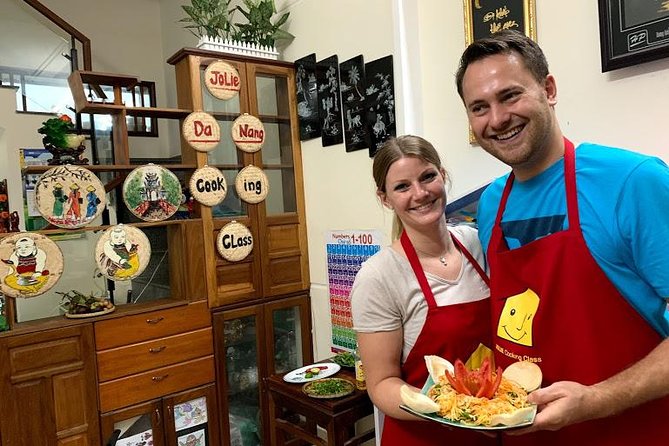
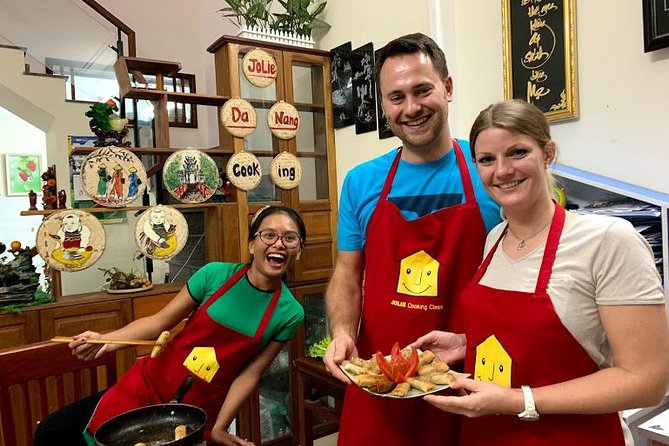
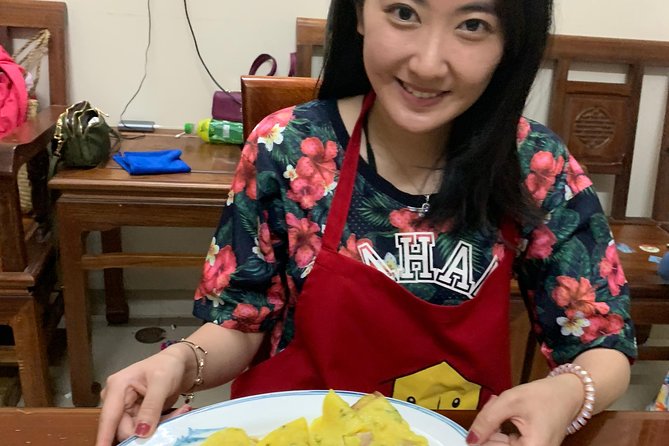
The final stop is a welcoming local home, where the class shifts from seeing and tasting to doing. You prepare traditional Vietnamese dishes step by step, with the ingredients and cooking equipment supplied.
That arrangement makes the lesson approachable. You do not need to shop, bring utensils, or worry about finding unusual ingredients in Da Nang. You can focus on the preparation, ask questions, and watch how the dishes come together.
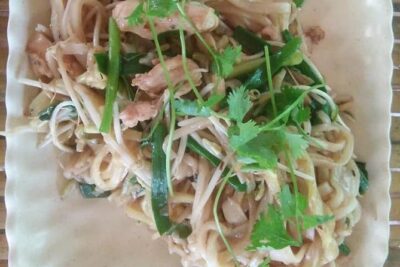
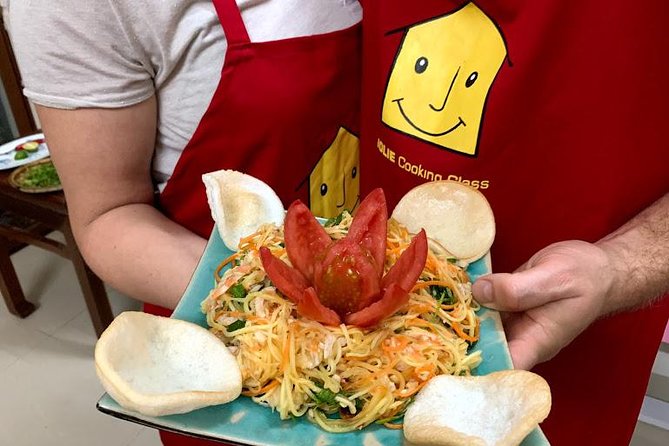
The menu can vary. The class material and participant comments refer to dishes such as pho bo, green papaya salad, pancake rolls, and aubergine hot pot. Those examples give you a sense of the range, but you should not assume every dish will appear in every session.
The food itself reflects the qualities that make Vietnamese cooking so appealing: light use of fat, strong flavor, fresh herbs, and contrasting textures. The class is not only about following instructions. It helps you see how a Vietnamese meal is assembled and why each component is used.
Hana, Hannah, and Blue are names connected with the instruction team. One of the strongest qualities associated with the class is its lively, attentive teaching style. If one of these instructors is leading your session, you can ask about the dishes, the ingredients, and ways to repeat the meal at home.
The cooking classroom is described as clean and well organized. That matters in a hands-on class, especially when several people are preparing food at once. A maximum of 10 participants should also make it easier to see demonstrations and get help when you need it.
Eating what you prepare
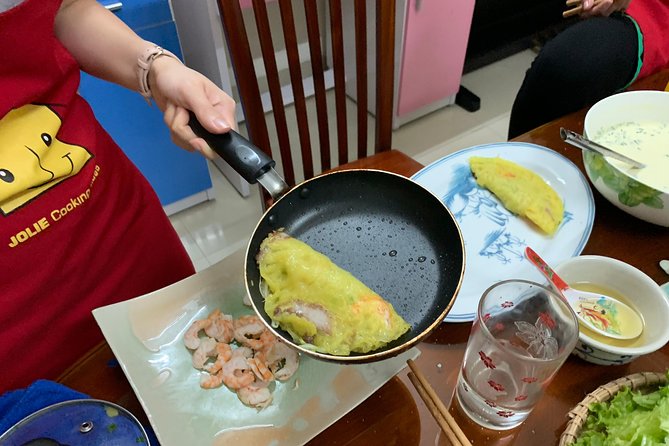
You sit down for the meal after the cooking is finished. This family-style ending is more satisfying than receiving a plate prepared entirely by someone else. You understand the work behind the food, and you can judge the flavors while the techniques are still fresh in your mind.
The meal is included in the price, along with all ingredients and equipment. You may still want to budget for personal expenses, since those are not covered. The tour does not list alcohol or extra purchases as part of the package.
This is also the part of the class that makes the experience useful after your return home. You leave with more than a pleasant lunch. You have seen the ingredients at the market, handled them in the kitchen, and tasted the result.
What $60 gets you
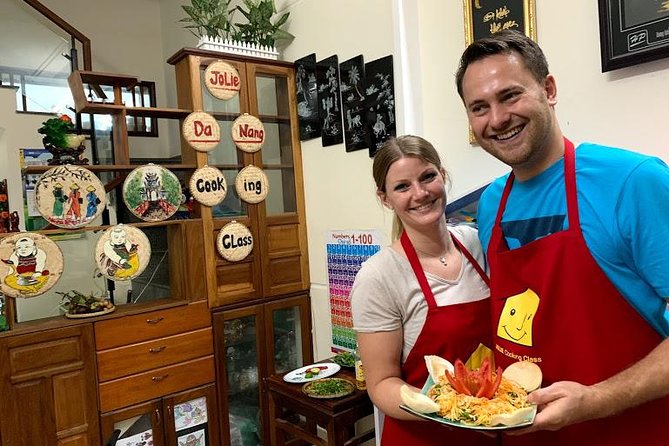
At $60 per person, this is not the cheapest way to eat lunch in Da Nang. It is also more than a simple market tour or short cooking demonstration. The price includes a garden visit, market visit, coffee tasting, cooking instruction, ingredients, equipment, transport during the experience, refreshments, and the meal you prepare.
That package gives the price reasonable value if you want several connected activities in one morning. You would pay separately for food, a guided market visit, and a class in many destinations. Here, those elements form one lesson.
The value is strongest for people who want to cook Vietnamese food at home. If you only want a quick lunch or a short market walk, the price may feel high. If you want a social activity with practical instruction, it is easier to justify.
The class is often reserved about 32 days ahead on average. That suggests you should not wait until the last minute if your dates are fixed, especially if you want a particular morning during a busy visit to Da Nang.
Timing, meeting point, and group size
The activity lasts about four hours and 30 minutes. It begins at 9 Hàm Tử, Bắc Mỹ Phú, Ngũ Hành Sơn, Da Nang 550000, and ends back at the same meeting point.
Hotel pickup and drop-off are not included. This is the most important logistical drawback. Plan your route to the meeting point before booking, and allow enough time to arrive without rushing. Transport during the experience is included, so the missing hotel transfer applies to the start and end of the activity.
The meeting point is near public transportation. You receive confirmation when you book, and a mobile ticket is available. The class has a maximum of 10 people, which keeps it more personal than a large demonstration.
The schedule includes walking, market time, and cooking. Comfortable clothing and shoes are sensible choices. The supplied information does not list special accessibility arrangements, so you should ask the provider directly if you need specific assistance.
Free cancellation is available up to 24 hours before the start time. Cancellations or changes made less than 24 hours ahead are not refunded or accepted. The class also requires a minimum number of participants, and if that minimum is not met, you are offered another date or experience, or a full refund.
Who should book it
I would choose this class if you want food to explain part of your time in Da Nang. It suits couples, families, solo visitors, and small groups who enjoy cooking and do not mind taking an active role.
It is especially useful for you if you like to ask questions. The English and French support means you can learn more than a list of dish names, and the small group gives you a better chance to get answers.
Families should find the mix of garden, market, and cooking more varied than a single kitchen lesson. Children would still need to manage the walking, market setting, and kitchen work, and the information provided does not set a minimum age.
You may want to skip it if you dislike markets, prefer a quiet restaurant meal, or have very limited time in Da Nang. The activity takes most of a morning, and the meeting point is your responsibility.
Should you book this Da Nang cooking class?
Book it if you want a practical introduction to Vietnamese food rather than a meal you simply watch someone else prepare. The garden and market give the cooking real context, while the local-home setting and small group keep the experience personal.
The main cautions are simple: no hotel pickup, a fixed morning schedule, and a menu that can change. For $60, the combination of transport during the class, coffee, ingredients, equipment, instruction, and lunch makes sense for anyone who plans to use the cooking skills again.
If you arrive in Da Nang eager to understand how fresh herbs, market ingredients, and home cooking fit together, this is a strong choice. If you only want to sample food with no hands-on work, spend the money on a meal instead.
FAQ
Where does the cooking class start and finish?
It starts at 9 Hàm Tử, Bắc Mỹ Phú, Ngũ Hành Sơn, Da Nang 550000, Vietnam. The activity ends back at the same meeting point.
How long does the experience last?
The experience lasts approximately four hours and 30 minutes.
Is hotel pickup included?
No. Hotel pickup and drop-off are not included. Transportation during the experience is included.
What activities are included?
You visit a vegetable village and local market, taste Vietnamese coffee, take part in a hands-on cooking class, and eat the meal you prepare.
How many people can join the class?
The activity has a maximum of 10 participants.
Are ingredients and cooking equipment provided?
Yes. All ingredients and equipment needed for the class are included.
Can I cancel for a full refund?
Yes. You can cancel at least 24 hours before the start time for a full refund. Cancellations made less than 24 hours before the start time are not refunded.
More Farm Cooking Classes in Da Nang
- Half-Day Thai Cooking Class at Organic Farm in Chiang Mai
★ 5.0 · 19,087 reviews - Cooking Class and Lunch at a Tuscan Farmhouse with Local Market Tour from Florence
★ 5.0 · 4,831 reviews - Chiang Mai: Authentic Cooking Class with Market & Farm Visit
★ 4.9 · 4,546 reviews - Ubud: Balinese Cooking Class at an Organic Farm
★ 5.0 · 1,786 reviews
More Market Tour Cooking Classes in Da Nang
- Home Cooking Class: Market, Garden and cooking 4 dishes
★ 5.0 · 61 reviews - Cook 5 Dishes Authentic Vietnam Food and Market Adventure
★ 5.0 · 56 reviews - Da Nang Cooking: Market tour, farming, and cooking class
★ 4.8 · 13 reviews - Hanoi Cooking Class: Culture, Local Market & Meaning CSR Impact
★ 5.0 · 5,147 reviews
Just added around Da Nang
- 3-hour Traditional Vietnamese Home-Cooking Class in Da Nang★ 5.0 · 10 reviews
- Cooking Class and Tasting Pho in Da Nang with Local Chef★ 5.0 · 8 reviews
- RICE PAPER Noodle Making Experience & Hoi An Cooking Class Class★ 5.0 · 164 reviews
- Happy Cooking Class in Danang★ 4.5 · 20 reviews
- Eco Cooking Class and Basket boat tour from Da Nang/ Hoi An★ 5.0 · 4 reviews
- Coffee Making and Cooking Class★ 5.0 · 12 reviews
- Da Nang Coffee Making and Vietnamese Home Cooking Class★ 5.0 · 7 reviews
- Cook 5 Dishes Authentic Vietnam Food and Market Adventure★ 5.0 · 56 reviews
Cooking Classes with a Market Tour, compared.
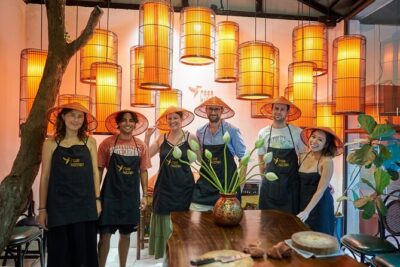
Hanoi Cooking Class: Culture, Local Market & Meaning CSR Impact
Read our review →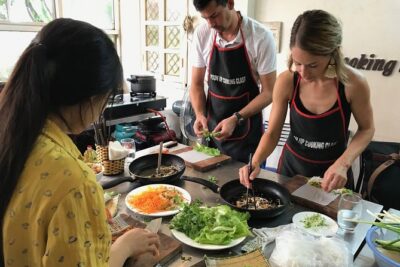
5 Traditional Dishes Hanoi Cooking Class with Market Trip
Read our review →
Cooking Class and Lunch at a Tuscan Farmhouse with Local Market Tour from Florence
Read our review →
Chiang Mai: Cooking Class, Market & Thai Herbs Garden Tour
Read our review →
Chiang Mai: Authentic Cooking Class with Market & Farm Visit
Read our review →
Barcelona: Paella Cooking Experience & Boqueria Market Tour
Read our review →
Cooking Class Hoi An:Local Market, Basket Boat, Fishing & Cooking
Read our review →