
Review · UBUD
Balinese Authentic Cooking Class in Ubud
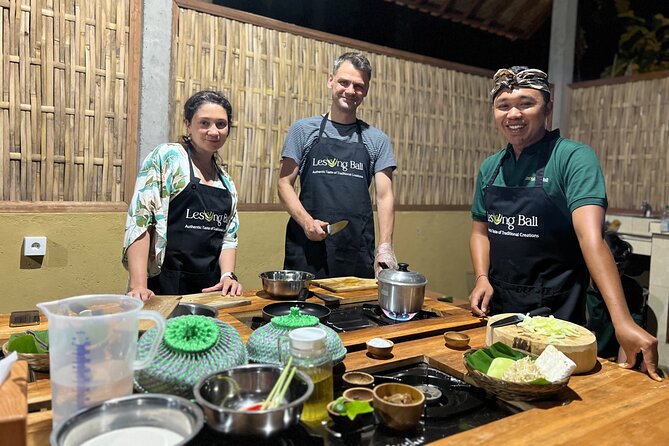
The best part of this Ubud cooking class comes before the cooking. You visit a local market, see a traditional Balinese family compound, and walk through a farm to gather ingredients. Putri, Ron, Don, and other local instructors lead the hands-on work, depending on the session.
I like the small-group format, which gives you real time at the chopping board instead of watching a chef work from across the room. I also like the choice of regular, vegetarian, or vegan menus, plus the chance to grind spices in a large lesung, the traditional mortar and pestle. The main consideration is that the morning market visit is only offered with the morning class, and one past participant found parts of the lesson a little rushed.
Key points at a glance
- A morning market visit: The early class includes a walk through a traditional market to see and buy spices, plus chances to try local fruit.
- A real look at Balinese home life: You visit a family compound and learn how its buildings and shared spaces are arranged.
- Farm-to-table cooking: You tour the garden and harvest some of the herbs and spices used in your meal.
- Six-course potential: Several sessions prepare six dishes, including dessert, though the exact menu depends on your chosen option.
- Menus for different diets: Regular, vegetarian, and vegan choices are available.
- Ubud pickup included: Transport is free within the Ubud area, while pickup from other parts of Bali costs extra.
A cooking class that begins with Balinese daily life
This is not simply a lesson in how to prepare nasi, vegetables, or spice paste. The class uses food as a way to explain daily life in Bali. You start with the ingredients, then see the home and garden where local traditions make more sense.
The experience lasts about five hours and takes place on the west side of Ubud, in a countryside setting surrounded by green space. That location matters. You leave central Ubud’s traffic behind and spend the cooking portion in a quieter garden setting with a separate cooking area.
The group can reach 15 people, but many sessions are smaller. A group of four has enough room for a friendly, personal class, and one solo participant ended up with a private market tour and cooking session when nobody else chose the early start. You should not assume a private lesson, but the small-group design gives you a good chance to receive direct help.
The price is $39.71 per person. For roughly five hours, that includes transportation within Ubud, the market and home visits, farm access, instruction, ingredients, tea or coffee, mineral water, a Balinese cake, and your cooked meal. I consider that fair value, especially because the class combines a food lesson with several cultural stops rather than charging separately for each part.
More Balinese Cooking Classes in Ubud:
- Ubud Cooking Class Bali with Balinese Chef
★ 5.0 · 1,609 reviews - PRIVATE Authentic Balinese Cooking Class in Ubud at Putu’s Home
★ 5.0 · 644 reviews - Balinese Ubud cooking school (9 Dish Cooking and Market Tour)
★ 5.0 · 540 reviews
The morning market makes the early start worthwhile
Choose the morning class if you want the fullest program. It is the only option that includes a visit to a traditional market, where you see the spices and produce used in Balinese kitchens and buy some ingredients with the guide.
This is useful even if you already know your turmeric from your ginger. A market shows how food fits into ordinary life, and the guide can explain unfamiliar fruits, vegetables, and seasonings as you walk. Some sessions include samples of local fruit, which makes the stop more than a quick photo opportunity.
The market also gives you a better sense of how Balinese spice mixtures begin. You see the raw ingredients before they are cleaned, chopped, and pounded into the pastes that give the finished dishes their flavor.
There is a practical tradeoff. The morning class requires an earlier start, and the market is not part of the afternoon or evening versions. If the market matters to you, confirm that you are booking the morning option rather than choosing a later time for convenience.
A traditional house puts the food in context
After the market, the program visits a traditional Balinese home. You learn about the family compound, the arrangement of its buildings, and everyday Balinese life. Depending on the host and the day, you may spend time with tea, coffee, fruit, steamed banana pudding, or other local snacks before cooking begins.
This stop is one of the strongest parts of the experience because it gives you cultural context without turning the class into a formal lecture. You see how the home is organized and hear about family life, ceremonies, and local customs from people who live within that tradition.
The exact level of access can vary. One participant saw the grounds and garden but did not go inside the main house, while other sessions included a warmer family welcome and more conversation. I would treat this as a visit to a working home and cultural setting, not a guaranteed room-by-room tour.
Take your time here. The pace is generally relaxed, and the coffee and snacks give you a chance to ask questions before the kitchen work starts. If you are interested in Balinese architecture or family structure, this part may be as valuable as the recipes.
The farm supplies more than a pleasant setting
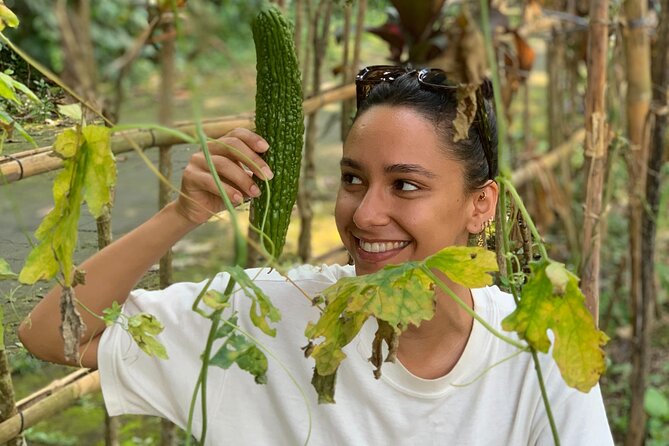
At the farm, you help decide or confirm the menu, then walk through the garden to see and harvest some of the herbs and spices used in the dishes. This small step changes the way you understand the food. Instead of treating spices as anonymous ingredients in little bowls, you can connect them to the plants growing around you.
The garden also gives you a break between the cultural visit and the cooking lesson. The grounds are described as clean, attractive, and relaxing, with the cooking area set apart from the garden. You should still expect a working farm setting rather than a polished restaurant kitchen.
The farm visit is especially helpful for cooks who want to repeat the recipes at home. You learn which ingredients matter to the flavor and which steps depend on fresh spice paste. The class does not just hand you a finished plate. It shows you the starting point.
More Hands-On Workshops in Ubud:
- Ubud: Cooking Class with Transfers and Optional Market Visit
★ 4.9 · 824 reviews - Ubud: Balinese Cooking Class and Market Tour
★ 4.8 · 531 reviews - Balinese Farm Cooking Class by Pemulan Bali
★ 5.0 · 410 reviews - PRIVATE Balinese Cooking Class in Ubud with Dewa with Transfers
★ 5.0 · 213 reviews
Grinding spices the Balinese way
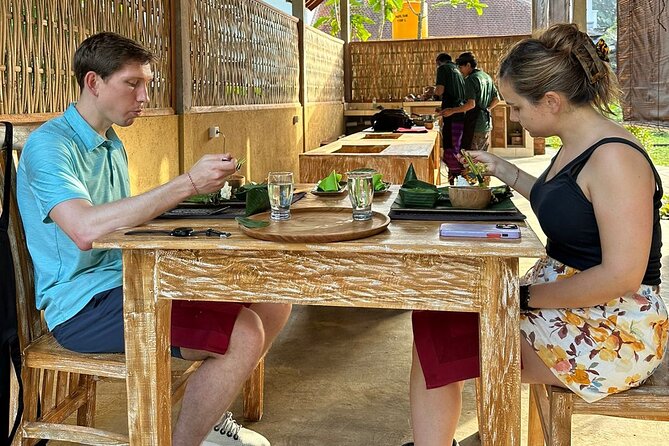
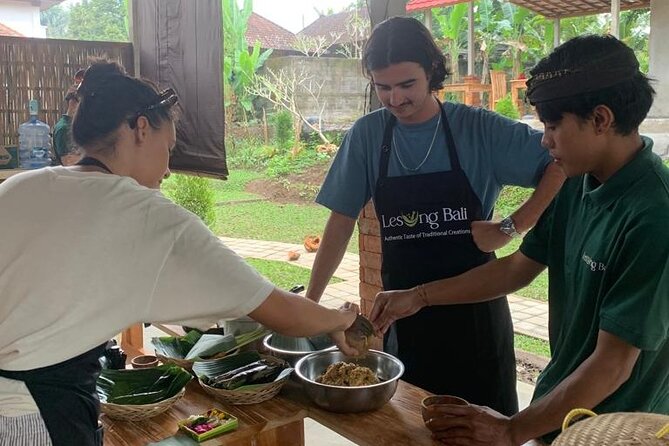
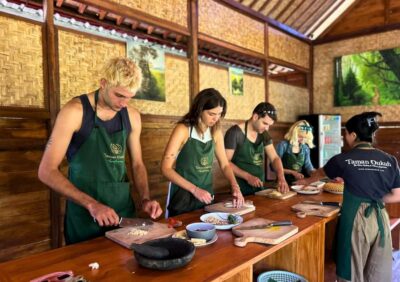
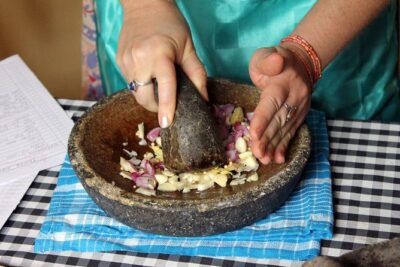
The cooking lesson is hands-on. You chop ingredients, prepare spice mixtures, and use a lesung, a large mortar and pestle, to pound the ingredients in the traditional style.
Your instructor explains how much of each ingredient to use, how to handle the spice mixture, and how the cooking method changes with the selected menu. The format suits beginners. You do not need strong kitchen skills to take part, and the instructors offer help as you work.
Several sessions prepare six dishes, including dessert. The regular menu may include meat, while vegetarian and vegan options are available. The exact recipes are not specified in advance, so check the menu choice when booking if you have a particular dish in mind.
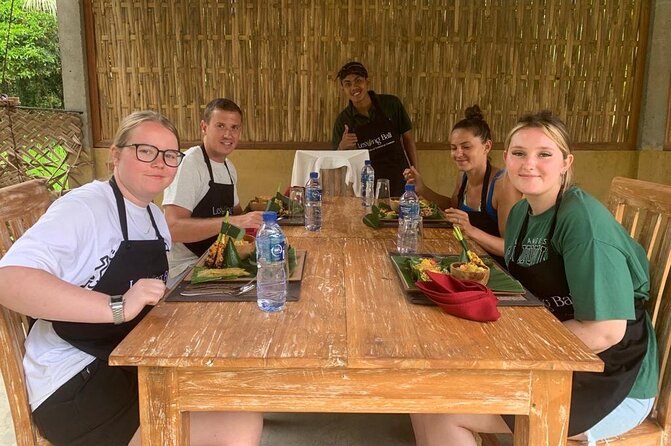
The best feature is that you are not limited to one small task. You can prepare several components and then eat the food you helped make. That gives the lesson a clear payoff, and it is why I recommend arriving hungry. Participants have found there was more food than they could finish.
The instruction style depends somewhat on the chef. Putri is described as patient and careful in her explanations. Ron brings humor and a relaxed style, while Don has been praised for explaining Balinese houses, family life, and cooking traditions together. Other instructors, including Gustie and Begul, have also led sessions.
One useful note from a past class is that an instructor occasionally added small spices without explaining them first. If you want to understand every step, speak up and ask before the ingredient goes into your bowl. The class is designed to be practical, but you may need to prompt the chef when the pace picks up.
Choosing morning, afternoon, or evening
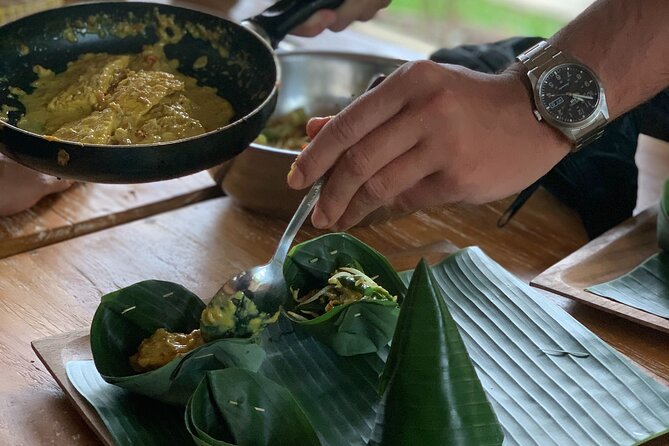
Each time slot has a different feel.
The morning class offers the most complete cultural program because it includes the market. It is the best choice if you want to see ingredients in their everyday setting and do not mind an early start.
The afternoon class works well if you want a slower morning in Ubud. You still get the home visit, farm tour, and cooking lesson, but not the market stop.
The evening class turns the cooking session into dinner. It is a sensible choice if your daytime schedule is full, and the class still includes hands-on preparation and a shared meal. One evening session prepared six traditional dishes with clear pickup communication.
The five-hour estimate includes more than time at the stove. Transfers, conversation at the home, the farm walk, and the meal all form part of the experience. If you want a quick two-hour lesson, this is longer than necessary. If you want food and culture in one outing, the length feels justified.
What the transportation arrangement means
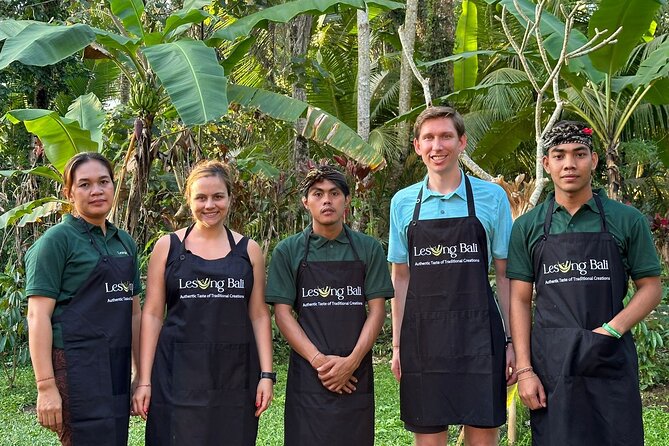
Free pickup and drop-off are offered within the Ubud area. An air-conditioned vehicle and mineral water are included, which is useful in Bali’s heat and makes the start of the day simple.
Transport from other areas is not included. The listed extra car charges are IDR 450,000 from Kuta, Seminyak, Sanur, or Canggu; IDR 500,000 from Nusa Dua or Jimbaran; and IDR 550,000 from Uluwatu. These are vehicle charges, not per-person prices, but you should confirm the amount and pickup details before booking.
If you are staying outside Ubud, compare the added transport cost with booking a cooking class closer to your hotel. For someone based in Ubud, the included shuttle improves the value considerably.
Pickup communication has been clear and on time in several sessions. Still, give the operator your exact hotel details and watch for confirmation, particularly if your accommodation is at a farm stay or outside the main town area.
Who will enjoy this most
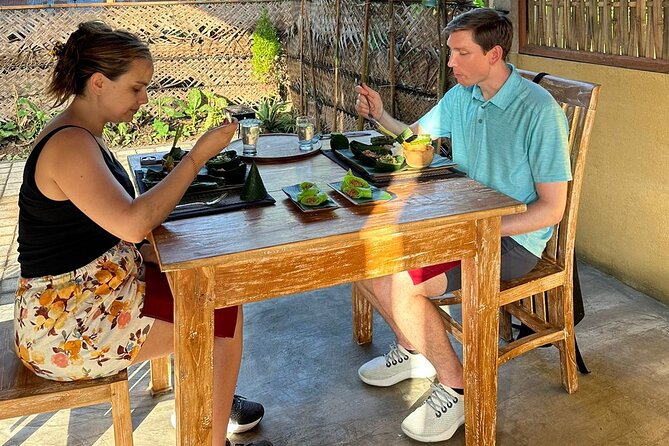
This class suits you if you want more than a restaurant meal and enjoy learning by doing. Beginners are welcome, and the instructors provide help with chopping, pounding, and cooking. You do not need to arrive with kitchen experience.
It is also a strong choice for solo visitors. The small group creates an easy social setting, and a solo booking may become especially personal if few people select the same time.
Families and couples should enjoy it too, provided everyone is happy to spend several hours moving between a market, home, garden, and cooking space. The food option can be adjusted for vegetarian and vegan diets, which makes it easier for mixed groups to participate together.
You may want another activity if you dislike group instruction, cannot stand strong spices, or want a tightly timed professional kitchen workshop. The visit includes conversation and cultural explanation, so its value depends partly on your interest in Balinese life.
Booking details and practical advice
The activity accepts mobile tickets, and confirmation is provided when you book. The maximum group size is 15 people, though the class may be much smaller.
Wear clothes that can handle a little food splatter and comfortable footwear for the market and farm portions. The supplied information does not state a dress code, but you will be more comfortable in practical clothing than in anything formal.
Tell the operator about your dietary choice when booking or before the class begins. Regular, vegetarian, and vegan menus are available, but the menu itself may vary by session.
Bring an appetite. Tea, coffee, water, a Balinese cake, and the cooked meal are included, and the amount of food can be substantial. You may also want to keep a small notebook or use your phone to record spice combinations, since the class focuses on techniques you can repeat at home.
Cancellation is free up to 24 hours before the start time. Within 24 hours, changes and cancellations are not accepted for a refund. The class also depends on suitable weather and a minimum number of participants. If the operator cancels for either reason, you are offered another date or experience, or a full refund.
Should you book the Lesung Bali class?
I would book this if you want a hands-on Balinese food lesson tied to local life, not just a cooking demonstration. The combination of market, family compound, farm, spice pounding, and shared meal gives you a fuller picture of where the food comes from.
The morning option is the best value for the complete program. Choose afternoon or evening if the market is less important or your schedule is tight. At $39.71, the class is reasonably priced for about five hours with Ubud transfers and food included.
The only real caution is that the experience can vary slightly with the instructor and group. Some sessions move quickly, and the home visit may be limited to the grounds. Ask questions during the cooking and confirm your menu choice. If those small limitations are acceptable, this is a very good pick for your Ubud plans, especially for first-time cooks, solo visitors, and anyone who wants to take home more than a restaurant memory.
FAQ
How long does the Balinese cooking class last?
The experience lasts approximately five hours, including the cultural visits, farm tour, cooking lesson, and meal.
Where does the cooking class take place?
The class is on the west side of Ubud, in a countryside setting surrounded by green space.
Is hotel pickup included?
Free shuttle service is included within the Ubud area. Pickup and drop-off outside Ubud are not included.
Is pickup available from Kuta or Seminyak?
Pickup from Kuta, Seminyak, Sanur, or Canggu requires an extra transportation charge of IDR 450,000 per car.
Is the morning market visit included with every class?
No. The traditional market visit is offered with the morning class only.
Can I choose a vegetarian or vegan menu?
Yes. Regular, vegetarian, and vegan menu options are available.
How many people can join the class?
The maximum group size is 15 people. The class is designed as a small-group experience.
What is included in the price?
The price includes coffee or tea, mineral water, an air-conditioned vehicle, taxes and fees, a Balinese cake, Ubud-area shuttle service, the cooking instruction, ingredients, and the meal you prepare.
Do I need cooking experience?
No. The class is suitable for beginners, and the instructor provides help with chopping, pounding spices, and cooking.
Can I cancel for a full refund?
Yes, if you cancel at least 24 hours before the experience start time. Cancellations or changes made less than 24 hours before the start time are not refunded.
Just added around Ubud
- The Authentic Balinese Cooking Experience★ 5.0 · 4 reviews
- Ubud: Organic Farm Harvest, Bali Cooking Class by Pemulan★ 4.8 · 12 reviews
- packages cooking class and romantic dinner in a local home★ 5.0 · 4 reviews
- Jambangan bali cooking class with morning market tour★ 5.0 · 35 reviews
- Balinese cooking class/Go shopping at the market, cook, eat★ 5.0 · 12 reviews
- Ubud: Balinese Cooking Class with Hotel Transfers★ 4.8 · 17 reviews
- Balinese Cooking class with traditional morning market visit★ 5.0 · 161 reviews
- Balinese Cooking Class at Organic Farm★ 5.0 · 51 reviews
Balinese & Indonesian Cooking Classes, compared.
Ubud: Balinese Cooking Class at an Organic Farm
Read our review →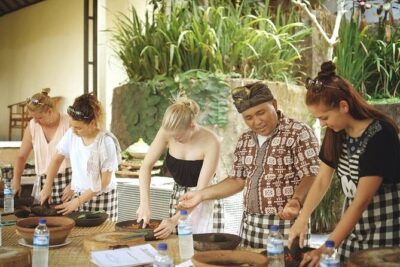
PRIVATE Authentic Balinese Cooking Class in Ubud at Putu’s Home
Read our review →
Balinese Ubud cooking school (9 Dish Cooking and Market Tour)
Read our review →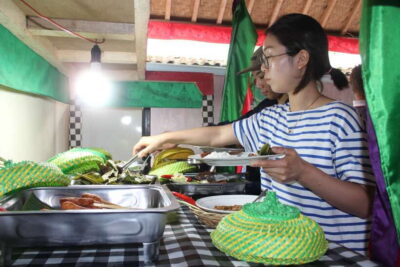
Learn to cook Indonesian food at Gili Cooking Classes Trawangan
Read our review →Browse the lists this tour appears in