Review · UBUD
Balinese Ubud cooking school (9 Dish Cooking and Market Tour)
The best part of this Ubud cooking class is its generous menu: you prepare nine Balinese dishes, not just one curry and a few garnishes. The morning option adds a market visit, rice paddies, and a look at local ingredients before you cook in a Balinese home setting.
I like the chance to taste unfamiliar fruits, cakes, spices, and vegetables at the market. I also like that you get recipe copies, a full meal, and enough food to share or pack away. The main drawback is the drive to the cooking school, which can take about 50 minutes from central Ubud, and the class may feel less hands-on because some preparation is done ahead of time.
Key points to know before booking
- Nine recipes in one class: Prepare soup, satay, chicken or tofu dishes, vegetable lawar, sambal matah, spice paste, tempe, and klepon.
- Morning means market and rice paddies: The traditional market visit is available only with the morning class.
- Friendly named instructors: Yogi, Gus, Putu, Tata, and Wayan are among the hosts and guides praised for clear teaching and good humor.
- Choose your menu carefully: Select regular or vegetarian food when booking, since the two menus use different main ingredients.
- Small group size: The class has a maximum of 14 people, with cooking stations arranged so couples or small groups can work together.
- Come hungry: You taste food at the market, cook a large meal, and eat lunch or dinner afterward.
Why nine dishes changes the value
At $58, this is not the cheapest cooking lesson in Bali. It is still a fair price if you want more than a short demonstration. The fee covers transport within Ubud, a guide, market and rice-paddy visits on the morning program, kitchen equipment, bottled water, recipes, food tasting, and the meal you prepare.
The menu is the main reason to consider it. You are not spending five hours on one signature dish. You work through a set of recipes that shows how Balinese meals are built: a soup, several protein or tofu dishes, a vegetable preparation, fresh sambal, a basic spice paste, a sweet snack, and rice.
The value also depends on how much you enjoy eating your way through a large meal. This is a generous spread, and several people have been unable to finish everything. You can ask to take leftovers back to your hotel, although that depends on the class staff and available packaging.
The price shown here is $58. Some older comments refer to a lower price, so check the amount at booking rather than relying on past figures. Even at the current price, I would compare it with the cost of a restaurant meal, a market outing, and private transport. If you want a serious introduction to Balinese home cooking, the package earns its keep. If you only want to learn two or three dishes, it may be more than you need.
More Market Tour Cooking Classes in Indonesia
- Ubud: Cooking Class with Transfers and Optional Market Visit
★ 4.9 · 824 reviews - Ubud: Balinese Cooking Class and Market Tour
★ 4.8 · 531 reviews - Balinese Cooking class with traditional morning market visit
★ 5.0 · 161 reviews
Starting at Ubud Palace
The listed meeting point is Ubud Palace on Jalan Raya Ubud. The activity ends back at the same meeting point. Pickup and drop-off are included within the Ubud area, but you should confirm the arrangement if you are staying outside town.
The meeting point matters because the cooking school is not right in central Ubud. The drive takes you away from the main streets and into a more rural part of the area. Several people have enjoyed that change of setting, but one serious complaint involved an unexpected drive of around 50 minutes after meeting in central Ubud.
My practical advice is simple: ask before the day begins how long the transfer will take and where the school is located. If you are staying outside Ubud, extra transport charges apply. Bring cash for those charges, and do not assume hotel pickup is included unless it has been arranged.
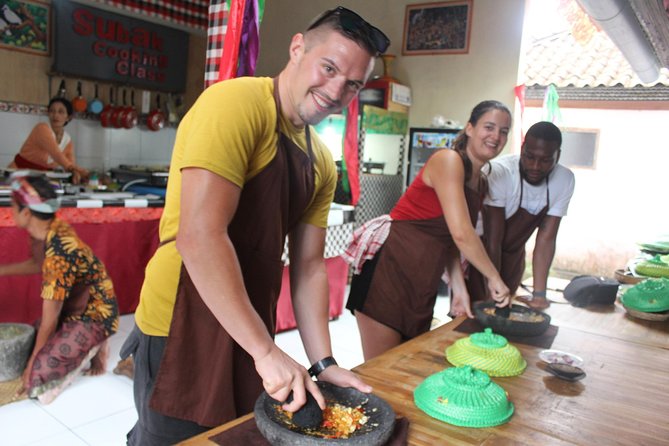
The group limit is 14 people. That is small enough to keep the class social without making it a private lesson. Some sessions place couples at their own burners around one large worktable. This arrangement lets you cook with your partner while still sharing the meal and jokes with the rest of the group.
The morning market and rice paddies
Choose the morning departure if the market matters to you. The traditional market visit is not included in the afternoon program. The morning itinerary also includes a rice-paddy stop, while the afternoon option includes making a Balinese offering instead.
The market is more than a quick photo stop. Your local guide explains the fruits, vegetables, spices, sweets, and other ingredients used in Balinese kitchens. You may taste fruits you have never seen before, along with local cakes and snacks. You also see people buying and selling food, which gives you useful context before you start cooking.
This is where guides such as Tata, Wayan, and Harry have made a difference. The guide role is not limited to transport. You can ask about ingredients, religion, food customs, and daily life. One particularly useful part of the visit is seeing flower offerings being assembled, a small detail that connects food, family life, and Balinese ceremony.
The market will not suit you if you dislike early starts, uneven walking surfaces, or strong food smells. It is a working market, not a polished food hall. That is exactly why I would choose it over a purely staged tasting stop, but you should allow extra time and wear ordinary, comfortable clothing.
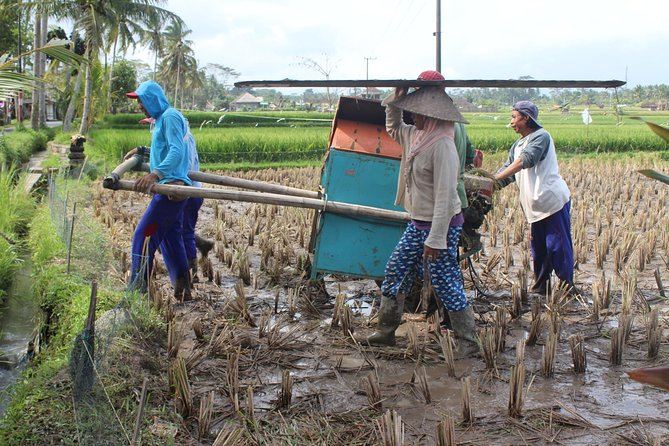
After the market, the route includes a rice-field visit. You learn about rice growing, the different kinds of rice used in Bali, and the length of the harvest cycle. The stop also gives you a chance to take photos, sometimes with a volcano in the distance.
The rice paddies are not the main event, and the time there may be brief. Still, this stop helps explain why rice is central to Balinese meals. It turns the cooking lesson into a wider look at where the food comes from.
Cooking in a Balinese home setting
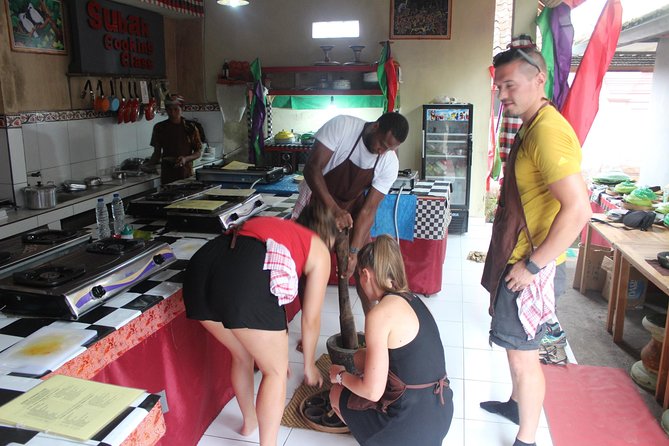
The cooking school is set up in a local Balinese house. That gives the class a more personal feel than a hotel demonstration kitchen. You use the provided stoves, utensils, ingredients, and preparation space, so you do not need to bring cooking equipment.
The kitchen team prepares some ingredients in advance. This is useful because nine dishes would be difficult to complete from scratch in five hours. It also means you can focus on chopping, seasoning, grinding, wrapping, frying, steaming, and assembling rather than spending the whole session on basic prep.
There is a trade-off. If you want to clean, peel, grind, and measure every ingredient yourself, you may find the class too assisted. One unhappy participant felt that too much had been prepared already and found it hard to hear the instructor over side conversations. I would treat this as a group cooking lesson with guided participation, not a private chef apprenticeship.
The teaching style varies by instructor, but Yogi is repeatedly described as funny, clear, and engaged. Gus is praised for adding cultural information as well as cooking advice. Putu is another instructor associated with a light, welcoming class. The staff also help at the individual stations, which is useful when several pans and dishes are moving at once.
Ask questions as you go. You will get more from the class if you want to know why a spice paste is pounded, how much chili to use, or how to adjust a dish for your kitchen at home. The recipes are copied for you to take away, so make notes beside them while the technique is fresh.
More Market Tour Cooking Classes in Ubud
- Jambangan bali cooking class with morning market tour
★ 5.0 · 35 reviews - Balinese cooking class/Go shopping at the market, cook, eat
★ 5.0 · 12 reviews
What you actually cook
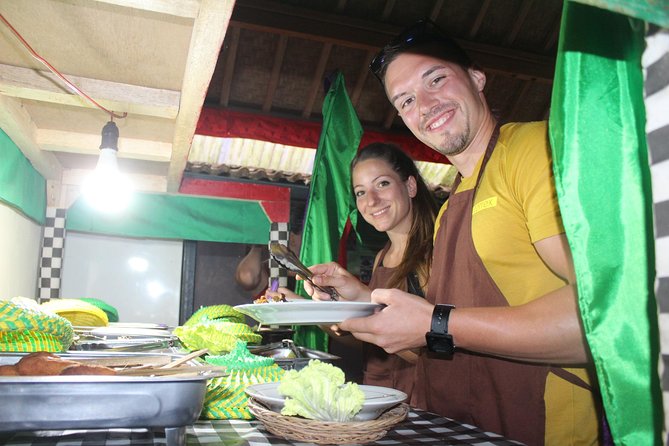
The regular menu includes chicken, while the vegetarian menu replaces those dishes with tofu and tempe. Both menus include nine recipes and white rice with the main courses.
The regular menu includes:
- Balinese vegetable soup
- Chicken with Balinese spices and coconut milk
- Sweet fried tempe
- Balinese chicken satay, known as sate lilit
- Chicken steamed or grilled in banana leaf
- Lawar, a mixed vegetable dish with Balinese spices
- Sambal matah, a fresh raw-spice sambal with coconut oil
- Base gede, the basic Balinese spice paste
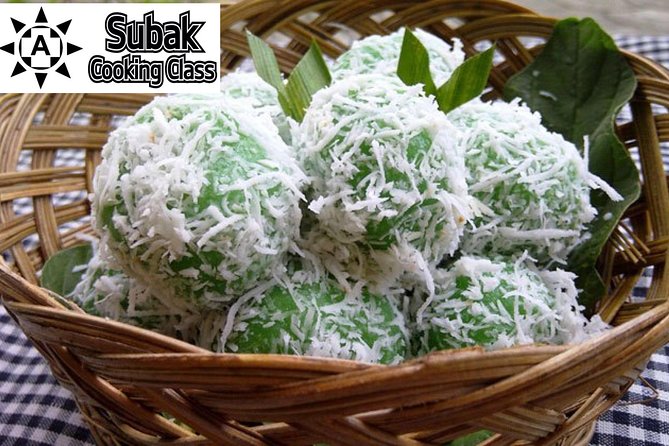
- Klepon, a sticky rice-flour sweet filled with palm sugar
The vegetarian menu swaps in tofu with Balinese sauce, tempe satay with peanut sauce, and tofu steamed or grilled in banana leaf. The soup, sweet tempe, lawar, sambal matah, base gede, klepon, and rice remain part of the meal.
I like this menu because it teaches more than one style of Balinese food. You work with coconut milk, banana leaves, fresh herbs, chili, spice paste, soy products, vegetables, and palm sugar. The result is a useful home-cooking toolkit rather than one recipe you make once and forget.
The spice level can be adjusted. One person prepared a mild version while other members of the group wanted more heat. Tell the instructor early if you prefer less chili. Balinese food can be hot, and the fresh sambal is likely to taste quite different from a mild bottled sauce.
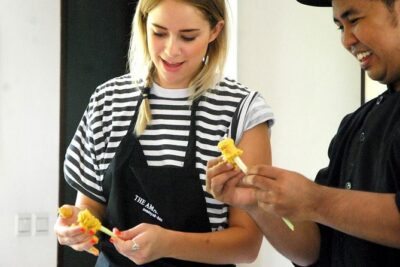
Sate lilit is a particularly interesting dish because the seasoned mixture is shaped around a skewer rather than formed into a standard cube. Pepes, the banana-leaf preparation, shows how wrapping food can add aroma while keeping it moist. Base gede is worth paying attention to because it forms the backbone of many Balinese dishes.
Klepon gives the class a sweet finish. These boiled sticky rice-flour balls contain palm sugar, so bite carefully. The filling can be hot and syrupy even after the outside has cooled.
The meal at the end
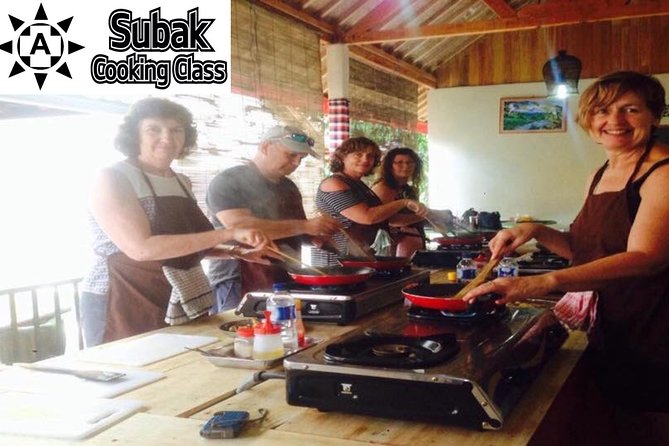
Once the cooking is complete, you eat the food together as lunch or dinner. This is not a small tasting menu. The nine dishes, rice, and market samples make it wise to arrive with an empty stomach.
Eating the food you prepared gives the lesson a clear payoff. You can compare the dishes, see how the spice levels work together, and ask last-minute questions about texture or seasoning. The meal also gives the class a relaxed social finish, especially for families and mixed-age groups.
You may not finish everything. The staff sometimes let you pack up leftovers for your hotel, which is useful because the portions are substantial. Do not count on this as a formal takeaway service, but it is worth asking.
The food quality has been a strong point. The ingredients are fresh, and several dishes are prepared close to serving time. Still, taste is personal. If you are sensitive to chili, coconut, or strong aromatics, speak up during preparation rather than waiting until the meal.
Morning or afternoon?
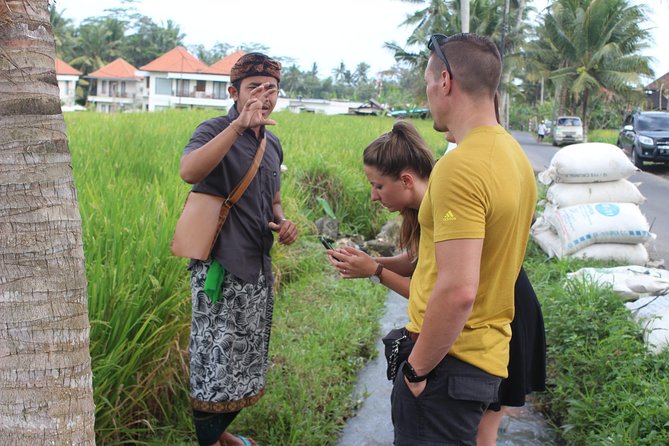
The morning class is the better choice for most first-time visitors to Bali. You get the market, the rice paddies, and the cooking lesson. It also gives the day a clear rhythm: see the ingredients, learn about rice, then use what you have seen in the kitchen.
The afternoon class has one distinct feature: making a traditional Balinese offering. It does not include the traditional market visit. If the offering is more appealing to you than shopping for ingredients, the later start may be the right choice.
The listing describes the activity as about five hours, so allow most of a half-day. Transfers can add time, especially if traffic is heavy or the school is well outside central Ubud. Avoid booking a tight afternoon appointment immediately afterward.
Who will get the most from this class?
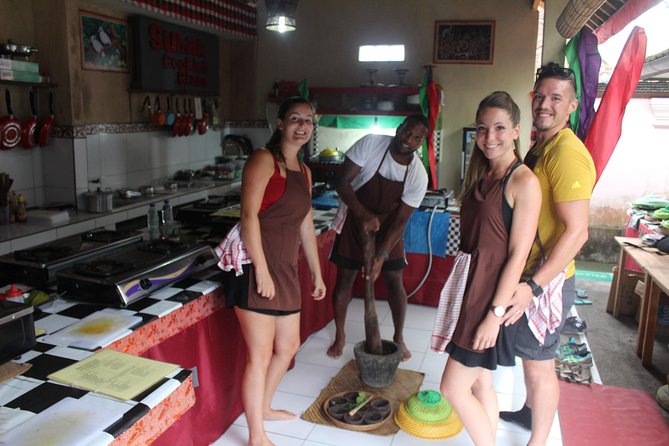
I would recommend it to food lovers, families, couples, and anyone who wants an activity with both cooking and cultural context. You do not need prior cooking experience. The instructions are step by step, and kitchen staff help at the workstations.
It also suits people who want recipes they can repeat at home. The menu uses techniques you can adapt, and the recipe copies give you a starting point. You may need to substitute some Balinese ingredients outside Indonesia, but the class helps you understand the role of each one.
Vegetarians are well served if they select the vegetarian menu in advance. The substitution is not just a plate of vegetables. You prepare tofu, tempe, peanut sauce, banana-leaf tofu, lawar, sambal, spice paste, and dessert.
I would hesitate to recommend it to someone who wants a quiet, private lesson or complete control over every preparation step. The group can reach 14 people, and some ingredients are prepared ahead. It is also not ideal if you have only a short window in Ubud and cannot allow for the drive.
Practical details before you go
Show your booking confirmation at the meeting point and bring your camera. Wear normal, comfortable clothing suitable for cooking. Bottled water is provided, but alcoholic drinks are not included.
The tour provides a driver or guide, local guide, host, cooking equipment, food tasting, and lunch or dinner. Pickup is included in Ubud only. If you stay elsewhere, request transport in advance and expect an additional charge.
The activity has free cancellation if you cancel at least 24 hours before the local start time. Changes or cancellations made less than 24 hours before departure are not accepted for a refund.
Should you book it?
Book this class if you want a large menu, local food context, and a full half-day activity rather than a quick cooking demonstration. Choose the morning option for the strongest overall program, especially if you care about markets and rice farming.
Before paying, confirm the meeting point, transfer time, and any outside-Ubud fee. Also decide between regular and vegetarian food at booking, and tell the instructor how much chili you want.
I would skip it only if you need a private lesson, dislike group cooking, or want to spend your limited Ubud time in the center. For everyone else, the combination of market tasting, rural scenery, nine dishes, recipes, and a shared meal makes this a strong food-focused use of five hours.
FAQ
How long does the Balinese cooking class last?
The activity lasts approximately five hours, including the cooking lesson and the associated visits.
Where does the tour start and finish?
It starts at Ubud Palace, at F7V7+72R, Jalan Raya Ubud No. 8. The activity ends back at the same meeting point.
Is pickup included?
Pickup and drop-off are included within the Ubud area. Transport from outside Ubud costs extra and should be requested in advance.
Is the traditional market visit included in every class?
No. The market visit is available only with the morning class.
What does the morning option include besides cooking?
The morning option includes a traditional market visit and a rice-paddy visit. You can learn about local ingredients, rice growing, and harvest timing.
What does the afternoon option include?
The afternoon option includes making a Balinese offering. The traditional market visit is not provided with the afternoon class.
Can I choose vegetarian food?
Yes. You must choose the regular or vegetarian menu when booking. The vegetarian menu includes tofu and tempe dishes instead of the chicken recipes.
Are recipes provided?
Yes. Recipe copies are included for you to take home.
Can I cancel for a full refund?
Yes, if you cancel at least 24 hours before the experience start time. Cancellations or changes made less than 24 hours before the start time are not accepted for a refund.
More Shopping Trips in Ubud
- Hanoi Cooking Class: Culture, Local Market & Meaning CSR Impact
★ 5.0 · 5,147 reviews - 5 Traditional Dishes Hanoi Cooking Class with Market Trip
★ 5.0 · 4,890 reviews - Cooking Class and Lunch at a Tuscan Farmhouse with Local Market Tour from Florence
★ 5.0 · 4,831 reviews - Chiang Mai: Cooking Class, Market & Thai Herbs Garden Tour
★ 4.9 · 4,824 reviews
More Balinese Cooking Classes in Ubud
- Ubud Cooking Class Bali with Balinese Chef
★ 5.0 · 1,609 reviews - PRIVATE Authentic Balinese Cooking Class in Ubud at Putu’s Home
★ 5.0 · 644 reviews - Balinese Farm Cooking Class by Pemulan Bali
★ 5.0 · 410 reviews - Balinese Authentic Cooking Class in Ubud
★ 5.0 · 239 reviews
Just added around Ubud
- The Authentic Balinese Cooking Experience★ 5.0 · 4 reviews
- Ubud: Organic Farm Harvest, Bali Cooking Class by Pemulan★ 4.8 · 12 reviews
- packages cooking class and romantic dinner in a local home★ 5.0 · 4 reviews
- Jambangan bali cooking class with morning market tour★ 5.0 · 35 reviews
- Balinese cooking class/Go shopping at the market, cook, eat★ 5.0 · 12 reviews
- Ubud: Balinese Cooking Class with Hotel Transfers★ 4.8 · 17 reviews
- Balinese Cooking class with traditional morning market visit★ 5.0 · 161 reviews
- Balinese Cooking Class at Organic Farm★ 5.0 · 51 reviews
Balinese & Indonesian Cooking Classes, compared.
Ubud: Balinese Cooking Class at an Organic Farm
Read our review →
PRIVATE Authentic Balinese Cooking Class in Ubud at Putu’s Home
Read our review →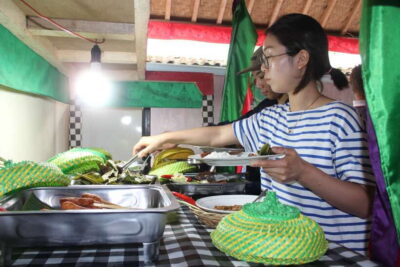
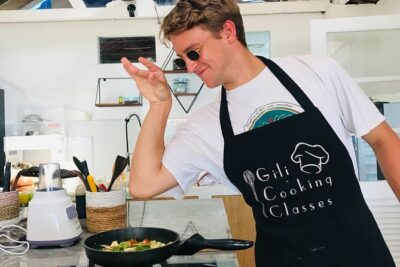
Learn to cook Indonesian food at Gili Cooking Classes Trawangan
Read our review →