
Review · OSAKA
Osaka: Ramen and Gyoza Cooking Class in Dotonbori
Making ramen from a packet is easy. Making the noodles from wheat, slicing them with a noodle machine, preparing broth, and folding chicken gyoza gives you a much better sense of what sits behind the bowl. This Dotonbori class turns two familiar Japanese foods into a practical, tasty lesson.
I like the small-group format, with up to about eight people and two instructors helping at the worktables. I also like that you eat the food you make, rather than simply watching a demonstration. The main consideration is time: allow roughly two to three hours, and expect the class to involve real hands-on work rather than a quick cooking show.
Key things to know before you book
- Make ramen noodles from wheat: Knead the dough, roll it, and cut it with a noodle machine.
- Prepare a classic soy sauce ramen: The broth uses chicken bones and dried sardines, with miso available as an added option.
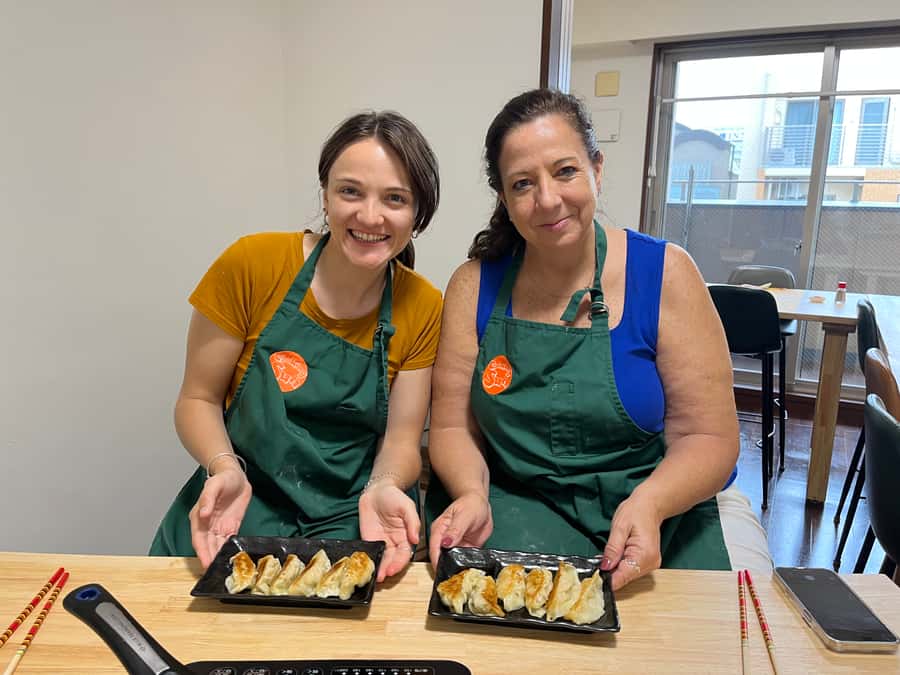
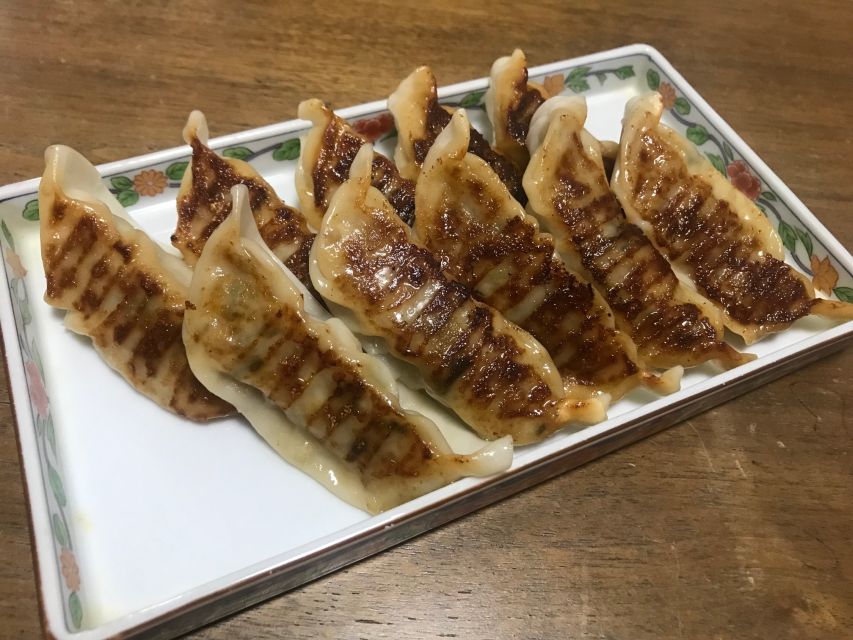
- Fold chicken gyoza by hand: You prepare the minced chicken filling and shape your own dumplings.
- Learn in English with close guidance: Classes use two instructors, with Miki, June, Yoshi, and Kasa among the teachers named by participants.
- Eat a full meal at the end: Your ramen and gyoza are cooked and served after the preparation work.
- Plan carefully for the location: The meeting point is Cooking Sun Osaka, room 807, in Dotonbori. At the entrance, press 807, then press 呼出, the call button.
Kneading wheat turns ramen into a real food lesson
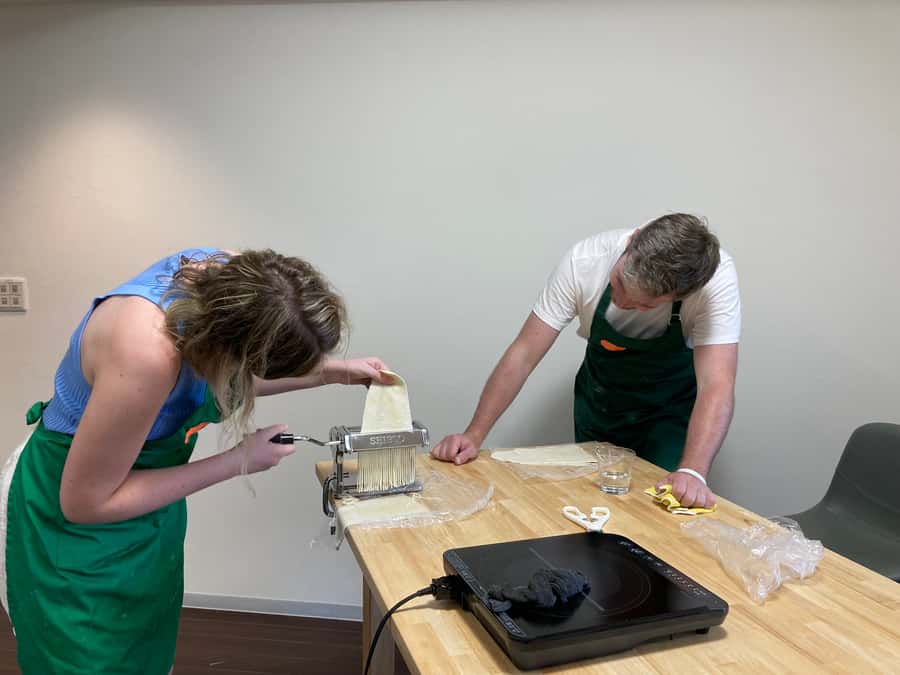
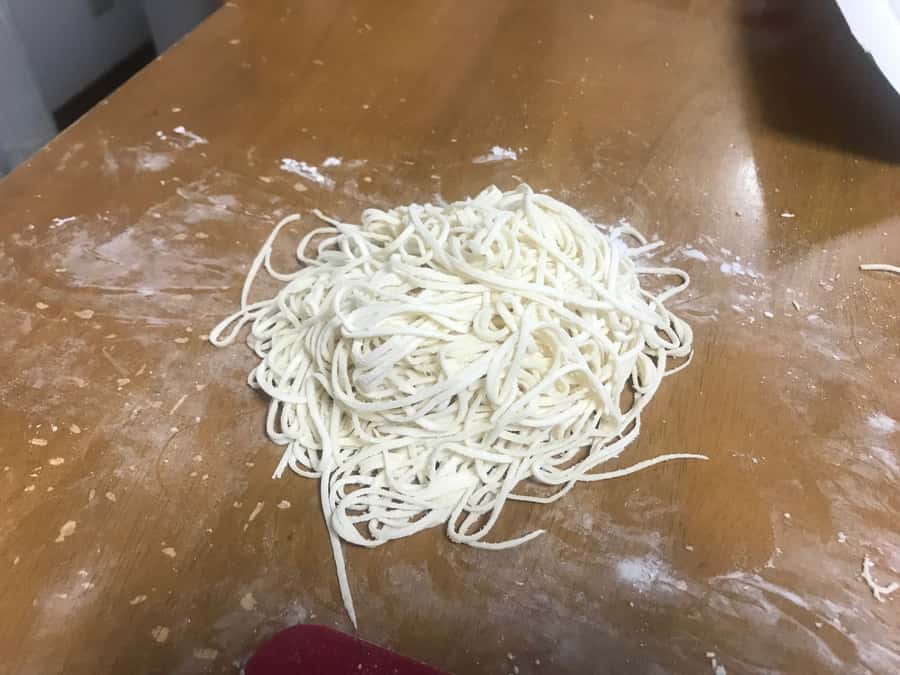
The best part of this class is that ramen begins with flour, not a packet. You knead wheat dough, work it into noodles, and use a machine to cut them to size. That simple change in perspective is valuable. You stop thinking of ramen as fast food and start seeing the texture, timing, and care behind the bowl.
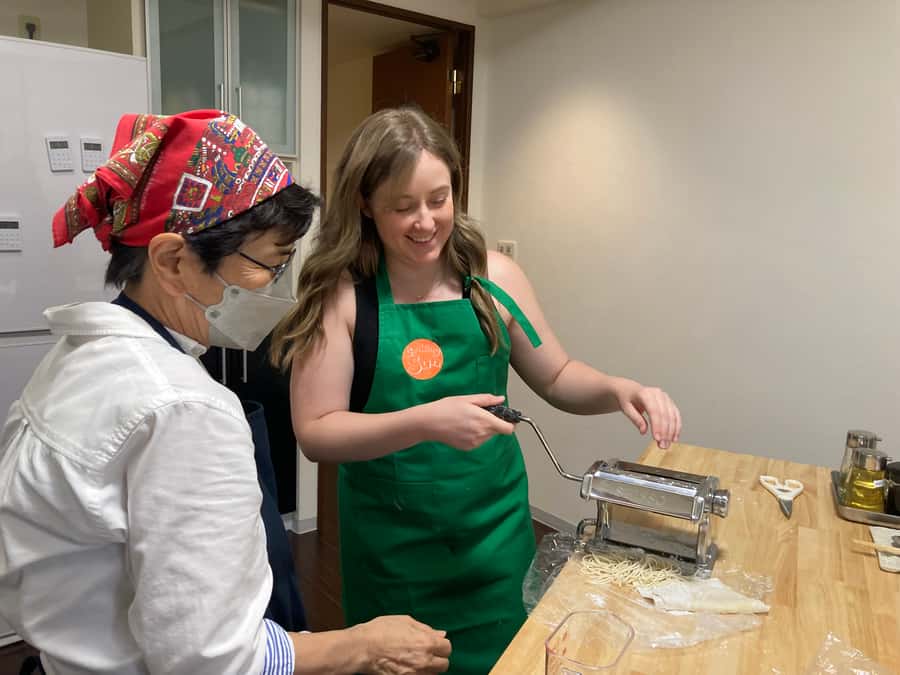
The noodle work is also the most unusual part of the experience. Many Japanese cooking classes focus on sushi, tempura, or simple home dishes. Here, you get to handle the dough and see how fresh noodles are made. The process requires attention, but the instructors guide you step by step and help if you fall behind.
You should not expect to become a ramen chef in one afternoon. You will, however, leave with a clear method you can try at home. Several participants specifically appreciated receiving the recipes, and that makes the $70 price more useful than a meal alone. You are paying for instruction, ingredients, equipment, and a substantial lunch or dinner.
The noodle dough also needs time to rest while you work on the gyoza. That gives the session a sensible rhythm. You are not standing around waiting, and the class keeps moving without feeling rushed.
More Sushi and Japanese Classes in Osaka:
- Sushi Making Osaka Roll and Authentic Japanese Sushi Class
★ 5.0 · 1,220 reviews - Osaka Sushi Making Experience
★ 5.0 · 400 reviews - Osaka Cooking Class: Okonomiyaki &Japanese cuisines experience
★ 5.0 · 261 reviews
Building the broth gives the bowl its character
The class teaches a standard soy sauce ramen. The broth uses chicken bones and dried sardines, giving you an introduction to two important sources of flavor in Japanese cooking. The instructors also explain ingredients such as different kinds of miso and how they can be used.
This is where the class moves beyond a simple recipe. You learn that ramen is not just noodles plus toppings. The broth, seasoning, noodle texture, and finishing ingredients all affect the final result. You can add toppings to your bowl, and you may add miso to change the flavor toward miso ramen.
The broth preparation is especially useful if you want to cook Japanese food at home. You learn how dried seafood and chicken can work together, and you get a better idea of why restaurant ramen tastes different from a quick supermarket version.
There is one practical point to consider. Dried sardines are part of the standard broth, so fish flavor may be present. The instructors have provided substitutions for people who do not like fish broth, and plant-based adjustments have also been made for vegan participants. If you have dietary needs, tell the team at the start. The class appears flexible, but the details of every substitution are not specified in advance.
Gyoza preparation adds a second set of skills
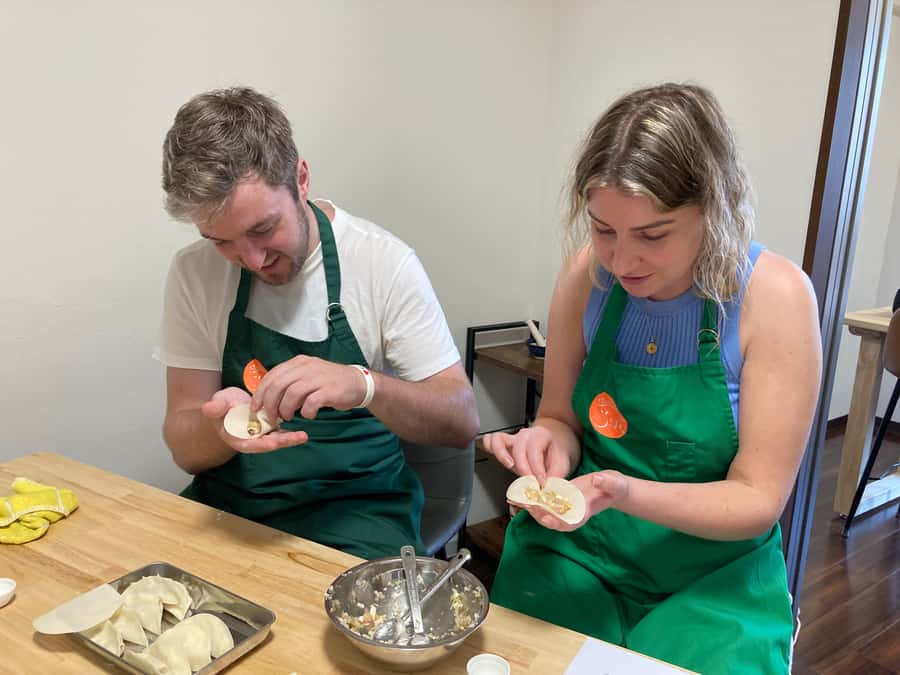
While the ramen dough rests, you prepare gyoza. The filling uses minced chicken, and you form the dumplings yourself. This is a good pairing with the noodle work because it gives you a different task: less kneading and cutting, more mixing, filling, and shaping.
Gyoza look simple until you try to make a neat, sealed dumpling. The class lets you practice the fold rather than handing you finished wrappers. You will see how much filling to use and how to close the edge so the dumpling holds together during cooking.
The gyoza also make the class feel like a full Japanese meal. In Japan, ramen and gyoza are commonly ordered together at a ramen shop. Preparing both dishes helps you understand that familiar combination from the inside.
I would book this class if you enjoy food with your hands and do not mind that the finished meal depends partly on your own technique. Your dumplings may not all look identical. That is part of the fun, and the instructors are there to help keep the cooking on track.
Two instructors keep a small class moving
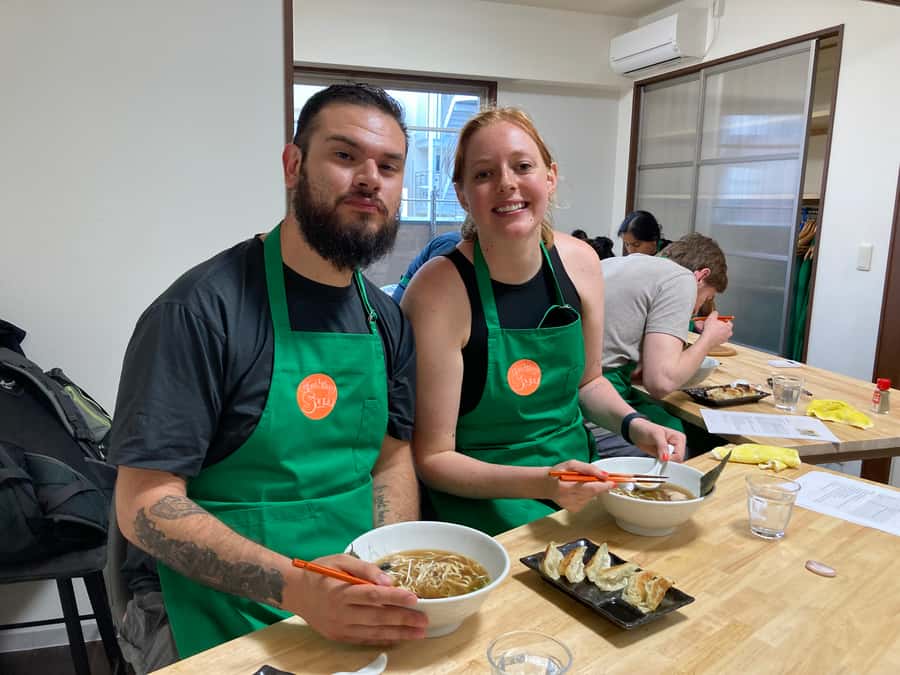
The class is designed for a maximum of about eight people, with two instructors. That ratio matters. Cooking with dough, a noodle machine, broth, and dumplings can become confusing when one teacher has to watch everyone at once. Here, an instructor can step in when someone falls behind without stopping the whole group.
Miki and June are among the instructors praised for clear explanations and quick assistance. Yoshi and Kasa are also named by participants in connection with successful classes. Staff speak English well enough to explain the process, answer questions, and add background about Japanese food and eating customs.
You can expect a friendly, patient teaching style rather than a formal culinary-school lesson. The instructors explain each ingredient and give practical tips as you work. They also take photos when requested, which is a nice touch for a hands-on activity where your hands may be covered in flour.
The teaching pace seems to be one of the strongest reasons to choose this experience. You get help without being hurried, but the class still keeps moving. That balance is important for families and mixed-ability groups.
More Hands-On Workshops in Osaka:
- Osaka: Roll and Authentic Sushi Making Class in Dotonbori
★ 4.9 · 239 reviews - Ramen and Gyoza Cooking Class in Osaka
★ 5.0 · 202 reviews - Osaka: Cooking Class Ramen & Gyoza Course in Nanba
★ 4.9 · 86 reviews - Osaka: Gluten-Free Ramen and Gyoza Cooking Class
★ 5.0 · 42 reviews
The final meal makes the preparation worthwhile
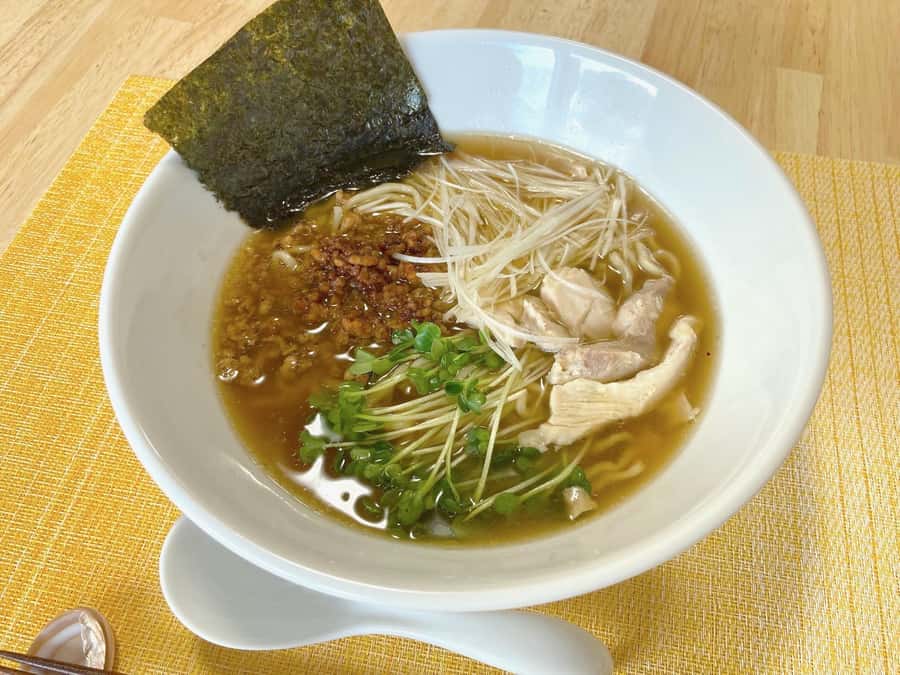
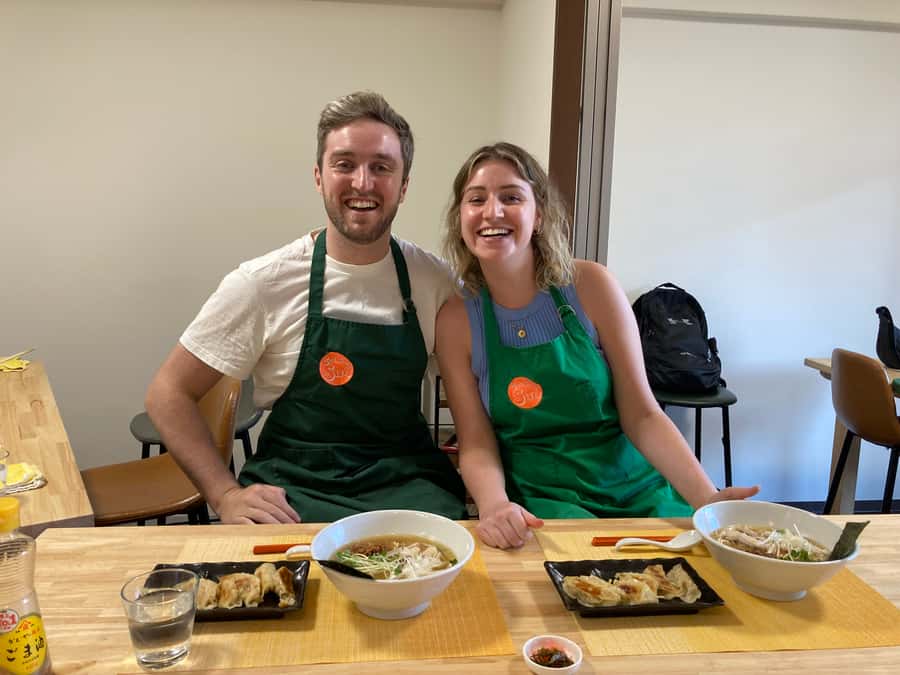
At the end, you sit down and eat the ramen and gyoza you prepared. The meal is not an extra course added to the class. It is the payoff for the work you have just done.
Expect a generous combination of noodles, broth, toppings, and dumplings. One useful tip is to arrive hungry. The class can last around two to three hours, and the final meal is substantial enough that you will want room for it.
Your bowl is also personal in a way a restaurant meal cannot be. You choose toppings, and you can adjust the soup with miso. That gives you an original version of ramen, even though the class follows a standard soy sauce base.
The result may surprise you. Fresh noodles have a different bite from dried noodles, and handmade gyoza feel more satisfying because you shaped them yourself. The food is not merely a prop for the lesson. It is the center of the experience.
What the $70 price includes
At $70 per person, this is not the cheapest meal in Osaka. You can eat ramen and gyoza for much less at a local restaurant. The value comes from the combination of a meal, instruction, ingredients, equipment, and a recipe you can use after returning home.
The price is easier to justify if you want an activity rather than another restaurant stop. You spend a meaningful block of time learning two dishes, asking questions, and making something with your own hands.
It is also good value for families and couples who want a shared activity. An 11-year-old has enjoyed the class, and adults do not need professional cooking skills. The instructors help maintain the pace, so you are not left struggling alone.
If you only want to taste excellent ramen, skip the class and visit a ramen shop. If you want to understand how ramen and gyoza are made, the class offers more than a meal.
Finding Cooking Sun Osaka in Dotonbori
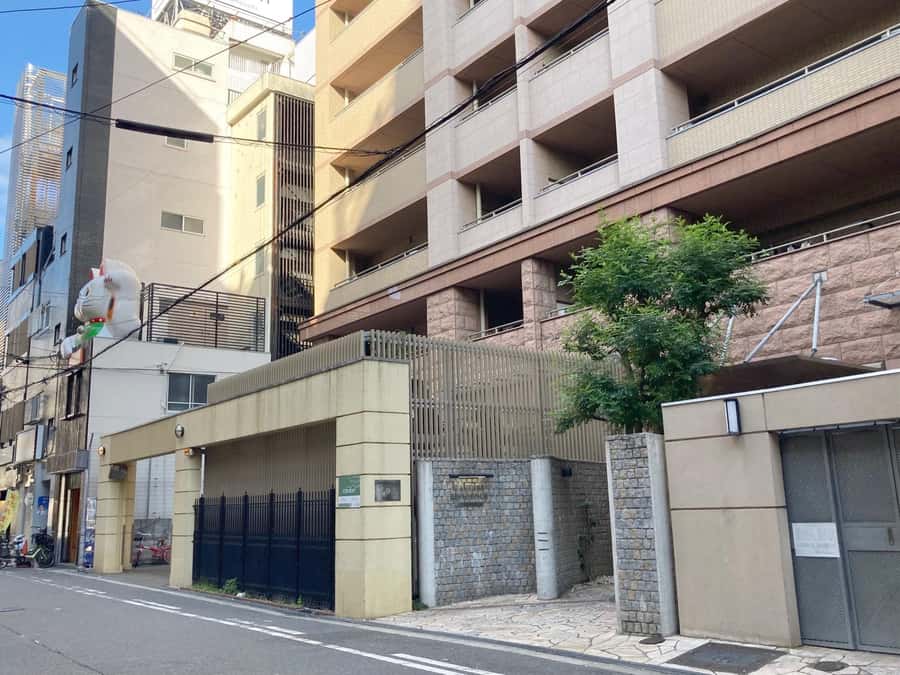
The meeting point is Cooking Sun Osaka, room 807. On arrival, go to the building entrance and press 807, followed by 呼出, the call button.
This detail matters because the entrance can be easy to miss, especially in the busy Dotonbori area. Give yourself extra time to locate the correct building and room. The activity begins and ends at the same meeting point, and hotel pickup and drop-off are not included.
Because the class is in Dotonbori, you can pair it with a walk through the area before or after cooking. The location is convenient for fitting the class into an Osaka sightseeing day, but it also means the surrounding streets can be crowded and distracting. Do not arrive at the last minute.
Who will enjoy this class most
This is a strong choice for first-time visitors who want a food experience with actual participation. You do not need advanced cooking skills, and the English instruction makes the process accessible.
It suits:
- Couples who want a shared activity beyond restaurant meals
- Families with older children or teenagers
- Visitors who enjoy Japanese cuisine and want to recreate it at home
- People curious about noodles, broth, and dumpling technique
- Vegetarians and vegans who confirm their needs with the instructors
- Anyone looking for a slower, more personal activity in Osaka
It may be less suitable if you dislike fish-based flavors, have serious allergies that require detailed advance planning, or want a quick activity. The class includes several preparation stages, and the food is made from scratch.
The class also works well for people who are nervous in a cooking setting. The steps are explained clearly, and the two-instructor setup means you can ask for help. You will still need to take part, but you will not be expected to know the technique beforehand.
Practical booking advice
The experience is offered in English. Ingredients are included, while transport to and from your hotel is not.
You can reserve now and pay later, which is useful if your Osaka schedule is still changing. Cancellation is available up to 24 hours before the activity for a full refund.
The class has a five-star rating from 378 reviews, but the more useful point is the pattern behind that score: strong praise for the instructors, clear teaching, patient help, well-paced cooking, and tasty food. Those are the parts that matter most once you are standing at the worktable.
Check the meeting instructions carefully. Room 807 and the 呼出 button are easy details to overlook, and the building may not be immediately obvious from the surrounding streets.
Should you book the ramen and gyoza class?
I would book it if you want to do more than eat Japanese food. Making noodles from wheat, cutting them with a machine, preparing chicken gyoza, and building a soy sauce broth gives you a useful look at everyday Japanese cooking.
The strongest reason to go is the teaching. Two English-speaking instructors can give close help in a small group, and the session is paced so you have time to learn without losing the flow. The recipes let you continue the experience at home.
The main reasons to pass are simple: the $70 cost is higher than a restaurant meal, the class takes a good part of an afternoon or evening, and fish broth may require a substitution. For everyone else, especially families, couples, and food-minded visitors, this is a practical and filling Osaka activity with something to show for it besides a photograph.
FAQ
Where does the cooking class meet?
The class meets at Cooking Sun Osaka, room 807. At the entrance, press 807 and then press 呼出, the call button.
Where does the activity finish?
The activity ends back at the same meeting point.
Is hotel pickup included?
No. Hotel pickup and drop-off are not included.
What language is the class taught in?
The class is conducted in English.
What dishes do I make?
You make ramen and gyoza. The ramen uses freshly made wheat noodles, and the gyoza uses minced chicken filling.
Do I make the ramen noodles from scratch?
Yes. You knead wheat to make the dough and cut the noodles with a noodle machine.
What kind of ramen do I make?
The standard version is soy sauce ramen. You can add toppings, and you may add miso to the soup to make a miso-style ramen.
Are the ingredients included?
Yes. All ingredients used in the cooking class are included.
Can the class accommodate vegan or fish-free preferences?
Plant-based substitutions have been provided for vegan participants, and substitutions have also been made for people who do not like fish broth. Tell the instructors about your needs when you arrive.
How much does the class cost?
The listed price is $70 per person.
Can I cancel for a full refund?
Yes. You can cancel up to 24 hours in advance for a full refund.
Can I reserve without paying today?
Yes. The reserve-and-pay-later option allows you to book your place without paying immediately.
Just added around Osaka
- Okonomiyaki&Takoyaki for Families:Osaka Street Food Festival★ 5.0 · 4 reviews
- Osaka: Sushi Making in Spacious Studio (SAME-DAY OK!)★ 5.0 · 75 reviews
- Osaka: Sushi Making Class and Dotonbori Food Tour★ 4.7 · 3 reviews
- Osaka Sake Tasting with Takoyaki Cooking★ 5.0 · 156 reviews
- Osaka Okonomiyaki Cooking Experience for Families & Groups★ 4.9 · 8 reviews
- Osaka: Sashiko Japanese Craftsmanship Workshop★ 5.0 · 31 reviews
- Osaka Dotonbori: Sushi Making Experience★ 4.9 · 122 reviews
- Osaka: Okonomiyaki Cooking Class with Beer or Soft Drink★ 4.9 · 9 reviews
Japanese & Sushi Cooking Classes, compared.
Sushi Making Tokyo Roll and Authentic Japanese Sushi Class
Read our review →
Tokyo: Roll and Authentic Sushi Making Class in Asakusa
Read our review →
Ramen Cooking Class at Ramen Factory in Kyoto
Read our review →
Tokyo: Sushi Making Class in a Happi Coat near a Famous Spot
Read our review →
Sushi Making Tokyo! Popular Maki Sushi & Japanese Sushi(+Recipe!)
Read our review →
Sushi Making Osaka Roll and Authentic Japanese Sushi Class
Read our review →
Tokyo Sushi Making Class in Tsukiji with Professional Chef
Read our review →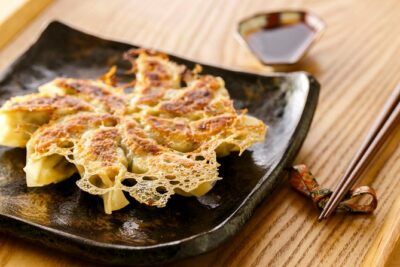
Ramen & Gyoza Cooking Class in Tokyo with Local Supermarket Visit
Read our review →Browse the lists this tour appears in