
Review · TOKYO
Tokyo Washoku 4-hour Cooking Class: From Market to Table
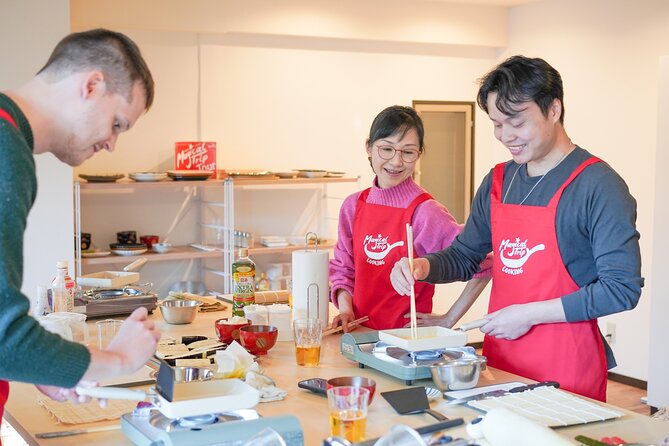
The best part of this Tokyo cooking class happens before you reach the stove. You start at a local supermarket near Iriya Station, where your guide shows you how to choose Japanese ingredients instead of simply handing you a prepared basket. April, Yuri, Alice, and Mihori are among the guides praised for clear instruction and warm conversation.
I like the useful mix of shopping and cooking, and I like that you do the work yourself, from knife cuts to rolled sushi. The chance to taste beer or sake with the meal adds a pleasant Tokyo touch. The main caution is timing: arrive early, since joining after the group leaves means no refund or rescheduling.
Key points at a glance
- Local supermarket first: Learn how Japanese shoppers choose vegetables, meat, seasonings, and other ingredients.
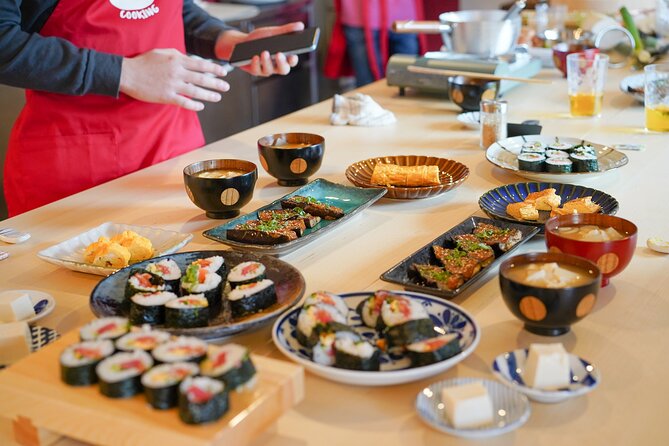
- Four hands-on dishes: Prepare makisushi, miso soup, dashimaki tamago, and nasu dengaku from scratch.
- Small group setting: The class has a maximum of seven people, allowing room for questions and individual help.
- Recipes for home: Take the cooking instructions with you so the class can continue in your own kitchen.
- Drinks with the meal: Sample sake or beer as you eat the dishes you prepared.
- Dietary requests need notice: Vegetarian and vegan arrangements are possible, but allergies and substitutions cannot be guaranteed.
Starting at a Tokyo supermarket near Iriya
The class begins at 10 a.m. outside the FamilyMart at 2-chōme-1-10 Shitaya, in Taito City. The meeting point is near public transportation, but Tokyo mornings can still feel rushed if you are navigating an unfamiliar station, so I would arrive with time to spare.
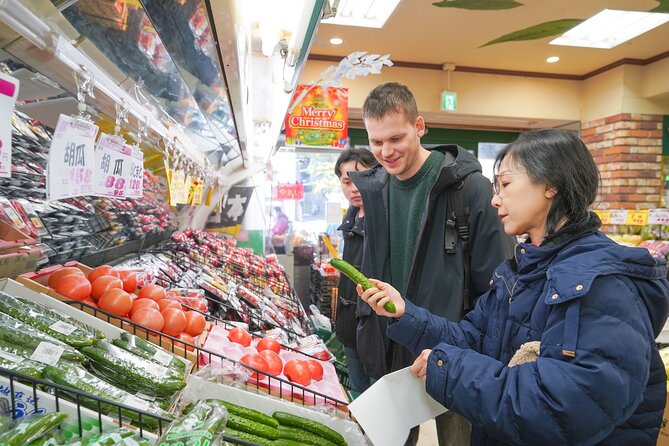
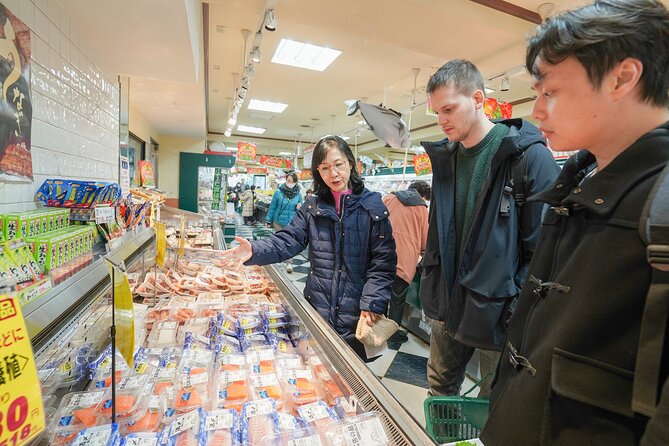
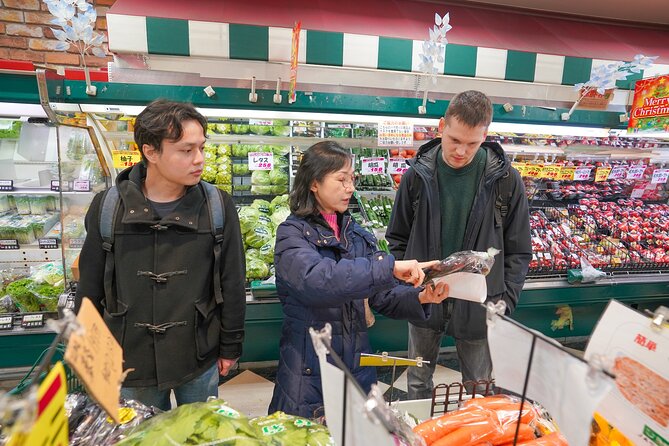
Your guide then takes you into a nearby supermarket. This is not just a quick shopping stop. It gives you a practical look at everyday Japanese food culture, including the ingredients used in ordinary home cooking.
You learn how to select what you will cook rather than simply watching someone else do it. Your guide may explain Japanese vegetables, meat, seasonings, or packaged ingredients as you move through the aisles. That makes the visit useful for anyone who plans to cook Japanese food at home after the trip.
I especially like this part for first-time visitors. A supermarket can tell you more about daily life than a formal museum display. You see what people buy, how ingredients are presented, and which products can be hard to identify without help.
The exact shopping conversation depends on your guide and your questions. Guides such as Mihori, Taka, and Masai have been praised for explaining ingredients clearly and answering questions about Japanese life. The class is not a lecture, so speak up if you want to know how an ingredient is used or what might work as a substitute at home.
More Market Tour Cooking Classes in Japan
- Tsukiji Fish Market Guided Tour and Sushi Making with Pro Chef
★ 5.0 · 775 reviews - Tokyo: Tsukiji Fish Market Sushi Making Class with Pro Chef
★ 4.9 · 506 reviews - Tokyo Tsukiji Fish Market Tour and Sushi Making Lesson
★ 5.0 · 390 reviews
Walking from the market to the cooking studio
After shopping, you walk to the cooking studio. The class ends at the studio, which is also the place where you eat the food you prepare.
The studio is described as spacious and well set up. That matters in a cooking class. You need room to chop, roll, stir, and work beside other people without feeling crowded. The maximum group size is seven, though there may be fewer participants at your session.
This is a social activity, but it is not designed as a private class unless your booking happens to fill the group. You may cook with people from different countries and age groups. One family found that their two teenagers enjoyed the practical work, while another group appreciated the easy conversation and questions about Tokyo life.
The walk between the supermarket and the studio also gives the class a natural rhythm. You begin by seeing the ingredients, then handle them in the kitchen, and finally eat the finished meal. It feels more connected than arriving at a studio where every item has already been measured.
Making makisushi, miso soup, and rolled omelet
The cooking portion covers several familiar Japanese dishes. You prepare makisushi, miso soup, dashimaki tamago, and nasu dengaku, described as grilled eggplant skewers.
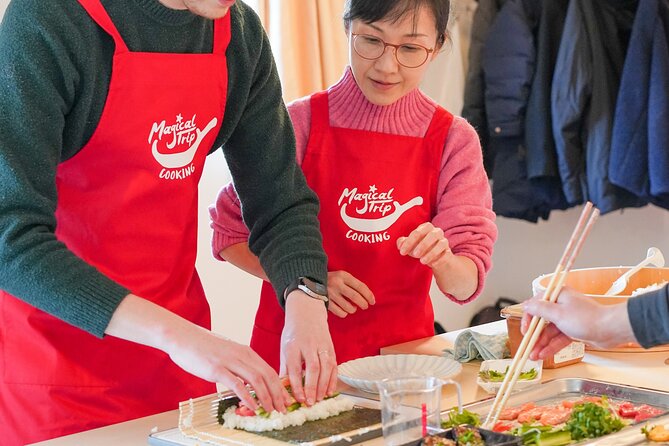
Makisushi gives you a chance to practice rolling and arranging ingredients. It is a simple dish to recognize, but getting a neat roll takes some care. Your guide walks you through the process and helps with the parts that feel awkward at first.
Miso soup looks easy, but the details matter. You learn how the ingredients come together and how the finished soup fits into a Japanese meal. One participant considered the miso soup the best they had tasted, which says something about the pleasure of eating a dish immediately after making it.
Dashimaki tamago is a rolled Japanese omelet with a soft texture and a little sweetness. The rolling technique can be the trickiest part of the menu. It gives you a clear example of how Japanese cooking often depends on patience, heat control, and repeated small movements rather than complicated equipment.
Nasu dengaku adds another texture and flavor to the meal. Eggplant absorbs seasoning well, making it a good teaching ingredient. Preparing it from scratch helps you see how a modest vegetable can become a satisfying part of a larger meal.
The menu gives you a full meal rather than one isolated recipe. You work with rice or sushi ingredients, soup, egg, and vegetables. That variety keeps the four hours active and gives you several recipes worth repeating at home.
Learning knife skills and Japanese cooking methods
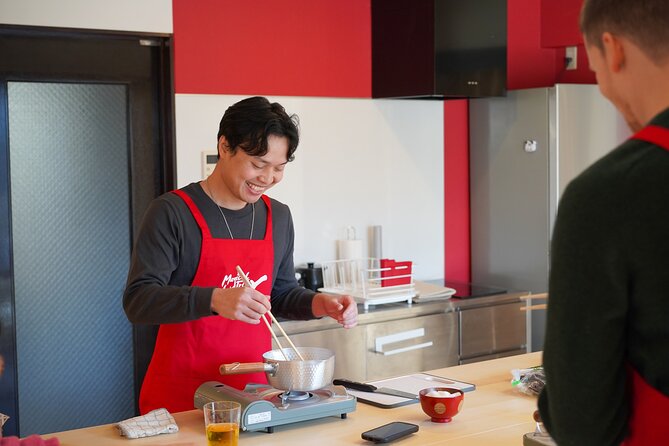
This is a hands-on class, not a demonstration where you sit and watch. Your guide teaches traditional Japanese knife and cooking techniques, then lets you practice them.
You should expect instruction on cutting, shaping, rolling, and cooking. The exact amount of help varies by guide and group, but the class is set up for questions. Guides including Yuri and Suzy have been praised for patient, detailed instruction, while Alice has been appreciated for cheerful conversation during the work.
That personal teaching is one reason the class earns its price. You are not only eating a Japanese meal. You are learning how the dishes are built and how to repeat them. The recipes supplied afterward make that value last beyond your Tokyo visit.
The class should suit beginners, since the teaching is described as patient and step by step. At the same time, experienced home cooks can ask about ingredients, methods, and Japanese food customs. I would not book it expecting advanced restaurant training. This is a friendly home-style session, with an emphasis on practical dishes and shared cooking.
More Market Tour Cooking Classes in Tokyo
- Tokyo: Tsukiji Market Walking Tour & Sushi Cooking Class
★ 4.6 · 122 reviews - Tokyo: Tsukiji Market Guided Tour & Sushi-Making Experience
★ 4.4 · 11 reviews
Eating the food you prepared with sake or beer
Once the cooking is complete, you sit down and eat together. This gives the class a satisfying finish because you can judge the results immediately, while the instructions are still fresh.
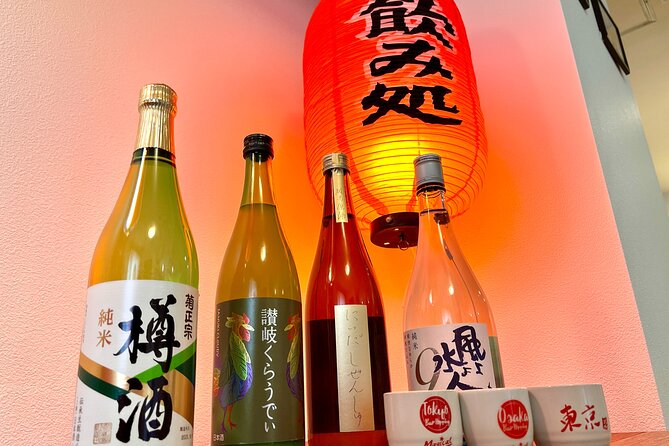
Beer and sake tasting may be included during the lesson and meal. The drink pairing is not the sole reason to book, but it adds a relaxed social element and helps you connect the food with Japanese dining habits.
You can ask questions while eating, including questions about the dishes, ingredients, or life in Tokyo. Some guides have traveled abroad and use comparisons that make unfamiliar cooking steps easier to understand. Masai, for example, was praised for drawing useful comparisons from travel in the western part of the world.
The meal is also a chance to slow down. Tokyo sightseeing can mean long walks, crowded trains, and a packed schedule. Four hours spent shopping, cooking, and eating gives you a different view of the city, focused on ordinary food and conversation.
What the $79.59 price includes in practical terms
At $79.59 per person, this class is priced above a short demonstration but below many private culinary lessons. The value comes from the amount of participation. You shop with a guide, prepare several dishes, eat the meal, sample drinks, and receive recipes.
It is a reasonable choice if you want an activity that combines food, instruction, and social time. A simple meal in Tokyo can cost far less, but a restaurant meal does not teach you how to choose ingredients or make the dishes yourself.
The value is less clear if you dislike group activities or mainly want to eat. This is a four-hour commitment, and some of that time is spent shopping and preparing food. You should book it for the process, not just for the final plate.
The small maximum group helps. Seven people is large enough for conversation but still small enough for a guide to offer personal help. The final experience can vary with the instructor and the mix of participants, but the guide names connected with the class include April, Yuri, Alice, Minnie, Mihori, Taka, Suzy, Masai, and Nigiri.
Who will get the most from this cooking class
I would recommend this class to first-time visitors who want a direct introduction to Japanese food. The supermarket visit gives you context, while the studio gives you a practical way to understand the dishes.
It also suits families with older children and teenagers. The work is active, and the meal gives everyone a clear reward at the end. Younger children may find four hours too long, but the supplied information does not specify a minimum age, so ask before booking if that matters to your family.
Home cooks should find the recipes especially useful. You leave with methods you can practice later, not just photos of a meal. The recipes may also help you identify Japanese ingredients when you shop at home.
Vegetarians and vegans are welcome if you provide the request at least one day ahead. The cooking process and ingredients can be arranged, but the operator cannot guarantee an entirely allergy-free kitchen. If you cannot eat eggs, your selection is reduced from four types of food to three.
People with serious allergies should think carefully before booking. Substitutions are not guaranteed, and the food is prepared in kitchens that are not owned by the operator. Tell the provider about dietary needs early, then confirm that the arrangements are suitable for you.
Timing, weather, and what to plan before arrival
The class begins exactly at 10 a.m. If you are more than five minutes late without contacting the provider, the booking is treated as a cancellation. You cannot join later, reschedule, or receive a refund, so plan your route the night before and allow extra time for Tokyo train stations.
The experience requires suitable weather. If poor weather causes cancellation, you are offered another date or a full refund. Tokyo can also be very hot or cold, with summer highs listed as reaching 40°C and winter lows dropping to -5°C. Dress for the season, especially for the supermarket walk.
Free date or time changes are available until 24 hours before the start. Cancellation at least 24 hours ahead brings a full refund. After that point, changes and refunds are not accepted, including for a no-show.
After the class, you may visit Kappabashi Dougu Street on your own. The activity does not include that visit, but the location gives you a useful chance to browse Japanese kitchen tools after learning how to use them.
Should you book this Tokyo cooking class?
Book it if you want to do more than sample Japanese food. The supermarket stop, hands-on knife work, four dishes, recipes, and shared meal give you a clear connection between shopping, cooking, and eating.
I would be more cautious if you have strict allergies, dislike group classes, or have a tight sightseeing schedule. Arrive early, report dietary needs at least a day ahead, and expect a friendly home-cooking lesson rather than a professional chef course.
For most food-focused visitors, the $79.59 cost is fair because the class fills four hours with useful activity. You leave with a better sense of Japanese ingredients, several techniques to practice, and a meal you helped create. That is a good trade for a morning in Tokyo.
FAQ
Where does the Tokyo cooking class start?
It starts at the FamilyMart at 2-chōme-1-10 Shitaya, Taito City, Tokyo 110-0004, near Iriya Station.
What time does the activity begin?
The class begins at 10 a.m.
How long does the cooking experience last?
The activity lasts approximately four hours.
What dishes will I prepare?
You prepare makisushi, miso soup, dashimaki tamago, and nasu dengaku, described as grilled eggplant skewers.
Is the class suitable for vegetarians and vegans?
Yes. Vegetarian and vegan arrangements are available if you inform the provider at least one day before the tour.
Can I join if I have food allergies?
You must report allergies at least one day ahead, but an allergy-free kitchen cannot be guaranteed. Substitutions may not always be possible.
How many people can join the class?
The activity has a maximum of seven participants, and other people may be in your group.
What happens if I arrive late?
The class starts on time. If you are more than five minutes late without contacting the provider, it is treated as a cancellation, with no refund or rescheduling.
More Shopping Trips in Tokyo
- Hanoi Cooking Class: Culture, Local Market & Meaning CSR Impact
★ 5.0 · 5,147 reviews - 5 Traditional Dishes Hanoi Cooking Class with Market Trip
★ 5.0 · 4,890 reviews - Cooking Class and Lunch at a Tuscan Farmhouse with Local Market Tour from Florence
★ 5.0 · 4,831 reviews - Chiang Mai: Cooking Class, Market & Thai Herbs Garden Tour
★ 4.9 · 4,824 reviews
More Sushi and Japanese Classes in Tokyo
- Sushi Making Tokyo Roll and Authentic Japanese Sushi Class
★ 5.0 · 3,971 reviews - Tokyo: Roll and Authentic Sushi Making Class in Asakusa
★ 4.9 · 1,957 reviews - Tokyo: Sushi Making Class in a Happi Coat near a Famous Spot
★ 4.9 · 1,377 reviews - Sushi Making Tokyo! Popular Maki Sushi & Japanese Sushi(+Recipe!)
★ 5.0 · 1,314 reviews
Just added around Tokyo
- Tokyo: Tsukiji Market Walking Tour & Sushi Cooking Class★ 4.6 · 122 reviews
- Tokyo: Sushi Cooking Class with Sake Tasting★ 4.8 · 55 reviews
- Sushi-Making Experience★ 4.7 · 4 reviews
- Tokyo: Tsukiji Market Guided Tour & Sushi-Making Experience★ 4.4 · 11 reviews
- Tokyo: Sushi and Ramen Cooking Class with Sake Pairing Set★ 5.0 · 81 reviews
- Tokyo: Kawaii Bento Cooking Class – Cute Character Lunchbox★ 4.9 · 55 reviews
- Tokyo: Learnt to cook Bento, Oyakodon and More!★ 5.0 · 5 reviews
- Tokyo: Real Ramen & Dumpling Cooking with Master Chef★ 5.0 · 10 reviews
Japanese & Sushi Cooking Classes, compared.
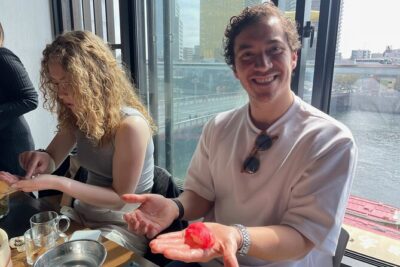
Sushi Making Tokyo Roll and Authentic Japanese Sushi Class
Read our review →
Tokyo: Roll and Authentic Sushi Making Class in Asakusa
Read our review →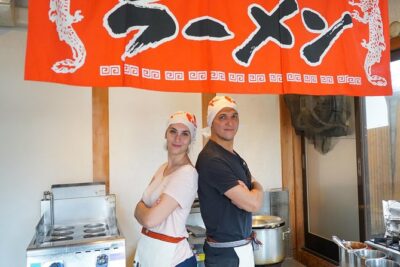
Ramen Cooking Class at Ramen Factory in Kyoto
Read our review →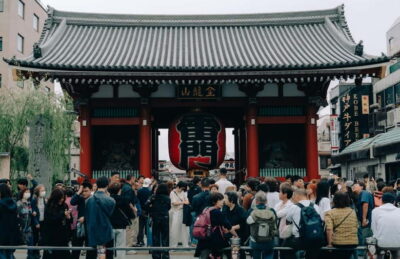
Tokyo: Sushi Making Class in a Happi Coat near a Famous Spot
Read our review →
Sushi Making Tokyo! Popular Maki Sushi & Japanese Sushi(+Recipe!)
Read our review →
Sushi Making Osaka Roll and Authentic Japanese Sushi Class
Read our review →
Tokyo Sushi Making Class in Tsukiji with Professional Chef
Read our review →
Ramen & Gyoza Cooking Class in Tokyo with Local Supermarket Visit
Read our review →Browse the lists this tour appears in