
Review · OSAKA
Osaka Street Food Festival :Takoyaki&Okonomiyaki for Families
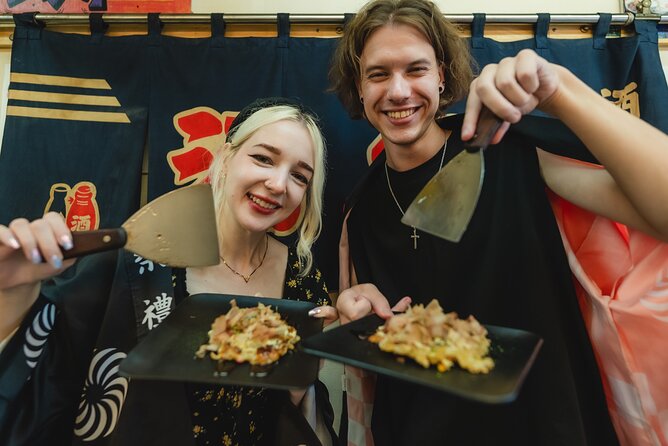
The best part of this Osaka activity is that you do not simply eat local specialties. You make takoyaki and okonomiyaki yourself, side by side on real teppan grills, with children, parents, and grandparents all taking part. Add festival games, happi coats, and unlimited dagashi snacks, and the hour and a half becomes a small Japanese matsuri under one roof.
I like the easy, family-friendly format and the chance to give everyone a job, from young children to novice cooks. I also like the flexible guidance: Jalar worked closely with a seven-person group and adjusted the level of hands-on help to suit them. The main consideration is the 90-minute limit, which can feel short if your group wants to cook slowly, take photos, play games, and linger over the food.
Key points at a glance
- Cook two Osaka classics: Make takoyaki and okonomiyaki using provided ingredients, utensils, and teppan grills.
- Designed for mixed ages: Children, parents, and grandparents can participate together, including first-time cooks.
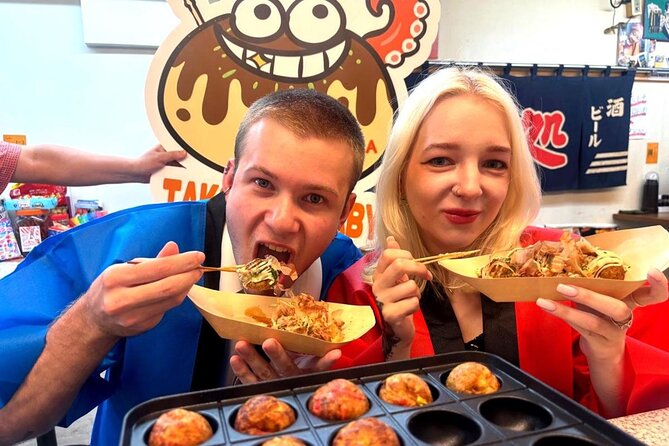
- Unlimited dagashi included: Sample Japanese candy and small snacks while the food is being prepared.
- Festival touches add variety: Try super ball scooping, wear happi coats, and take group photos.
- Small maximum group: The activity accepts up to 15 people, useful for families and larger parties.
- Simple Dōtonbori meeting point: Start and finish at 2-chōme-4-5 Dōtonbori in Chuo Ward.
A small Osaka festival in Dōtonbori
Osaka is famous for casual food, and this experience turns two of the city’s best-known dishes into a shared activity. Instead of sitting down to a finished plate, you take part in preparing takoyaki and okonomiyaki with your group.
That distinction matters for families. A standard meal can be over quickly, and young children may lose interest while adults order and wait. Here, the cooking gives everyone something to do. You can work together at the grill, learn as you go, and eat what your group has prepared.
The meeting point is at 2-chōme-4-5 Dōtonbori, Chuo Ward. The activity ends back at the same place, so you do not need to arrange a separate pickup or find your way to a second location afterward. Private transportation is not included, but the meeting point is near public transportation.
The whole experience lasts about 1 hour and 30 minutes. That is a useful length for a family day in Osaka. It fits before dinner, after sightseeing, or between other plans without taking up half your day.
More Sushi and Japanese Classes in Osaka:
- Sushi Making Osaka Roll and Authentic Japanese Sushi Class
★ 5.0 · 1,220 reviews - Osaka Sushi Making Experience
★ 5.0 · 400 reviews - Osaka: Ramen and Gyoza Cooking Class in Dotonbori
★ 5.0 · 378 reviews
Cooking takoyaki with the whole family
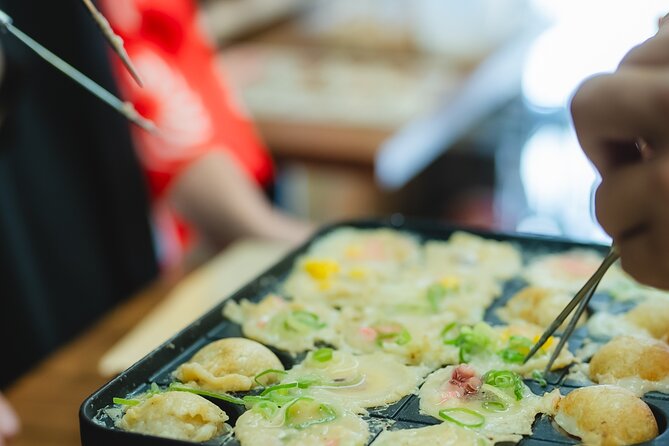
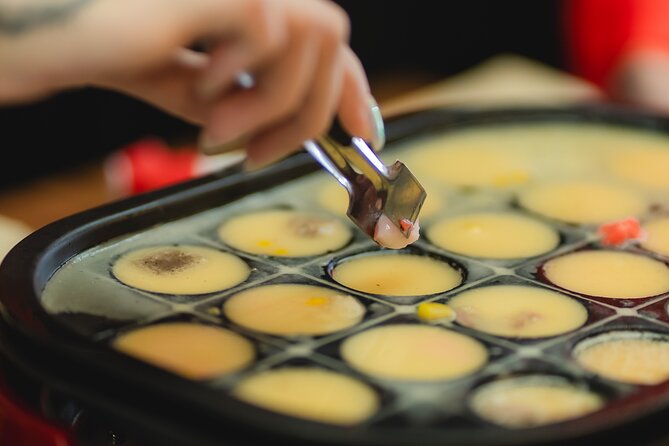
Takoyaki is one of Osaka’s signature street foods: small, round pieces cooked on a special grill. Here, the ingredients and cooking utensils are provided, and you prepare the food yourselves.
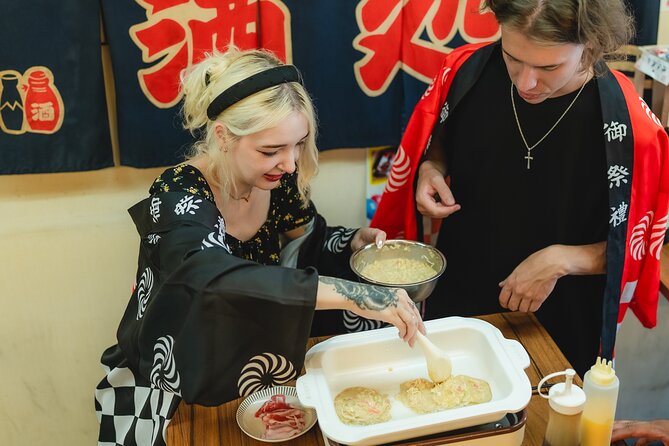
You will use a real teppan grill rather than watching a demonstration from the sidelines. That hands-on setup is especially helpful for groups with different ages and cooking experience. A child can participate alongside an adult, while grandparents or friends can join without needing to be expert cooks.
The supplied information does not set out an exact cooking sequence, so you should expect guidance during the activity rather than a fixed lesson plan with a detailed recipe in advance. The experience is built around participation, not a formal culinary course.
That is good news if you want a relaxed outing. It also means you should not book this expecting advanced instruction or a long lesson about Osaka food culture. The focus is simple: make the food, share the work, and have fun with the group.
One useful point comes from the way Jalar handled a larger party. A group of seven asked for a very hands-on session, and the support was adjusted for novice cooks. If your family includes people who are nervous around a grill, make your preferred level of help clear at the beginning.
Okonomiyaki adds a second round of cooking
Okonomiyaki gives the experience a different texture from takoyaki. Rather than making only one Osaka specialty, you get a second dish to prepare and eat as part of the meal.
The activity includes okonomiyaki meals, along with the ingredients and utensils needed for the cooking experience. Preparing two foods keeps the session active and gives your group more than one chance to learn the rhythm of cooking together.
For families, this can be more satisfying than a short tasting. You are not only checking Osaka food off a list. You are sharing the work, seeing how the food comes together, and sitting down to eat something your group has helped prepare.
The tradeoff is time. With only 90 minutes, you will need to keep moving between cooking, eating, games, snacks, and photos. If your group has a lot of young children or prefers to take its time, the experience may feel lively rather than leisurely.
Dagashi and festival games keep children involved
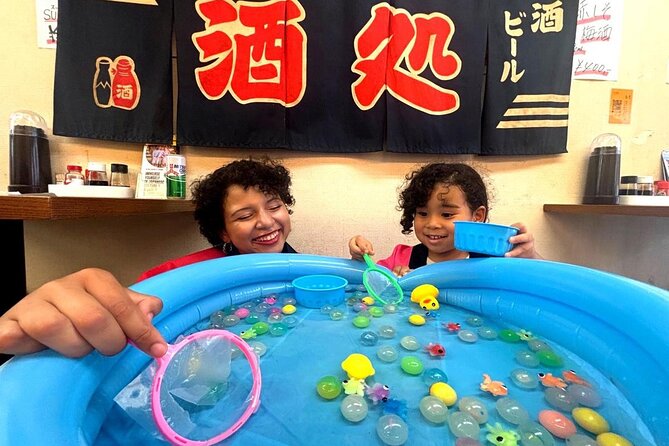
The food is the main reason to book, but the extra activities help prevent the outing from becoming an adult-centered cooking class. You can enjoy unlimited Japanese dagashi snacks while cooking. Dagashi refers to the inexpensive sweets and small treats often associated with Japanese childhood and local snack shops.
This is a smart inclusion for families. Children may not want to wait through every cooking step, and the snacks provide something to explore between turns at the grill. Adults can also try unfamiliar Japanese treats and compare favorites with the rest of the group.
The experience also includes classic festival games such as super ball scooping. That adds a playful break from the hot grill and gives children an activity that does not depend on cooking ability.
You should think of these extras as part of the outing’s character, not as separate attractions that will take up a large amount of time. The available details do not specify how long each game lasts or how many games are offered. The clear promise is a compact festival-style experience built around food, snacks, play, and group participation.
More Food and Drink Tours in Osaka:
- Osaka Sake Tasting with Takoyaki Cooking
★ 5.0 · 156 reviews - Eat Osaka: Street Food Cooking in an Authentic Kitchen!
★ 5.0 · 87 reviews - Osaka Cooking Class and Sake Tasting with Local Supermarket Visit
★ 5.0 · 79 reviews - Osaka: Cooking Class & Sake Tasting with Local Market Visit
★ 4.8 · 31 reviews
Happi coats make the photos more memorable
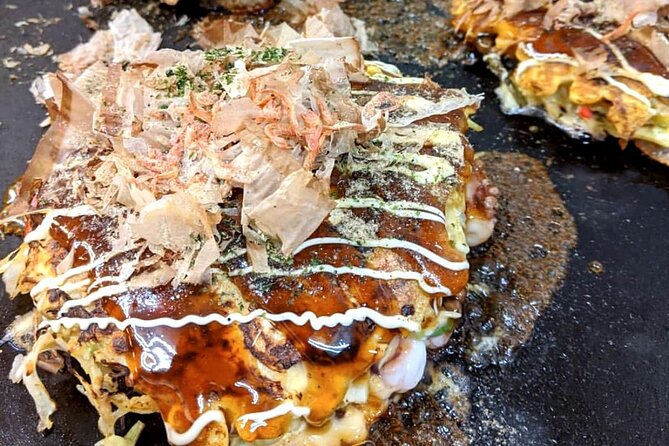
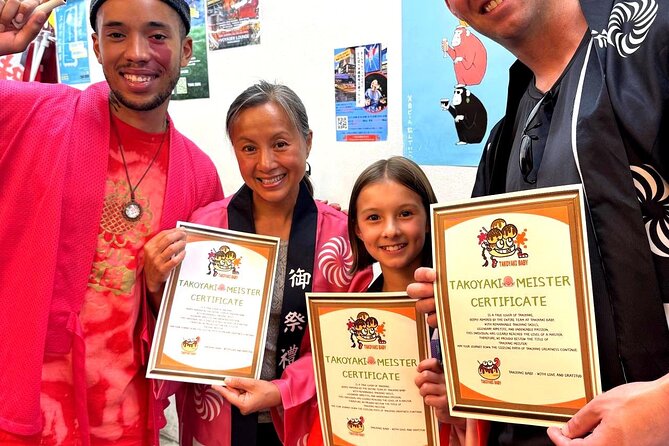
Group photos can feel like a minor add-on, but the festival-style happi coats give this experience a clear visual theme. You can put one on and take photos together, which works well for family groups and larger parties.
Happi coats are traditional festival garments often worn by staff or participants at Japanese celebrations. Wearing one here does not turn the activity into a full cultural performance, but it gives your photos a stronger sense of place than ordinary snapshots at a restaurant table.
This feature is especially useful if your group includes grandparents or children who want a shared souvenir. You do not need to organize a separate photo stop in Dōtonbori. Just remember that photos are one part of a 90-minute schedule, so your group may want to decide in advance who will take them and when.
What is included for the $65.32 price
The listed adult price is $65.32 per person. Children in elementary school and younger are priced at ¥7,000. Since the child price is shown in yen, check the final booking amount and exchange rate before paying.
The package includes:
- Takoyaki ingredients
- Cooking utensils
- Okonomiyaki meals
- Alcoholic beverages
- Soda or pop
- Snacks
- The festival-style activities described above
The price makes the most sense when you treat this as a combined meal and activity. You are paying for food, drinks, cooking equipment, staff support, games, snacks, and a structured group experience in central Osaka. It is not the cheapest way to eat takoyaki, but it offers more than ordering a plate at a street stall.
Alcoholic beverages are included, but the available information does not state the selection or amount. Soda and snacks are also included, and the dagashi is described as unlimited. If drink choice matters to your group, ask the provider for current details before booking.
The price is easier to justify for families and groups that would otherwise pay separately for a meal and an activity. Solo visitors or couples focused only on tasting Osaka food may find a regular restaurant or street-food stop more economical.
The right group size and level of help
The maximum group size is 15 people. That is large enough for extended families, school-age groups, or a gathering of friends, while still keeping the activity more personal than a huge food hall.
The strongest practical point is the flexible approach to participation. Jalar worked with a seven-person group that included novice cooks, giving individual help and letting the group choose how hands-on it wanted to be. That detail matters because cooking on a grill can be intimidating for someone who has never made these dishes.
You should tell the guide if your group wants close instruction or prefers to work independently. The experience suits both styles better than a rigid class would, at least based on the way the session is described.
The maximum of 15 is not a promise that every session will have 15 people. It simply sets the upper limit. If you are booking for a large party, the group size gives you a useful sense of scale, but you should not assume the session will be private.
Timing, meeting point, and practical planning
The start and finish point is 2-chōme-4-5 Dōtonbori, Chuo Ward, Osaka, postal code 542-0071. The activity is near public transportation, which makes it practical to combine with sightseeing in the Dōtonbori area.
No private transportation is included. Plan to reach the meeting point on your own and allow enough time to locate the exact address. Since the experience ends where it starts, you can continue exploring Dōtonbori afterward without arranging a return transfer.
A mobile ticket is provided, which is convenient for keeping the booking on your phone. Confirmation is received at the time of booking.
Service animals are allowed. The supplied information does not give detailed guidance about general accessibility, grill height, seating, or dietary restrictions. If anyone in your group has a food allergy, mobility concern, or special meal requirement, contact the provider before booking rather than assuming the cooking setup will meet those needs.
The cancellation terms are reasonable but firm near the start time. You can cancel for a full refund up to 24 hours in advance. Cancellations or changes made less than 24 hours before the local start time are not accepted for a refund.
Who will enjoy this most
I would choose this for a family that wants a shared activity instead of another restaurant meal. The format gives children something to do, lets adults join rather than supervise from the side, and includes enough food to make the outing feel complete.
It also suits groups of friends and large family parties. The group of seven handled the session well, and the maximum of 15 leaves room for a sizable gathering. Novice cooks should feel comfortable asking for help, especially if they explain that they want close guidance.
Grandparents can take part without needing to keep up with a fast walking tour. Children can switch between cooking, snacks, games, and photos. Friends can make the activity as hands-on or relaxed as they prefer.
I would be more cautious about booking it for someone seeking a serious cooking lesson. The session is short and playful. It offers hands-on practice, but the information does not promise advanced techniques, a printed recipe, or a detailed food-history lecture.
I would also think twice if your group dislikes shared activities or has very limited time. The appeal comes from participating together, not from a quick meal eaten independently.
Is this Osaka food experience worth booking?
For most families, yes. The combination of takoyaki, okonomiyaki, dagashi, games, drinks, and happi-coat photos gives you a lot to do in 90 minutes. The 5.0 rating from 13 reviews and a 100 percent recommendation rate support the idea that the format works well for people who want an upbeat group activity.
The best reason to book is the flexible help. Jalar’s work with a seven-person group of novice cooks shows why this can suit mixed ages and mixed confidence levels. You can ask for a very hands-on session instead of worrying that everyone must already know what to do.
The main caution is value. At $65.32 per person, this costs more than simply buying Osaka street food. You are paying for the meal plus instruction, equipment, snacks, games, drinks, and a shared event. Book it when the activity matters as much as the food.
For a family in Dōtonbori, a group celebrating together, or anyone who wants to make rather than only taste Osaka specialties, this is a strong pick. If you want a quiet meal, an advanced class, or the lowest possible food cost, choose something simpler.
FAQ
How long does the Osaka street food experience last?
The activity lasts approximately 1 hour and 30 minutes.
Where does the activity start and finish?
It starts at 2-chōme-4-5 Dōtonbori, Chuo Ward, Osaka, 542-0071, Japan, and ends back at the same meeting point.
What food will I make?
You will make takoyaki and okonomiyaki. Takoyaki ingredients, cooking utensils, and the okonomiyaki meal are included.
Are drinks and snacks included?
Yes. Alcoholic beverages, soda or pop, and snacks are included. The experience also provides unlimited Japanese dagashi snacks.
Can children join?
Yes. The activity is designed for families and groups of all ages. Children in elementary school and younger have a listed price of ¥7,000.
What is the cancellation policy?
You can cancel up to 24 hours before the start time for a full refund. Cancellations or changes made less than 24 hours before the local start time are not accepted for a refund.
More Food Experiences in Osaka
- Osaka Dotonbori: Vegan/Vegetarian Sushi Making Experience
★ 5.0 · 9 reviews - Okonomiyaki&Takoyaki for Families:Osaka Street Food Festival
★ 5.0 · 4 reviews - Osaka: Sushi Making Class and Dotonbori Food Tour
★ 4.7 · 3 reviews - Small Group Cooking Class & Market Food Tour in Florence
★ 5.0 · 1,574 reviews
Just added around Osaka
- Three Types of Ramen Cooking Class in Osaka★ 5.0 · 119 reviews
- Takoyaki DIY Cooking in the Heart of Osaka★ 5.0 · 7 reviews
- SUSHI Making Experience at Restaurant★ 5.0 · 8 reviews
- Sushi Making Osaka Omakase Cooking Class in Japan★ 5.0 · 4 reviews
- Cooking Class for Ramen and Gyoza in a Quiet Old Osaka House★ 5.0 · 3 reviews
- Sushi and Japnese foods cooking class in Osaka★ 5.0 · 51 reviews
- Ramen and Gyoza Cooking Class in Osaka Dotonbori★ 5.0 · 73 reviews
- Osaka Market Tour & Cooking Class with Local Expert Masato/Shohei★ 5.0 · 7 reviews
Japanese & Sushi Cooking Classes, compared.
Sushi Making Tokyo Roll and Authentic Japanese Sushi Class
Read our review →
Tokyo: Roll and Authentic Sushi Making Class in Asakusa
Read our review →
Ramen Cooking Class at Ramen Factory in Kyoto
Read our review →
Tokyo: Sushi Making Class in a Happi Coat near a Famous Spot
Read our review →
Sushi Making Tokyo! Popular Maki Sushi & Japanese Sushi(+Recipe!)
Read our review →
Sushi Making Osaka Roll and Authentic Japanese Sushi Class
Read our review →
Tokyo Sushi Making Class in Tsukiji with Professional Chef
Read our review →
Ramen & Gyoza Cooking Class in Tokyo with Local Supermarket Visit
Read our review →Browse the lists this tour appears in