
Review · OSAKA
Osaka Okonomiyaki Cooking Class “Learn here and make it at home”
Osaka’s best-known comfort foods are made for hands-on cooking. In this small class, you prepare okonomiyaki and takoyaki yourself, then sit down to eat what you have made with drinks. The cooking is practical, social, and easy to follow, even if your kitchen skills stop at boiling noodles.
I especially like the small maximum of eight people and the useful written recipes, plus the chance to see ingredient packaging that can help you find the same products in a Japanese supermarket. The main drawback is the price: at $70 per person, it is not a cheap meal, and the three-hour format may feel long if you only want a quick taste.
Key points at a glance
- Two Osaka classics in one class: Make savory okonomiyaki pancakes and octopus-filled takoyaki.
- A compact group: The class accepts no more than eight people, with the possibility of a very personal session.
- Useful take-home skills: Written recipes and ingredient packaging make it easier to repeat the dishes at home.
- Central Osaka setting: The kitchen is about five minutes on foot from Shinsaibashi and Honmachi stations.
- Drinks included: Sake, beer, and soft drinks are served during the one-hour tasting period.
- Language help: Instruction is available in English, with Japanese and Spanish support upon request.
Cooking Osaka’s comfort food from scratch
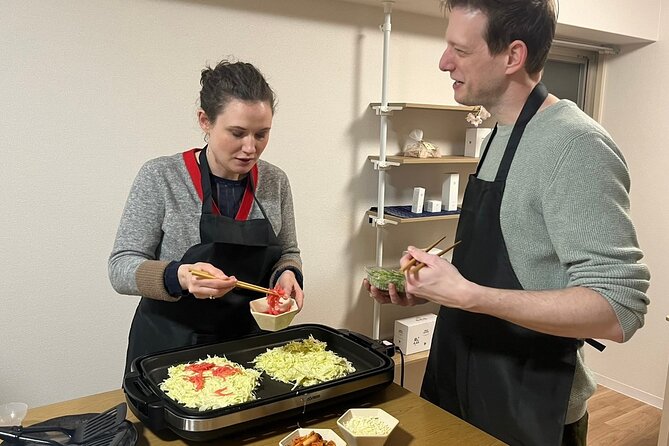
This experience focuses on two dishes that are strongly linked with Osaka’s food culture. Okonomiyaki is a savory pancake made from batter, cabbage, and fillings such as pork or seafood. It is finished with sauce and bonito flakes, giving you a dish that is filling, saucy, and easy to adapt.
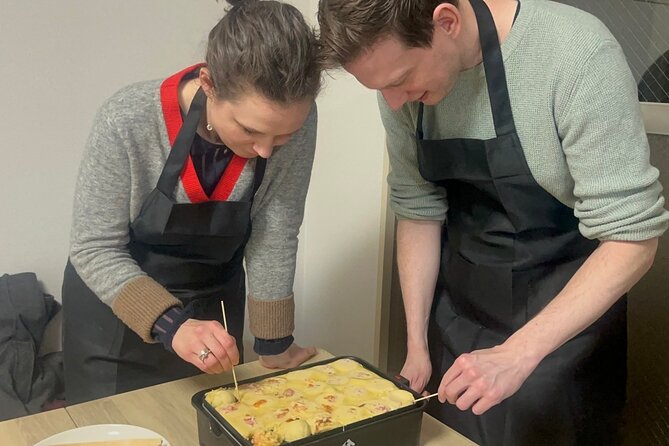
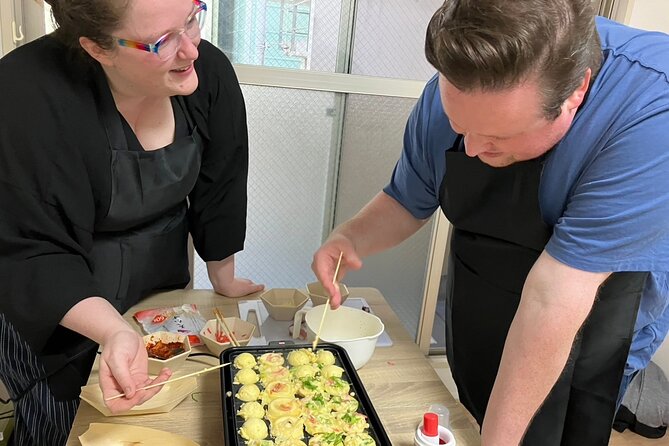
Takoyaki uses a softer batter cooked into round balls with octopus inside. The finished pieces receive sauce, bonito flakes, and seaweed powder. Making them is a different task from preparing okonomiyaki, so the class gives you two distinct cooking experiences rather than repeating the same method.
I like this pairing because it shows two sides of casual Osaka food. Okonomiyaki is spread across a hot cooking surface, while takoyaki requires careful handling of individual balls. You get a better sense of the ingredients and techniques than you would from simply ordering both dishes at a restaurant.
The class provides the ingredients, tools, aprons, and disposable plastic gloves. You do not need to pack special equipment or bring cooking supplies. Just arrive ready to work with the food and follow the instructor’s guidance.
More Sushi and Japanese Classes in Osaka:
- Sushi Making Osaka Roll and Authentic Japanese Sushi Class
★ 5.0 · 1,220 reviews - Osaka Sushi Making Experience
★ 5.0 · 400 reviews - Osaka: Ramen and Gyoza Cooking Class in Dotonbori
★ 5.0 · 378 reviews
The first 30 minutes: orientation and preparation
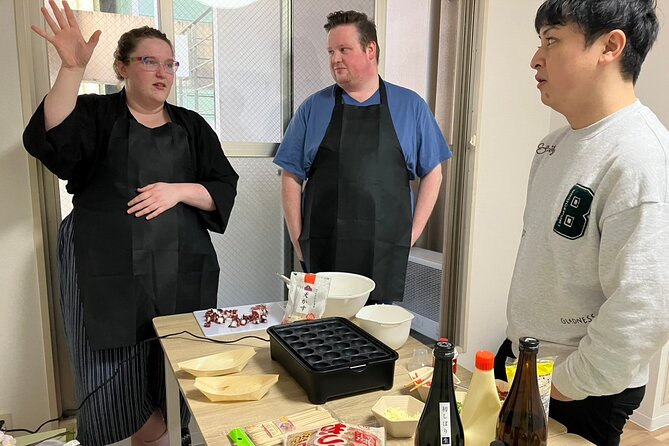
The session begins with about 30 minutes of orientation and preparation. This opening matters because it gives you time to understand the ingredients and the cooking process before the heat is turned on.
You can expect a step-by-step introduction to the dishes, including what goes into the batter and how the toppings are used. The class is designed for people who may not have made either food before, so the emphasis is on showing you what to do rather than assuming you already know Japanese cooking methods.
This is also the part of the experience where the class can be especially useful for home cooks. Written recipes are provided, and ingredient packaging is shown to help you recognize products in a supermarket later. That small detail adds real value. A recipe may tell you what to buy, but seeing the actual Japanese packaging can make the shopping trip far less confusing.
The multilingual setup is another practical advantage. Instruction is offered in English, while Japanese and Spanish support can be requested. No instructor names are provided, but the class is built around direct guidance rather than a demonstration you watch from a distance.
Ninety minutes of cooking
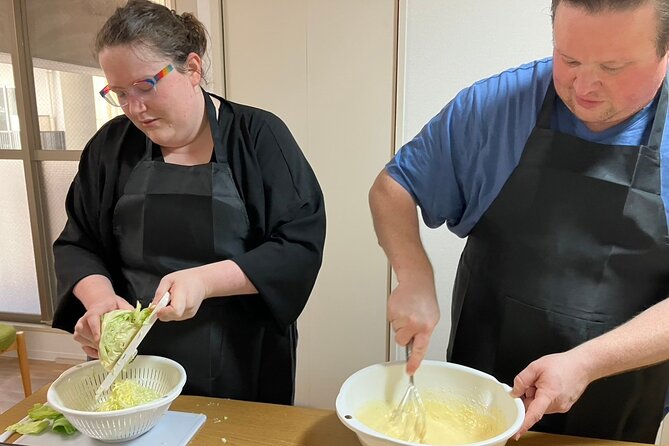
The main cooking period lasts about 1.5 hours. You prepare both okonomiyaki and takoyaki with help from the instructor, using the supplied tools and ingredients.
Okonomiyaki is likely the more forgiving of the two dishes. You combine batter, cabbage, and your chosen fillings, then cook the mixture into a savory pancake. The finishing touches matter: sauce, bonito flakes, and other toppings turn a plain pancake into the familiar Osaka-style dish.
Takoyaki asks for more attention. The batter is cooked in round molds, with octopus placed inside. You need to shape the pieces as they cook, rather than simply leaving one flat mixture on the surface. That makes this portion entertaining, but it may also be the trickier part for first-time cooks.
The instructor’s role is important here. Instead of leaving you to guess when to turn or how much batter to use, the class provides help at each stage. The small group limit should make it easier to ask questions and get a closer look at the cooking process. On a quiet date, the class could be very intimate, even with only two people booked.
You should expect to be involved for much of the cooking period. This is not a food demonstration with a finished plate handed to you at the end. If you prefer to sit back and watch, a restaurant meal will be more relaxed. If you enjoy learning by doing, the format makes sense.
One hour to eat, drink, and compare results
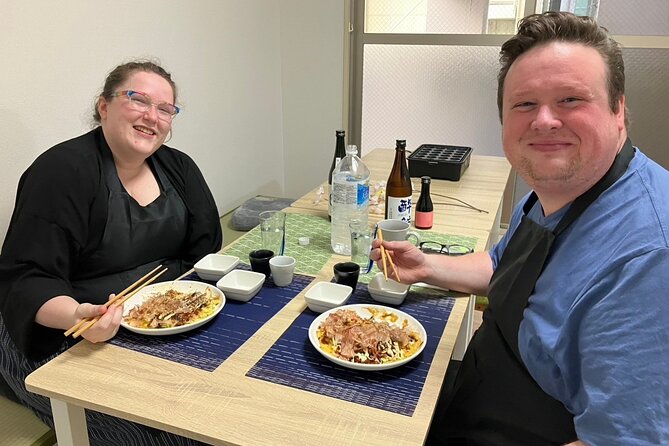
After the cooking, you have about an hour to taste the okonomiyaki and takoyaki you prepared. Sake, beer, and soft drinks are included, with alcoholic drinks available only to people aged 20 and above. Anyone under 20 receives non-alcoholic drinks.
The tasting period gives the class a pleasant change of pace. You have already spent time handling ingredients and cooking, so the final meal feels connected to the work you just completed. I also like that the schedule does not rush you straight from the hot plate to the door.
The drinks add to the value, though they should be viewed as part of the social meal rather than the main reason to book. The real benefit is the combination of instruction, food, and time to sit down afterward.
Because the food is made during the class, results may vary slightly from one group to another. That is part of the appeal of a cooking lesson. You are not only tasting a polished restaurant dish. You are learning how the ingredients come together and seeing what your own technique produces.
More Hands-On Workshops in Osaka:
- Osaka Cooking Class: Okonomiyaki &Japanese cuisines experience
★ 5.0 · 261 reviews - Osaka: Roll and Authentic Sushi Making Class in Dotonbori
★ 4.9 · 239 reviews - Ramen and Gyoza Cooking Class in Osaka
★ 5.0 · 202 reviews - Three Types of Ramen Cooking Class in Osaka
★ 5.0 · 119 reviews
A quiet kitchen near Shinsaibashi and Honmachi
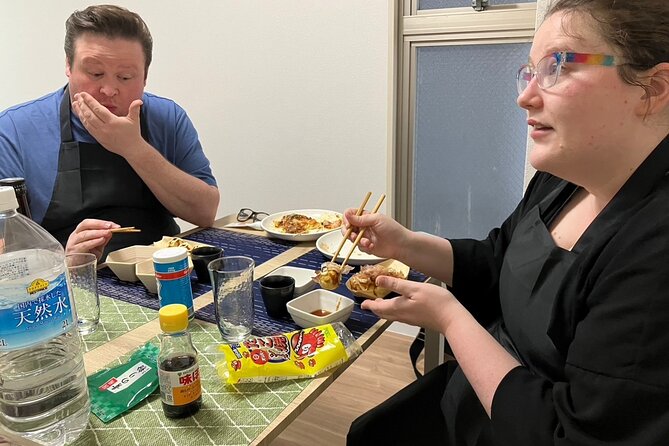
The kitchen is in central Osaka, about a five-minute walk from both Shinsaibashi and Honmachi stations on the Osaka Metro. The meeting point is at 南船場コレット904, 4-chōme-3-1 Bakurōmachi, Chuo Ward, Osaka.
This location works well if you are already spending time around Shinsaibashi or Honmachi. You can reach it by public transportation and avoid arranging private transport, which is not included. The kitchen is described as being in a quiet neighborhood despite its central position, so you get a break from Osaka’s busy shopping streets without leaving the city center.
Allow enough time to find the exact building and meeting point. The supplied address includes Japanese text and a room number, so checking it before you leave your hotel is sensible. The activity ends back at the same meeting point.
The three-hour length also makes the class easier to fit into a day than a full-day excursion. It works as a morning activity, an afternoon plan, or an early evening meal, depending on the available start time. The exact schedule is not provided, so check the booking details before planning other fixed activities around it.
How much value do you get for $70?
At $70 per person, this is more expensive than simply ordering okonomiyaki and takoyaki at a casual Osaka restaurant. You are paying for more than the food itself: an instructor, ingredients, kitchen equipment, apron, gloves, recipes, drinks, and three hours of guided time.
The price makes the most sense if you want a hands-on food activity, not just dinner. The written recipes and ingredient guidance improve the long-term value because you can try to repeat the dishes after returning home. If you cook the recipes even once, the lesson becomes more than a single meal.
The maximum group size of eight also matters. A large class can make cooking instruction feel distant, but this experience keeps the group relatively compact. On a lightly booked date, you could have a particularly personal session. That possibility is reflected in the strong overall response, with a 4.9 rating and 100 percent recommendation rate based on 20 ratings.
Still, I would not call it a bargain for everyone. Families or couples who only want to eat Osaka specialties may spend less at a restaurant. You are paying for the process, the conversation, and the chance to learn. Book it for those reasons.
A good choice for families and mixed-age groups
The class can work well for families because the cooking is interactive and the dishes are familiar in shape and flavor. The activity has also worked well with younger children, according to the information available, although adult supervision and attention will still matter around hot cooking surfaces.
It is also a useful choice for a couple or a small group of friends. The format gives you a shared task, and the final tasting creates time to talk. If you happen to be the only booking, the session may feel more like a private lesson than a standard group activity.
Vegetarian and food allergy requests are possible, but you must contact the provider after booking. Do not wait until you arrive. The standard dishes include ingredients such as pork, seafood, and octopus, so dietary needs need to be discussed in advance.
The class is less suited to someone looking for a fully passive evening. You will be preparing food, handling tools, and following instructions. That is the point, but it is worth keeping in mind before you pay.
What to bring and what not to expect
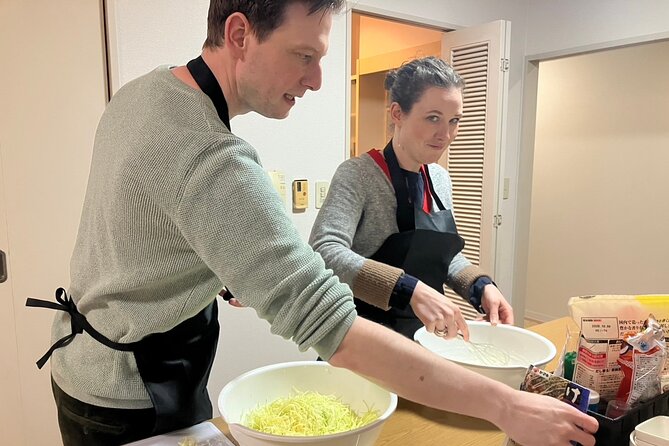
You do not need to bring cooking equipment, ingredients, an apron, or gloves. Everything required for the class is supplied.
Private transportation is not included, so you will make your own way to the kitchen. The central location and nearby Osaka Metro stations make that straightforward, but the activity is not a door-to-door tour.
The experience is listed as requiring good weather. If poor weather causes cancellation, you are offered a different date or a full refund. That condition is worth noting even though the cooking takes place in a kitchen.
Free cancellation is available up to 24 hours before the start time for a full refund. Changes or cancellations inside that 24-hour window are not accepted, and the local Osaka time controls the cut-off.
Should you book the Osaka cooking class?
Book this class if you want to learn two Osaka dishes and repeat them at home, rather than simply eat them once. The English-language instruction, small group limit, recipes, ingredient packaging, and included drinks give the $70 price a clear purpose.
I would especially recommend it for food-focused visitors, families who enjoy practical activities, and couples seeking a relaxed evening away from Osaka’s crowded streets. It is also a smart rainy-day plan when the class is operating, though the provider’s weather policy means you should check for updates.
Skip it if your main goal is the cheapest possible meal or if you dislike cooking in a group. For everyone else, this is a friendly, useful introduction to two Osaka favorites, with enough practical information to keep the experience going after you leave Japan.
FAQ
How long does the Osaka cooking class last?
The class lasts about three hours. It includes 30 minutes of orientation and preparation, 1.5 hours of cooking, and one hour for tasting the food with drinks.
What dishes will I make?
You will make okonomiyaki, a savory pancake with batter, cabbage, and fillings such as pork or seafood. You will also make takoyaki, savory dough balls filled with octopus.
Are drinks included?
Yes. Sake, beer, and soft drinks are included during the tasting session. Alcohol is served only to people aged 20 and above, while minors receive non-alcoholic drinks.
Is the class taught in English?
Yes. An English-speaking instructor is included. Japanese and Spanish-speaking instructors are available upon request.
Where does the class meet?
The meeting point is 南船場コレット904, 4-chōme-3-1 Bakurōmachi, Chuo Ward, Osaka, 541-0059, Japan. The kitchen is about a five-minute walk from Shinsaibashi and Honmachi Osaka Metro stations.
What is the maximum group size?
The class accepts a maximum of eight people.
Do I need to bring ingredients or cooking tools?
No. Ingredients, kitchen tools, aprons, and disposable plastic gloves are provided. You only need to bring yourself.
Can the class accommodate vegetarian diets or food allergies?
Possibly, but you must contact the provider after booking to discuss vegetarian or food allergy options.
Just added around Osaka
- Traditional Home cooking Experience in Osaka, Japan★ 5.0 · 14 reviews
- Well-balanced BENTO (lunch box) Cooking Class★ 5.0 · 35 reviews
- Osaka Street Food Festival :Takoyaki&Okonomiyaki for Families★ 5.0 · 13 reviews
- Three Types of Ramen Cooking Class in Osaka★ 5.0 · 119 reviews
- Takoyaki DIY Cooking in the Heart of Osaka★ 5.0 · 7 reviews
- SUSHI Making Experience at Restaurant★ 5.0 · 8 reviews
- Sushi Making Osaka Omakase Cooking Class in Japan★ 5.0 · 4 reviews
- Cooking Class for Ramen and Gyoza in a Quiet Old Osaka House★ 5.0 · 3 reviews
Japanese & Sushi Cooking Classes, compared.
Sushi Making Tokyo Roll and Authentic Japanese Sushi Class
Read our review →
Tokyo: Roll and Authentic Sushi Making Class in Asakusa
Read our review →
Ramen Cooking Class at Ramen Factory in Kyoto
Read our review →
Tokyo: Sushi Making Class in a Happi Coat near a Famous Spot
Read our review →
Sushi Making Tokyo! Popular Maki Sushi & Japanese Sushi(+Recipe!)
Read our review →
Sushi Making Osaka Roll and Authentic Japanese Sushi Class
Read our review →
Tokyo Sushi Making Class in Tsukiji with Professional Chef
Read our review →
Ramen & Gyoza Cooking Class in Tokyo with Local Supermarket Visit
Read our review →Browse the lists this tour appears in